France is approaching the 2027 presidential election in a state that most local commentators describe with the word “mess.” President Emmanuel Macron, constrained by the constitutional rule limiting presidents to a maximum of two consecutive terms, cannot run again. He is the first president for whom this limit, introduced by the 2008 constitutional reform, has actually taken effect. His predecessors either served only a single term or voluntarily opted out of seeking re-election, such as François Hollande in 2017.
Over the past three years, the country has experienced unprecedented political turbulence: prime ministers have changed one after another, work on the budget has regularly ended in deadlocks, and in September 2025, François Bayrou’s government fell following a vote of no confidence after failing to pass the 2026 budget. The assumption of office at the Hôtel Matignon by Sébastien Lecornu triggered another mini-crisis. In October 2025, Minister of the Interior and leader of The Republicans, Bruno Retailleau, resigned in protest over the composition of the new cabinet. This led to Lecornu resigning from his post as head of government for a few days before Macron reappointed him. Against this backdrop, the 2027 presidential campaign is breaking records for fragmentation. More than 30 politicians have already officially announced their candidacies — a figure unprecedented in the entire history of the Fifth Republic. French political scientists (Bruno Jeanbart, Antoine Bristielle, Élie Michel) link this state of affairs to a deeper crisis of the party system that has been ongoing since 2017. Nevertheless, the real battle for the second round is taking place among six figures. This article analyzes their chances, platforms, and — what is particularly vital for the future of the European Union — each candidate’s stance on European integration, drawing from an analysis by Resurgam as well as a collection of current French and international sources.
Conditions Under Which France Enters the Electoral Cycle Economic conditions. France’s public sector deficit reached 5.1% of GDP in 2025 (INSEE data), following 5.5% in 2023 and a record 5.8% in 2024. In the first quarter of 2026, it hit 5.1% of GDP again, while the eurozone average stands at just 3.1%. Since the summer of 2024, France, along with nine other EU member states (Austria, Belgium, Bulgaria, Finland, Hungary, Italy, Poland, Romania, and Slovakia), has been subject to an excessive deficit procedure. This obligates the country to present EU partners with a credible path back to a deficit level below 3% of GDP. Public debt at the end of 2025 reached 115.6% of GDP, and in the first quarter of 2026 stood at 117.6% of GDP — marking the third-highest result in the EU according to Eurostat data. According to forecasts by the European Commission and the French OFCE, by the end of 2026, debt will approach 118–118.5% of GDP, and in 2027 it could surpass 120%. Economic growth remains anemic — according to estimates from the European Commission, OECD, and the Bank of France, it will amount to around 0.9–1% of GDP in 2026. The unemployment rate has risen for the fifth consecutive quarter, exceeding 8% for the first time since 2021 (INSEE data for Q1 2026). Under the ILO methodology, around 2.6 million people are unemployed. Among youth aged 15–24, this indicator remains over 21%. France’s credit ratings — A+ from S&P, Aa3 with a negative outlook from Moody’s, and A+ from Fitch — reflect growing investor anxiety, while debt service costs are rising due to higher interest rates that have persisted since 2022.
Political conditions. The National Assembly has lacked an absolute majority since the June 2022 parliamentary elections, and following the snap elections called by Macron in 2024, it is divided into three roughly equal blocks in terms of influence — left-wing, centrist-presidential, and right-wing/far-right — none of which can form a government on its own. This has translated into unprecedented cabinet instability: over the last two years, several individuals have held the office of Prime Minister. Michel Barnier’s government fell in December 2024 due to a vote of no confidence — the first successful one since 1962 — and François Bayrou’s cabinet shared the same fate in September 2025 after failing to secure support for the 2026 budget. Frequent use of Article 49, Paragraph 3 of the Constitution (passing legislation without a parliamentary vote) continues to fuel public debate over the executive’s lack of democratic legitimacy. An additional significant factor is the judicial case against Marine Le Pen. For the first time in the history of the Fifth Republic, a court applied immediate execution of a sentence against a presidential candidate before a cassation appeal was considered, triggering a fierce public debate over the boundaries between the judiciary and the executive branch. Against this backdrop, an unprecedented fragmentation of the campaign unfolds ahead of the presidential election scheduled for 2027. Over 30 candidates have already thrown their hats into the ring, which is a record number.
Social conditions. Purchasing power remains the main concern for French voters, regardless of their political preferences. The 2023 pension reform (raising the retirement age from 62 to 64), which sparked months of mass protests, has once again become a key campaign topic — its full or partial repeal is promised by candidates ranging from Mélenchon to Glucksmann. Immigration and security, including the fight against drug trafficking, remain the topics that most strongly mobilize the electorates of National Rally (RN) and The Republicans (LR). A telling indicator of the public mood was the March 2026 local elections, in which RN took power in over 60 municipalities for the first time in the party’s history.
Polls: The Situation at the Beginning of August The most complete sociological picture relies on two sources. The Ipsos/BVA poll for Le Parisien (May 27–28, 2026) recorded the situation prior to the decisive court ruling. Across all eight tested scenarios, Jordan Bardella led (33.5–36%), while Marine Le Pen, whose candidacy depended on court decisions, polled at 31–32%.
On July 7, 2026, the Paris Court of Appeal altered the course of the campaign. The court confirmed Le Pen’s guilt in the case regarding the embezzlement of European Parliament funds, but significantly reduced the penalty. Instead of the initial five-year ban on running for office, she received a 45-month ban on holding public office, 30 of which were suspended. The remaining 15 months were considered served under precautionary measures during the appeal process. That same evening on TF1, Le Pen announced that she herself would run for president rather than pass the torch to Bardella. She also immediately filed a cassation appeal — a procedural step that automatically suspends the execution of the sentence, including the requirement to wear an electronic monitoring bracelet. The First President of the Court of Cassation publicly announced that a decision will be reached before the first round of elections (April 18 – May 2, 2027), meaning legal uncertainty surrounding Le Pen’s candidacy will persist at least until the spring of 2027.
The first Elabe poll following this announcement (July 9–10) showed not only a preservation but a strengthening of Le Pen’s lead: 34–35.5% in the first round — up 3 percentage points compared to spring. More tellingly, she defeated every tested rival in the second round: against Attal (54% to 46%), Glucksmann (58.5% to 41.5%), Retailleau (56% to 44%), and Mélenchon (67.5% to 32.5%). This diverges sharply from the outlook of a few months ago, when a “republican front” victory in the second round was treated as nearly certain. However, it is worth remembering that this study merely captures public sentiment following an emotional trial. Time will tell how durable this effect proves to be (more on the limitations of polls later in the article).
Six Contenders
1. Marine Le Pen (National Rally): The favorite in the shadow of legal issues
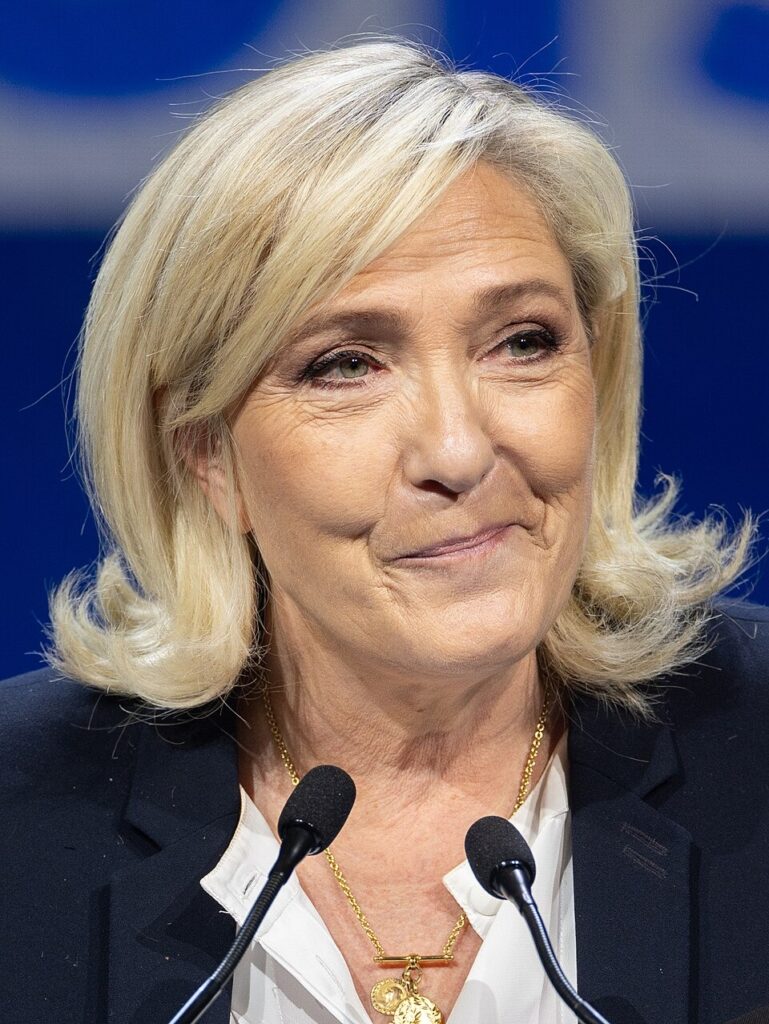
This marks the fourth presidential campaign for the 58-year-old Le Pen — following runs in 2012, 2017, and 2022. In 2017 and 2022, she made it to the second round against Macron twice and lost both times. This time, for the first time in her career, she is the undisputed favorite in the polls, though with a caveat absent from previous cycles. The fate of her candidacy formally hinges on the Court of Cassation’s decision, which could come literally on the eve of the vote.
Bardella, who spent two years preparing for a potential presidential run and was regarded as the polling favorite before the July verdict, has now officially returned to the role of “prime minister-in-waiting.” On July 12, in an interview with Le Figaro, he declared his intention to form a “government of national unity” in the event of an RN victory, not limited solely to party cadres. At the same time, he remains the sole candidate seeking re-election as head of RN during the party congress in Orléans in late October. Inside the party, this setup (the Le Pen–Bardella “tandem”) is presented as a new model for division of labor in French politics, combining Le Pen’s experience and name recognition with Bardella’s dynamism.
Le Pen’s electorate consists primarily of the working class, residents of small towns, and “peripheral France.” These are mainly individuals with lower incomes and education levels who feel economic and cultural anxiety. Her strong points are high brand recognition, a loyal electorate, and the ability to mobilize the protest vote; her weaknesses include an inconsistent economic program and the party’s image burden.
RN’s economic program combines broad tax relief (such as abolishing income tax for under-30s or lowering VAT on energy) with a promise to bring the deficit below 3% of GDP by 2030 — without detailing the necessary spending cuts. The Asterès think tank warns that in reality, the deficit could rise to 6.4% of GDP, and public debt could exceed 117% of GDP. Even RN’s economic advisor publicly admitted that the reaction of financial markets is the “main problem” of the platform. At the same time, the party is increasingly actively courting big business. In April 2026, Bardella participated for the first time in a lunch with the management of the Medef organization, and Le Pen met with heads of CAC 40 companies, including Bernard Arnault and Patrick Pouyanné.
In European policy, Le Pen proposes not reform, but the actual dismantling of the European Commission — converting it into a purely technical “General Secretariat of the Council” without the right of legislative initiative. In its place, an intergovernmental “Alliance of Nations” would be formed, in which every decision would require unanimity. In industry, she supports the “best bidder” principle — dividing joint projects, such as the FCAS (SCAF) fighter jet, among the most efficient national producers instead of Franco-German cooperation.
For France, this would mean a break with the role the country has played from the very beginning of the European project — the role of co-architect of supranational integration. Unlike Hungary or other smaller states promoting a similar agenda, the weight of France — the eurozone’s second-largest economy, a nuclear power, and a permanent member of the UN Security Council — means it is in a position to genuinely alter the institutional balance of the Union, rather than merely block majority decisions. In such a scenario, the Franco-German tandem, historically the engine of European integration, risks turning into open confrontation. Berlin would most likely seek alternative anchors — from deepening cooperation within the Weimar Triangle with Poland to informal “coalitions of the willing” bypassing Paris. The market response to RN’s budgetary plans — described by the party’s own economic advisor as the “main problem” — carries the risk of a pan-European debt crisis due to the size of the French economy. Unlike Greece in 2010, France cannot simply be “bailed out” without endangering the entire eurozone architecture. The “best bidder” principle would de facto bury joint armament programs such as FCAS, forcing Europe to completely overhaul its industrial-defense cooperation system. At the same time, even in the event of a Le Pen victory, implementing such radical changes will run into the most fragmented National Assembly in the history of the Fifth Republic. The left and centrists combined hold enough votes to pass a vote of no confidence against an RN government. Bypassing this parliamentary arithmetic could likely only occur through an immediate dissolution of parliament and new parliamentary elections, the outcome of which would be entirely unpredictable.
2. Édouard Philippe (Horizons): The most dangerous rival to RN with the highest chances of winning

Former Prime Minister of France (2017–2020), Mayor of Le Havre, and leader of the Horizons party, 55-year-old Édouard Philippe consistently achieves the highest results among potential RN rivals in the second round. Depending on the configuration, he can count on support between 16.5–19% in the first round. His electorate consists primarily of educated middle-class professionals living in the suburbs of major cities who expect competent, center-right governance without deepening societal polarization. Philippe’s main asset is his reputation as an experienced and moderate administrator. His primary weakness, however, is his strong association with unpopular reforms from Macron’s presidency and a lack of a fresh political message.
Philippe’s economic program provides for reducing production taxes, abolishing social security contributions on overtime, introducing a constitutional “golden rule” on the budget deficit, and raising the retirement age to 67. The method for implementing these proposals is quite radical. He plans to dissolve parliament immediately after winning and hold three referendums: on pension reform, the budgetary rule, and expanding the scope of governmental decrees to healthcare, education, and justice. Critics view this as an attempt to bypass parliamentary checks and balances that previously blocked Macron’s reforms. Furthermore, such a package of systemic reforms poorly addresses voters’ most pressing concern — falling purchasing power and struggling to make ends meet at the end of the month.
In European policy, Philippe is a consistent advocate of the Franco-German tandem. He himself is fluent in German, received part of his education in Bonn, and as Prime Minister defended the 2019 Treaty of Aachen against RN’s accusations of “treason of sovereignty.” In the realm of defense, he favors European preference in arms procurement and emphasizes that the French defense industry should increase ammunition production — the opposite of the approach promoted by Le Pen.
A Philippe presidency would signify an attempt to restore France’s traditional role as co-pilot of the Franco-German tandem — a configuration that set the pace of European integration for decades, though it has weakened in recent years due to parallel political instability in both countries. His emphasis on “European preference” in arms purchases would support initiatives for EU strategic autonomy (such as PESCO or the European Defence Fund). However, this would be executed in a variant that preserves the primacy of the French defense industry, a traditional point of friction with Berlin, which historically has been more inclined to purchase American equipment. At the same time, his announced program — dissolving parliament, three referendums, deep structural reforms — means that the first months of his presidency would be consumed by internal political battles rather than new European initiatives. France under his leadership would stabilize Macron’s current course in Brussels rather than propose a new vision.
Philippe’s key problem is not the second round, but reaching it. Macron’s 2022 right-of-center electorate is divided between him and Attal, and as of mid-summer 2026, an agreement on a single candidate for the entire block is still lacking.
3. Gabriel Attal (Renaissance): A younger and sharper face of Macronism
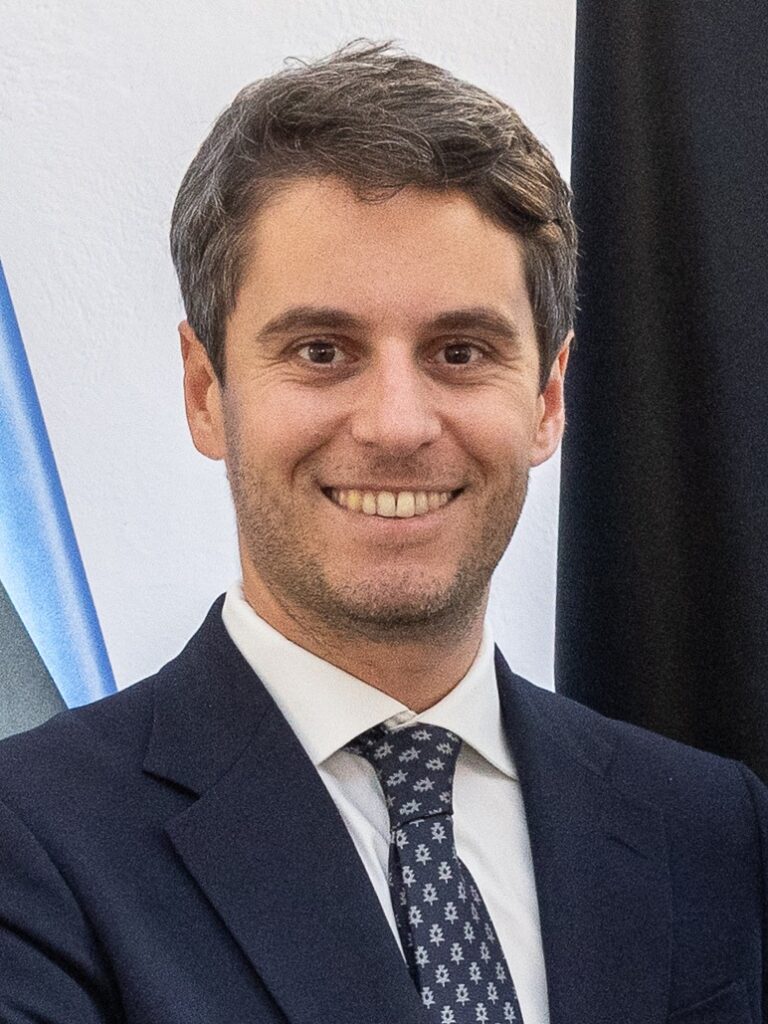
37-year-old Attal, who in 2024 became the youngest prime minister in French history and the first openly gay head of a French government, officially announced his presidential candidacy on May 22, 2026. He based his platform on priorities such as education, wages, borders, and artificial intelligence. According to polls, with full vote fragmentation, he secures around 8.5%, but that number rises to 14.5–17.5% in scenarios with a narrower pool of candidates — yet he still trails behind Philippe. Their shared problem is that the centrist electorate is split between two of Macron’s former prime ministers, and only the withdrawal of one would give the other a clear path to the second round.
In the summer, Attal attempted to close the gap through a tour of the regions (including Brittany), positioning himself as a “renewal” of Macronism rather than its continuation. His youth and vivid identity lead him to be perceived as less tied to the “Macron system” than Philippe. His economic program is not yet detailed in its budgetary dimension. Among his main proposals is a wage-boosting mechanism through a “right to gross pay” (effectively the equivalent of a 13th-month salary) and lifting overtime restrictions.
In European policy, Attal is a federalist and integrationist. At the Eurosatory 2026 defense exhibition, he presented a defense policy vision alongside Philippe focused on scaling up production capacity. Significantly, Attal is the candidate among all six who most openly formulates the goal of “de-Americanizing” European defense — reducing reliance on US systems in favor of autonomous European capabilities. This sets him apart from both Mélenchon (who also criticizes NATO, but for anti-Atlanticist rather than pro-European reasons) and Philippe (who emphasizes production growth while avoiding framing the US as a problem).
His younger age and clear identity could theoretically allow Attal to reposition French leadership in the EU toward a new generation — appealing to a broader circle of younger European politicians rather than just the familiar Franco-German duo. However, federalist ambitions require Berlin’s agreement and a consensus among all 27 member states. This process historically moves very slowly, leaving it open to question how much Attal’s energy would actually translate into institutional change. In practice, the most likely result of his presidency would be pressure to deepen joint defense procurement at the EU level and — perhaps — create new joint debt instruments modeled on the post-pandemic recovery fund.
4. Raphaël Glucksmann (Place Publique): The “solid” European of the left

A Member of the European Parliament from the social-democratic S&D group and co-founder of the Place Publique party, 46-year-old Glucksmann embodies the strain of left-wing politics described in France as “solid.” It is characterized by consistent, pro-European rhetoric, distancing itself from Mélenchon’s radical-left tone. His electorate consists primarily of educated, urban voters from Paris and other major cities who are concerned about the rise of far-right sentiment. In polls, he maintains 10.5–14% support. This gives him a stable base, though it will likely not be enough to reach the second round without a significant weakening of the other left-wing candidates.
Glucksmann’s economic program includes raising the minimum wage and revising the 2023 pension reform (reversing the decision to raise the retirement age to 64) funded by increased taxation of big capital. With France’s budget deficit already exceeding 5% of GDP, analysts point to a structural contradiction between fulfilling his campaign promises and the need to curb debt. On migration, Glucksmann takes a much softer stance than Philippe or Attal. Instead of tightening border controls, he proposes creating a “citizens’ convention” composed of randomly selected individuals. This approach clearly sets him apart from RN, but leaves him open to criticism given French voters’ anxieties regarding migration.
On the European stage, Glucksmann advocates shifting from the unanimity rule to qualified majority voting. This would mean effectively abolishing the veto power, which the federalist wing of the Union considers the main obstacle to achieving greater geopolitical agency. He also supports deepening joint arms and military equipment procurement at the EU level.
This is likely the most radical institutional proposal among all six candidates. Abolishing the veto would represent the deepest shift toward supranationality since the Treaty of Lisbon. The paradox, however, is that abolishing unanimity would require the unanimous treaty ratification of all 27 member states. As an MEP with years of experience in Brussels and Strasbourg, Glucksmann would bring to the Élysée Palace an institutional fluency rare among French presidents. France under his leadership would act as an advocate for a “geopolitical” Union capable of collective action — aligned with the ambitions voiced by the von der Leyen Commission itself. Glucksmann’s left-wing yet consistently pro-European profile could serve as a bridge in Franco-German discussions on budgetary solidarity. He openly supports expanding joint debt and redistribution mechanisms at the EU level — a topic that traditionally cautious and “frugal” northern states approach with reserve.
5. Jean-Luc Mélenchon (La France Insoumise): A veteran’s fourth attempt

On May 3, 2026, on TF1, 74-let-old Jean-Luc Mélenchon officially confirmed his fourth consecutive run for the presidency — following 2012, 2017, and 2022, when he finished third for the third time, falling just 420,000 votes short of making the second round. Inside the party, the decision was made practically without debate. As party coordinator Manuel Bompard stated, an alternative candidacy was not even considered. Mélenchon immediately identified RN as his “main rival,” though he publicly declared he does not believe in a Le Pen victory in the second round.
His support level of around 13% reflects LFI’s core electorate rather than his true ceiling. Mélenchon’s core supporters are young urban residents, students, and people in precarious employment who feel the “traditional left” no longer represents them. Mélenchon advancing to the second round would require a simultaneous, deep collapse in the standing of both centrist forces and the moderate left. This scenario is improbable, though not impossible in conditions of extreme political instability.
His economic program marks the most radical break from the course of all previous governments. It includes: reducing the workweek from 35 to 32 hours, lowering the retirement age to 60, widespread nationalization of strategic sectors, and a “1 to 20” rule (limiting the wage spread between the lowest and highest salary within a company). The Institut Montaigne think tank estimated that implementing a similar program in 2022 would have generated over 250 billion euros in deficit annually — a level comparable only to the surge in spending during the pandemic.
In European policy, Mélenchon’s strategy relies on the concept of “European disobedience.” It entails executing his own program even in defiance of EU rules (including the stability pact or free competition rules) and negotiating from a position of strength, even allowing for the possibility of unilaterally breaking existing treaties if negotiations fail. In reality, amending the Lisbon Treaty requires the unanimous consent of all 27 countries, making it practically impossible. On NATO, Mélenchon advocates for France’s withdrawal from the Alliance’s structures.
In practice, a policy of “disobedience” would mean a direct collision between France and the EU legal order. Deliberately violating EU budget rules would pave the way for a new excessive deficit procedure, lead to sharp friction with the European Central Bank, and potentially trigger a legal crisis within Community structures if a key founding state unilaterally refused to honor treaty obligations. Furthermore, withdrawing from integrated NATO structures (modeled on de Gaulle in 1966) would complicate coordination with the EU’s own defense initiatives, which are increasingly closely linked with Alliance structures. Although Mélenchon’s chances of actually reaching the second round are slim, the very presence of such a program in public debate demonstrates the profound radicalization of the French left. Exercising this rhetoric would severely strain France’s relations with partners who ground their relationships in predictability and shared rules — above all Germany and the Netherlands, states that are traditionally fiscally conservative and belong to the “frugal” group.
6. Bruno Retailleau (The Republicans): A right-wing alternative without a ready formula for victory
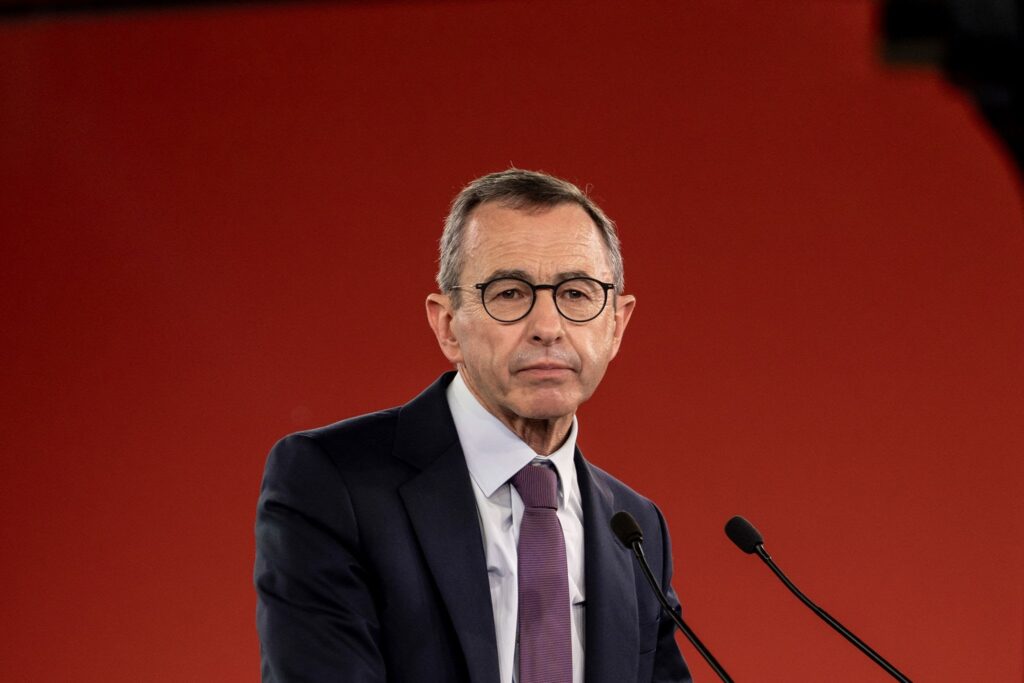
Bruno Retailleau — a 65-year-old senator from Vendée and leader of The Republicans (LR) party since 2025 — headed the French Ministry of the Interior in 2024–2025, first in Michel Barnier’s government and then under François Bayrou. When Lecornu formed a new cabinet in October 2025, Retailleau initially retained his post. Soon after, however, he resigned in protest over other personnel appointments. This episode triggered a government crisis for several days, led to the resignation of Lecornu himself, and significantly damaged Retailleau’s reputation. Party members designated him as LR’s official candidate for the 2027 presidential election in an internal vote in mid-April 2026.
Retailleau positions himself as the “president of order, justice, and French pride.” He takes a hardline stance on immigration and drug trafficking. His “Better housing, for less” program aims to build one million new homes in five years and reform preferential loans for first-time buyers. He also promises a referendum on immigration, criminal justice reforms, and declaring a state of emergency in neighborhoods afflicted by drug dealing. In polls, Retailleau consistently garners 8–11% of the vote, depending on the race configuration. This is distinctly lower than Philippe or Attal, and in a hypothetical second round, he loses to Le Pen by roughly 44% to 56%. The main challenge of his campaign is structural: the right-of-center niche between Macron’s center and RN is the exact space where successive LR leaders have unsuccessfully attempted to anchor themselves since 2017.
In foreign policy, Retailleau occupies a distinct position among right-wing candidates that is difficult to categorize neatly. He remains consistently pro-Atlanticist on hard security issues and advocates building a European pillar of NATO in tandem with the British. At the same time, he is skeptical of federalist projects like a “European army” promoted by Attal. In the Senate, he framed it as follows: Europe’s security is worth building not by “subcontracting” to the US, but independently — primarily through large national defense programs rather than a new supranational military structure.
For France’s role in the EU, this would mean a shift toward a “sovereigntist, yet non-exit-seeking” right-wing course — closer to Meloni’s approach in Italy than the institutional dismantling proposed by Le Pen. Retailleau does not seek to dismantle the European Commission or restore universal veto rights, but he is in no hurry to transfer new powers to Brussels. His emphasis on strengthening national border and migration controls would most likely put Paris at odds with EU migration policy (the Pact on Migration and Asylum). Friction of this kind is characteristic today not only of groups aligned with RN, but of an expanding portion of the center-right camp across the entire Union.
What Does This Mean for France and the European Union?
Regardless of the outcome, the 2027 election is above all a choice regarding the model under which the European Union will operate in the coming years. France is the EU’s second-largest economy, one of the continent’s two nuclear powers (alongside the UK, which left the Union), and a permanent member of the UN Security Council. It is also the largest agricultural producer in the Union and — together with Germany — a pillar of common defense and security policy. Unlike smaller states such as Hungary, whose national-conservative governments can only block individual initiatives, France possesses real power to alter the institutional balance of the Union — if not toward leaving the Community, then toward a gradual dismantling of its supranational competencies.
At stake is essentially a choice between several models: an intergovernmental “Europe of Nations” without veto power (Le Pen, partially Retailleau), supranational deepening of integration (Attal, Glucksmann), managerial continuation of the current course (Philippe), or direct confrontation with the legal order of the Union (Mélenchon). Regardless of the result, the Franco-German tandem — the historical engine of European integration — enters the 2027 electoral cycle structurally weakened. Even in the event of a pro-European victory, France will have significantly less fiscal space for joint initiatives than during the Macron–Merkel or early Macron–Scholz duos, and a fragmented parliament will effectively limit its foreign policy ambitions. This could accelerate an already visible trend: replacing formal Franco-German leadership with more flexible formats, such as the Weimar Triangle (including Poland) or ad-hoc “coalitions of the willing.” The fiscal dimension poses a separate risk for the entire Union. France is a systemically important economy, not a peripheral state on the scale of Greece in 2010. A full-scale loss of confidence in French bonds would test the EU and ECB crisis response tools (including the Transmission Protection Instrument), which were designed primarily with smaller economies in mind. In defense, the election outcome will decide the fate of joint procurement programs like the FCAS fighter jet and the MGCS tank. Le Pen’s “best bidder” approach would in practice halt Franco-German cooperation, whereas a pro-integration course under Attal or Glucksmann would lead to deeper joint procurement. Finally, the French election fits into a broader sovereigntist trend gaining momentum across the continent. In Germany, the AfD has become the second political force behind the CDU; in Italy, Giorgia Meloni’s coalition governs; and Viktor Orbán’s Hungary has for years promoted an intergovernmental model opposing supranational institutions — a vision close to Le Pen’s program. A victory for Le Pen (or even Retailleau) in France, a key player in the Council of the EU, could shift the European Council’s center of gravity toward groups less favorable to further integration. This would disrupt the balance that historically favored closer relations within the Union.
Trends Shaping the Race
Unprecedented fragmentation. Over 30 politicians have already announced or are considering running for president — a record number in the entire history of the Fifth Republic. The left remains deeply divided: only a portion of LFI supporters would accept Glucksmann’s leadership, and vice versa. The center, in turn, is split between Philippe and Attal. This fragmentation could work to RN’s advantage in two ways: in the first round, by scattering votes of the governing camp, and in the second — by allowing RN to compete against an opponent with a weaker political mandate who failed to consolidate the entire anti-RN electorate in time.
Primaries in the centrist block — an unresolved issue. The centrist block’s “liaison committee” (bringing together Horizons, Renaissance, MoDem, UDI, and the Radical Party) has still not reached an agreement on a mechanism for selecting a joint candidate. Attal does not rule out organizing primaries in early 2027. Philippe, on the other hand, publicly rejected the idea, citing poll results that confirm his natural leadership. Although monthly committee meetings continue, the block’s joint strategy remains unagreed. Meanwhile, electoral arithmetic indicates that none of these candidates running independently exceeds 20–22% support, while the Bardella/Le Pen duo easily maintains 34–36% of the vote. The judicial factor. The decision of the Court of Cassation in the Le Pen case, expected before the first round, remains the biggest institutional unknown of the campaign. If the court upholds the court of appeal’s ruling, the sentence enters into force immediately. In such a scenario, the party would have to put forward Bardella’s candidacy on short notice. The “for the EU, but against Brussels” line. Some analysts predict that the 2027 election could turn into a vote “for or against Europe.” According to Eurobarometer data (2025), only 30% of French people view the EU positively (down 6 percentage points compared to the spring of the same year and significantly below the EU average of 42%). Additionally, only 27% of French people trust the Union, compared to an average of 48% across the entire block. This is one of the lowest indicators among member states. These sentiments align with a broader European sovereigntist trend: in Germany, the AfD has become the second force behind the CDU, and in Italy, Giorgia Meloni’s Fratelli d’Italia party has become the most influential political force.
How Much to Trust the Polls
Before drawing conclusions, it is worth remembering the limitations of pre-election polling, which in France has repeatedly given an inaccurate picture of the final outcome. Joseph de Weck, a researcher at the German Council on Foreign Relations (DGAP), writing for The Guardian in May 2026, pointed out two lessons from history. The first is the phenomenon of “reverse shyness” among far-right voters. While it is usually assumed that supporters of such parties hide their preferences, the opposite is observed in France. RN voters readily declare their intent to vote for the party in polls, but do not always translate that support into a vote in the second round when the “republican front” is activated. The second lesson comes from 2012, when François Hollande, at an equivalent stage of the campaign, was perceived by political and media elites as a weak and compromised candidate, yet won the election anyway. Macron himself in July 2026 publicly called for “caution regarding polls” predicting a Le Pen victory, drawing an analogy to his own unexpected victory in 2017.
An additional nuance is the March 2026 municipal elections, in which RN took control of over 60 municipalities for the first time. This is a historic milestone for the party, but also a potential risk. The experience of the UK’s Reform UK shows that protest parties, after high-profile victories in local elections, often disappoint their voters with how they govern in practice. The discrepancy between anti-systemic rhetoric and daily governance at the local level could also become a challenge for RN in 2027.
By Way of Conclusion
At the beginning of August 2026, Marine Le Pen remains the undisputed favorite of the first round. For the first time in the history of her four presidential runs, her position as leader is accompanied not by disbelief, but by a widespread expectation of winning in the second round as well — at least according to data from the most high-profile poll conducted right after the July court ruling. The decisive factor in 2027, however, will not be Le Pen’s victory in the first round (which seems nearly certain), but whether the moderate left, the center, and the moderate right manage to put forward a single, strong candidate capable of consolidating the entire anti-RN electorate. Currently, Édouard Philippe is considered the most likely compromise option, although Gabriel Attal and Raphaël Glucksmann remain viable alternatives, and Bruno Retailleau is building his own right-of-center niche distinct from the center. If one of them consolidates the anti-RN vote and advances to the second round, the “republican front” would have a chance to unite around them with extraordinary unanimity for French politics. However, if fragmentation persists until the spring of 2027, Le Pen’s chances of winning will rise sharply.
Regardless of who wins, the room to deliver on campaign promises will be extremely limited. France’s budget deficit already exceeds 5% of GDP, placing the country under the EU’s excessive deficit procedure. Additionally, the most fragmented National Assembly in the history of the Fifth Republic is capable of blocking almost any governing majority. Yet the stakes of this election for the European Union extend far beyond personalities. At issue is whether France will maintain its role as one of the key architects of supranational integration and common defense policy, or, on the contrary, become another major state limiting its commitments in favor of an intergovernmental “Europe of Nations.”
Bibliography:
-> Text translated by Gemini Ai, Original in Polish
Resurgam, „Pięciu pretendentów do Pałacu Elizejskiego”, 9 lipca 2026
Ipsos/BVA dla Le Parisien, sondaż 27–28 maja 2026
Elabe dla BFMTV/La Tribune Dimanche, sondaż 9–12 lipca 2026
Al Jazeera, CNN, Reuters, France24, Franceinfo, Touteleurope.eu, JURIST — kronika sądowa sprawy Le Pen (lipiec 2026)
The Conversation, „With Marine Le Pen’s sentence the judiciary is giving French citizens the final say”
Wikipedia, „2027 French presidential election”; „Élection présidentielle française de 2027”
LCP – Assemblée nationale, Europe1, Public Sénat, Élysée Scope — przeglądy kandydatów i prawyborów partyjnych (luty–lipiec 2026)
INSEE, Eurostat, Banque de France, OFCE, Touteleurope.eu — wskaźniki makroekonomiczne i dane dotyczące procedury nadmiernego deficytu (2025–2026)
Źródło: INSEE, dane o deficycie sektora publicznego za 2025 r. i I kw. 2026 r.
Źródło: Eurostat, dług publiczny państw UE, I kw. 2026 r.
Wotum nieufności wobec rządu Michela Barniera, grudzień 2024 r. — pierwsze skuteczne od czasu rządu Georges’a Pompidou.
Źródło: sondaż Ipsos/BVA dla Le Parisien, 27–28 maja 2026 r.
Źródło: wyrok paryskiego sądu apelacyjnego, 7 lipca 2026 r.; relacje Reuters, CNN, Al Jazeera.
Źródło: sondaż Elabe dla BFMTV/La Tribune Dimanche, 9–10 lipca 2026 r.
Źródło: analiza ośrodka Asterès dot. programu budżetowego RN, 2026 r.
Źródło: oficjalne ogłoszenie kandydatury Gabriela Attala, 22 maja 2026 r.
Źródło: Institut Montaigne, analiza kosztów programu LFI z kampanii 2022 r.
Źródło: wystąpienie Bruno Retailleau w Senacie
Źródło: Joseph de Weck, komentarz dla The Guardian, maj 2026 r.
Źródło: wypowiedź Emmanuela Macrona, lipiec 2026 r.
Źródło: Getty Images photos