
The Central African Republic has never, in its relatively short political history, been a particularly happy, prosperous, or even stable country. Already at the moment of gaining independence in 1960, the French “guardians” of the newly created state admitted that, of all of Paris’s former colonies, it was the least prepared for sovereignty. The consequences of that unpreparedness became especially visible during the first two decades of this young African state’s existence. The first coup d’état was carried out as early as 1965, that is five years after independence. It was staged by a highly eccentric military man, Jean-Bédel Bokassa, who during his fourteen years in power became known above all for changing the name of the state to the Central African Empire and for organizing for himself a coronation as emperor in the style of Napoleon.
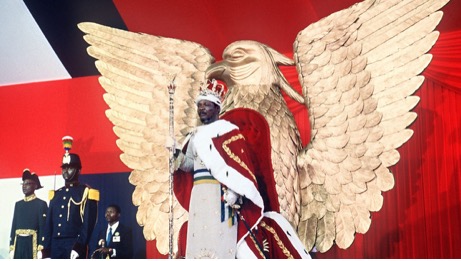
Fortunately, most of the bill for the staggeringly expensive coronation was covered at the time by the French. It was estimated to have been worth about ⅓ of the entire GDP of this very poor country, which then had a population of roughly two million people. Paris’s favor, however, ended as early as 1979, when murders of pupils and students protesting in the streets of the country’s capital — Bangui — came to light. They were protesting mainly against the government-imposed obligation to purchase school uniforms — produced exclusively by a company belonging to the “emperor’s” family — and against rampant unemployment in the country. Bokassa was branded the Butcher of Central Africa, and a French military intervention quickly stripped him of power in the country and installed his predecessor. David Dacko returned to the presidential chair, and the Central African Empire once again became a republic. Only two years later, however, another coup d’état changed the government in Bangui, as a result of which André-Dieudonné Kolingba took power. Kolingba’s rule brought relative stabilization, but it was authoritarian in character. In 1993 the country’s first multiparty elections were held, which Ange-Félix Patassé won with 53% of the vote. However, chaos in the state caused by economic problems, ethnic fragmentation, and military mutinies did not allow the brief stabilization and democratization of the 1990s to be put to use. After the end of the Cold War, France also began to make its further economic and military assistance increasingly dependent on the introduction of democratic reforms. Four years after winning the elections again in 1999, Patassé was removed by yet another coup d’état. It was carried out by the recently exiled-to-Chad former chief of staff, François Bozizé.
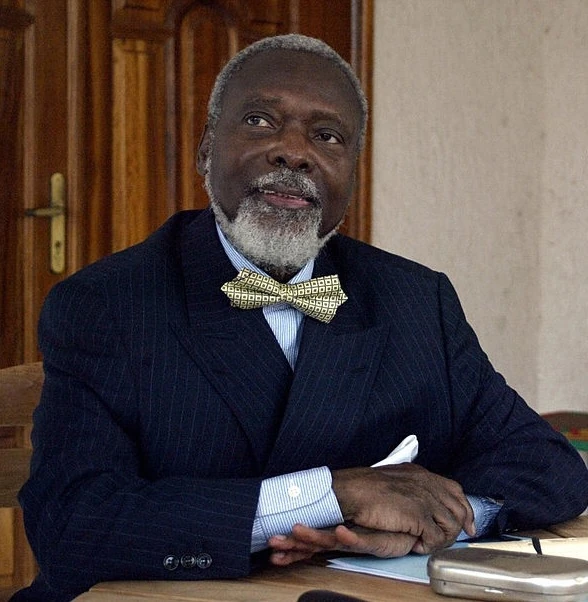
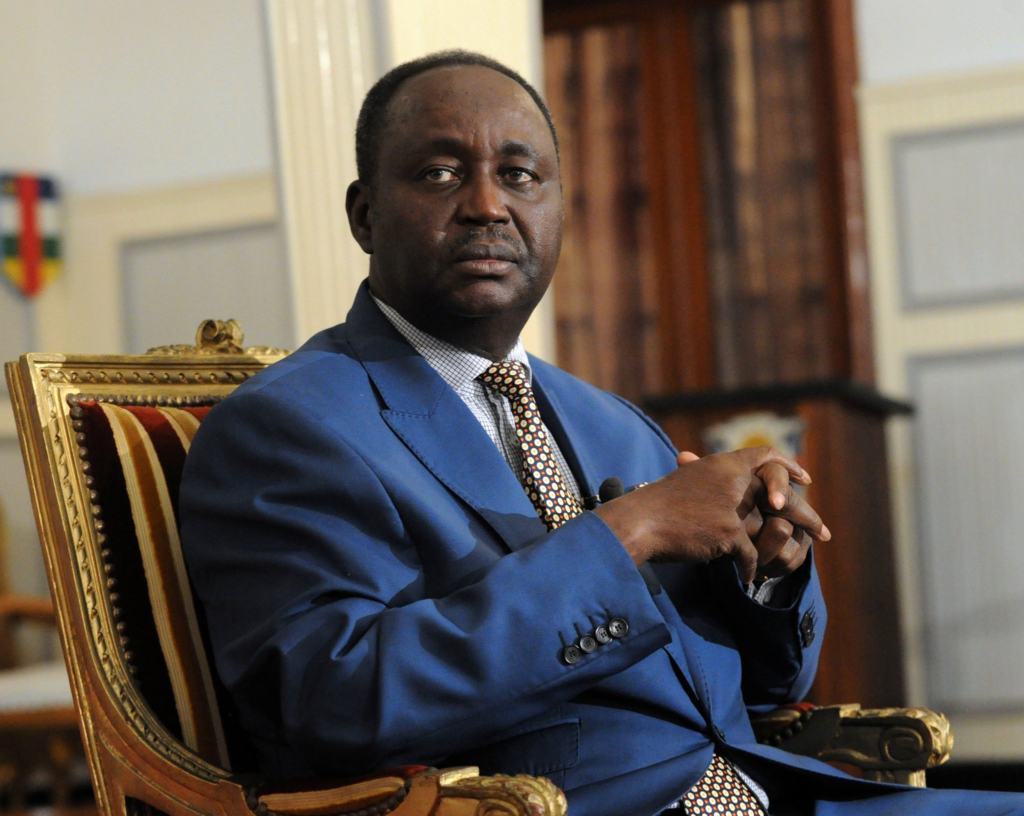
After initial conciliatory steps by Bozizé’s administration and attempts to introduce an agreement with the armed groups fighting the government in Bangui, the situation began to deteriorate again. Although some rebels agreed to halt operations and join the government under the IPD (Inclusive Political Dialogue) program, a substantial part of the opposition and armed groups felt disappointed by the reform process and continued to fight. In 2011 another election was held, won by Bozizé and contested by most opposition groups as rigged.
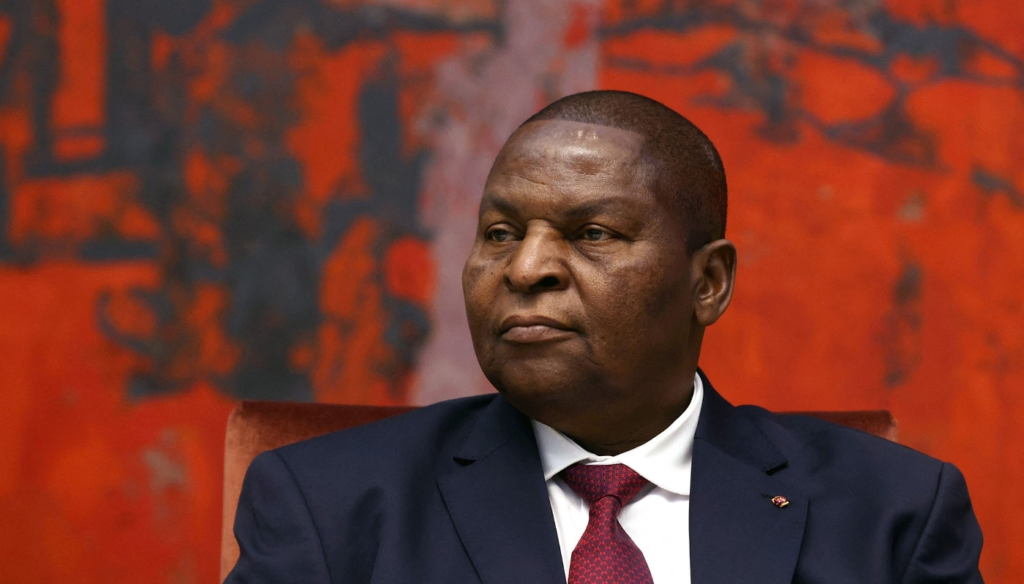
In 2012, Seleka — a new rebel coalition dominated primarily by Muslims from the north of the country — invaded the Central African Republic and quickly advanced on the capital, where after failed negotiations with the authorities it finally seized the city in 2013 and brought the next government to a violent end. The capture of the capital by Seleka opened a period of deep isolation of the state, the foremost example of which was its suspension from the structures of the African Union. The ineptitude of the next weak government in Bangui also produced complete impunity among rebels who had once belonged to Seleka, who after dispersing into the provinces began to carry out mass looting, killings, and rapes, causing an enormous humanitarian catastrophe. The drama of the situation was compounded by the fact that the rebels were predominantly Muslim, which led to attacks being concentrated on the Christian population. In response, the mostly Christian population of the south of the country began to form its own self-defense groups, which in turn started attacking the Muslim population. As a result of these events the country sank into a deep internal conflict, within which it was divided among many different local militias of varied ethnic and religious background that had no intention whatsoever of submitting to the powerless central authority in Bangui. After negotiations among representatives of political circles in the capital, given impetus by a UN intervention, it was decided to call new elections in 2016. They were won by a doctor of mathematics and former prime minister, Faustin-Archange Touadéra, who has served as head of state of the Central African Republic to this day.
Wagner Steps In to Help
At the moment Touadéra took office, the central government controlled barely about 20% of the republic’s territory, limited mainly to areas around the capital itself. It was during his presidency that eyes began to turn toward Moscow, rather than Paris, in order to obtain help in stabilizing a state plunged into chaos. In 2018 the government of the Central African Republic officially invited Russian mercenaries from the Wagner Group into the country. They were to provide military assistance and train government forces to fight the rebels controlling most of the country’s territory. Quickly, however, the group became the foundation of state power, providing, besides support for the republic’s armed forces, protection of the president himself. In return the mercenaries did not want direct cash transfers from Bangui, which the weak government simply could not afford. They expected instead guarantees that, in exchange for help in subduing the provinces and pushing back rebel forces, Wagner could count on broad concessions for the extraction of valuable mineral resources, above all gold and diamonds. The Russian mercenaries did not have to wait long for a chance to prove their usefulness. Already at the turn of 2020 and 2021, the Coalition des Patriotes pour le Changement (CPC) — one of the strongest armed groups fighting the state authorities — attempted to seize the capital. Thanks to the direct actions of the Wagner Group and the FACA (Central African Armed Forces) units trained by it, however, the attack was repelled and a counteroffensive launched. The counterattack conducted by the Russian mercenaries and the army focused primarily on gaining control of areas rich in mineral deposits. This deprived some armed groups of important sources of financing and provided Wagner with income from control of lucrative deposits, and strengthened their position. The foremost example of this is the armed seizure in 2021 of the Ndassima mine in the central part of the country. In 2020 Wagner managed, without any specific legal basis, to take over the title to the site, whose gold deposits are estimated at around 2.8 billion dollars. Since then Ndassima has remained entirely under Wagner’s control, while government inspectors attempting to gain access to the site are driven off by armed mercenaries and even threatened with death. Gold and diamonds from facilities controlled by the Wagner Group in the great majority bypass official government distribution channels. The minerals are illegally taken out of the country by the mercenaries using alternative transport networks. The resources reach, by indirect and direct routes, mainly the United Arab Emirates, where after processing they are incorporated into international circulation.
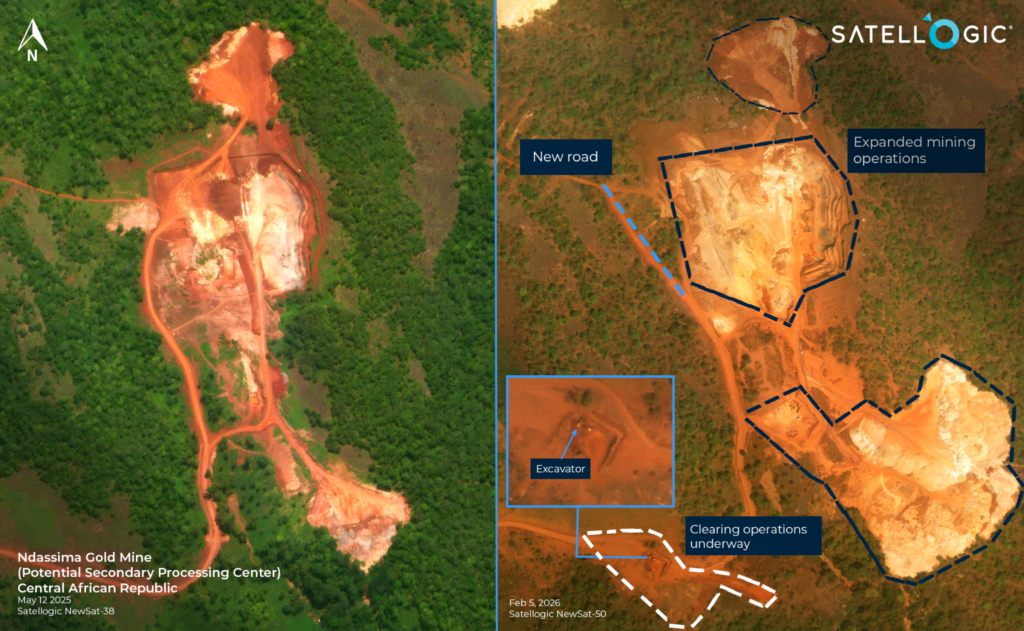
These operations also allowed the Wagnerites to increase their personnel numbers considerably. According to information obtained by Le Monde, by September 2021 almost 1,500 members of the Wagner Group were already present in the Republic, operating in 47 locations. This was a huge increase from the initial figure of about 210 “military instructors” still declared to the UN in 2018. It was at that moment that a specific arrangement took shape, under which the Wagner Group began to provide stabilization in areas occupied by government forces, and in return there was the authorities’ tacit consent to the mercenaries’ extraction of resources and the government’s deliberate ignoring of any abuses on the part of the Russians. The mercenaries brutally drove numerous artisanal miners off the lands they had occupied, so that they could begin more industrial extraction.
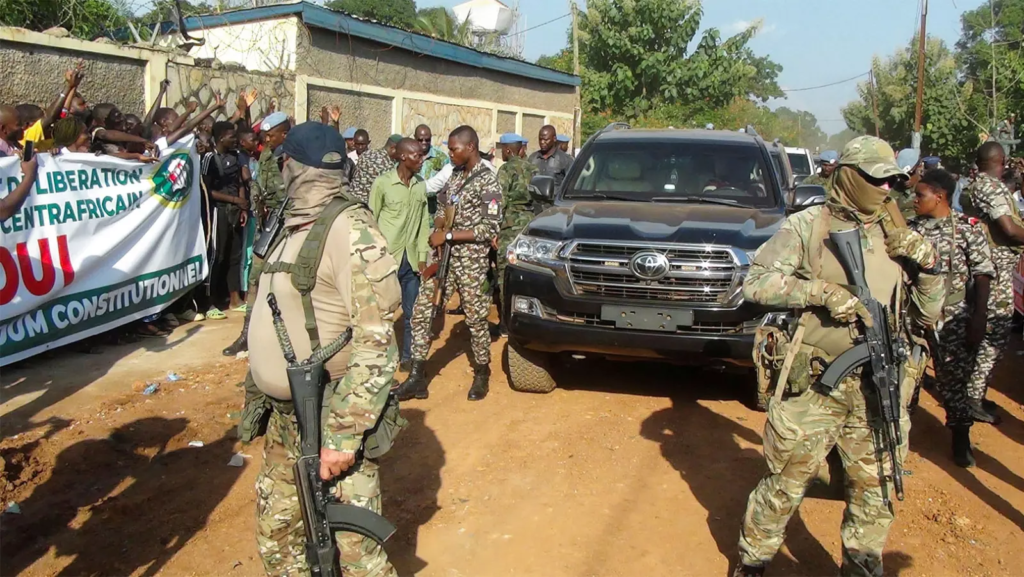
Help in avoiding another coup d’état in 2020 and the counterattack carried out by the Wagnerites allowed not only the Russians themselves but also President Touadéra to consolidate their position. In 2023 a referendum was organized on amending the Republic’s constitution. Among the most important proposed changes were extending the term of office of the head of state from 5 to 7 years and completely abolishing the term limit. The opposition’s decision to boycott the referendum and the still limited scope of the central government’s control over the state’s territory meant that — according to opposition estimates — only about 15% of those eligible to vote took part in it. That did not stop the authorities from claiming that turnout was almost 60%. The result was of course favorable for President Touadéra, who gained the ability to run in future elections an unlimited number of times. In the same referendum the president did not hesitate to tighten cooperation with the Russians either. One of the changes approved in the referendum was the abolition of the requirement of parliamentary consent for the granting of government concessions for resource extraction on the territory of the Republic. From then on this remained exclusively within the purview of the head of state. This deepened still further the dependence between the office of the president and the Russian mercenaries, who in order to obtain further concessions now had to talk only to Touadéra. These events show a strong symbiosis between Touadéra’s administration and the Wagner Group. As long as the mercenaries have access to resource extraction, the president’s position remains strong, and even grows. Thanks to the Russians’ interventions he has been able to enjoy a much greater field of maneuver than his predecessors, who were at the mercy of an increasingly reluctant France or of numerous armed groups at odds with one another. The continuation of this arrangement, advantageous to both sides, is however increasingly in question. After the failed putsch of Yevgeny Prigozhin — the founder and principal financier of the group — in 2023 in Russia, the Kremlin decided to replace the Wagner Group with Africa Corps, already controlled directly by the Ministry of Defense. It is precisely the Wagner cell in the Central African Republic that has most resisted this change. The mercenaries still use the group’s emblems, and President Touadéra’s administration is also resisting Moscow’s demands. According to Touadéra, Wagner is more effective. Replacing it with Africa Corps would also mean that for the further services of Russian mercenaries the government of the Central African Republic would have to start paying in hard currency rather than with concessions for resource extraction. This would be a huge problem for Bangui, because together with the takeover of the concessions the Wagnerites created their own infrastructure for extracting and transporting resources to international markets. Taking over and replacing the entire alternative system created by Wagner could prove unfeasible for the relatively weak government forces. Time will tell whether Wagner will indeed have to withdraw and abandon the lucrative smuggling of resources, and whether in that situation the Republic will manage to pay for a continued Russian presence and maintain the stability of power in Bangui. Or whether there will instead be yet another coup d’état and the end of President Touadéra’s rule?