
On 19 August, at exactly the same hours when Zelensky officially submitted to the Verkhovna Rada a request to confirm Yevhen Khmara as permanent defence minister, Mykhailo Fedorov recorded a video address in which he spoke publicly for the first time about the need to hold elections during wartime and called the situation in the country a “systemic crisis of governance.” Polls, meanwhile, show that in a hypothetical second round he would beat Zelensky.
This is not a single episode, nor anyone’s personal ambition. This is, so far, the last point in a story that began not in July 2026 and not even in November 2025, but in 2019.
This text is not about Fedorov, not about Zaluzhny, and not even about Zelensky himself taken separately. It is about why none of them, popular, enjoying high personal trust, at times genuinely effective, managed to convert that trust into something more durable than a one-man presidential decision. And why this is a systemic problem, not a matter of the personality traits of a particular individual.
2019: a cycle that never managed to finish
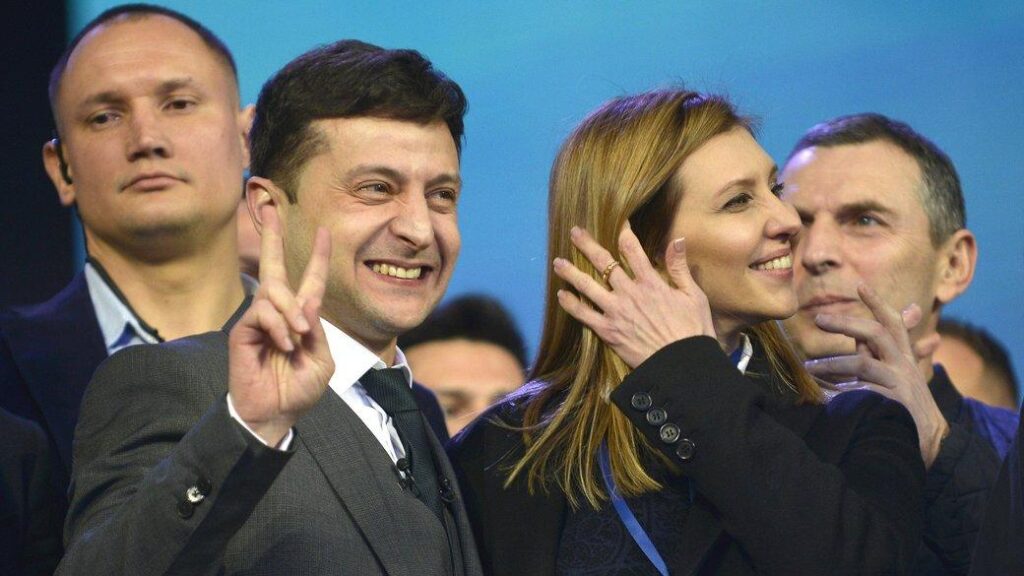
The year 2019 brought Ukraine not only a new president. The staggering 73.2 percent of the vote in the second round was more than an electoral victory: it meant the dismantling of the entire party configuration that had taken shape after the Maidan. Servant of the People won a standalone majority in the Verkhovna Rada, an unprecedented case for Ukraine’s party system, which since 1991 had grown used to coalitions and a balance of forces.
Behind that façade lay a structural fragility that few wanted to see in 2019. A large share of the deputies entered the Rada without political capital of their own. The party existed not as an institution with a tradition, an apparatus and a local electoral history, but as an extension of a single face. The mandate (presidential, parliamentary, later also governmental) was personalized to the furthest possible limit.
This revealed itself almost immediately, still before the pandemic and long before the invasion. In the spring of 2020, around 40 percent of citizens were prepared to support Zelensky in an election, a significant drop compared with 73 percent. By October 2021 the figure had fallen to 24.7 percent, and on the eve of the invasion, in February 2022, to 24.6 percent. The balance of trust and distrust toward the institution of the presidency itself turned negative: 27 percent trust versus 50 percent distrust in December 2021. A month before 24 February, 37 percent trusted Zelensky himself; 52 percent did not.
The most telling test proved to be the local elections of 25 October 2020: the first attempt to check whether a personal mandate could be scaled downward, to the level of cities and communities. Turnout collapsed to 36.88 percent. Servant of the People, the party that a few months earlier had won a standalone majority in parliament, took the lead in only three of the twelve regional-centre cities covered by the exit poll, and failed to enter Lviv’s city council at all. Petro Poroshenko put it bluntly at the time: “the green fairy tale is over.” There was no shortage of political interest in that sentence, but the numbers on which it rested were entirely real.
This matters for everything that follows. The 2019 model of power rested on direct, personal trust between the president and the voter, trust unmediated by a party, by local elites, or by institutions. The first test of that model’s scalability, downward, to the level of a city or community, ended in failure. Not because Zelensky was a bad president, but because personalized trust by its nature translates poorly into anything else: into a party structure, into a network of loyal local cadres, into durable institutions. That inability to convert is the guiding motif of this entire text, from 2020 through August 2026.
2022: a freeze, not a solution
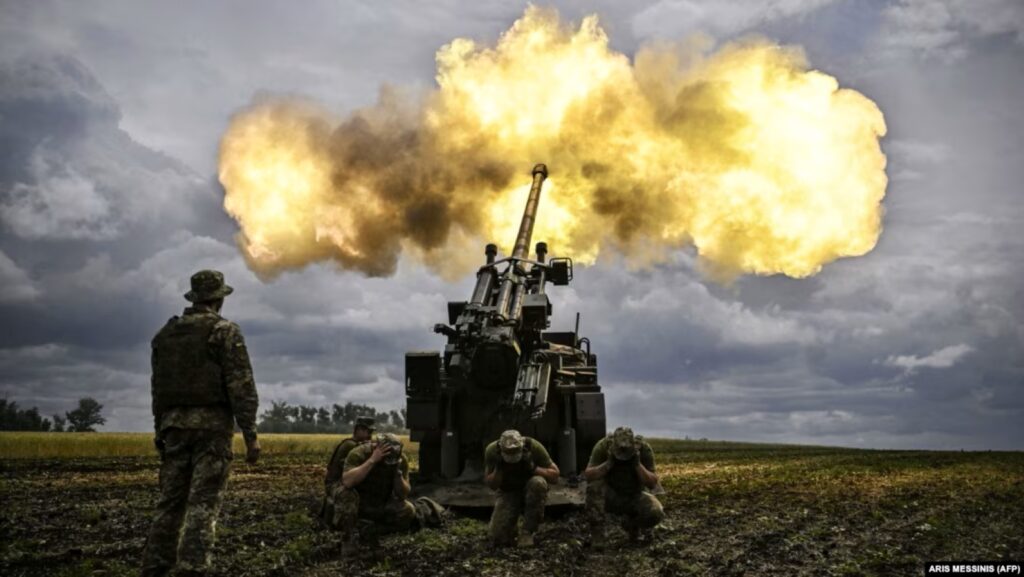
The full-scale invasion did not solve this problem. It froze it.
Within a few weeks, trust in the president shot up to levels unthinkable in peacetime, according to various polling centres, to 90–95 percent. But this was not a solution to the structural crisis of 2019–2021. It was a temporary cover for it.
The president became the main node of the state’s mobilization, and in that role he was genuinely effective. But in parallel everything disappeared that could theoretically have compensated for the weakness of the party as an institution and the personalization of the mandate. There is no normal electoral cycle. There is no renewal of parliament. There is no reformatting of the party. There is no competition over the future political course. Martial law legally makes elections impossible, and from the standpoint of defence capability that logic is indisputable. But it also means that the only mechanism capable of turning personal trust into something more durable than a one-man decision, namely elections, has now not been working for a sixth year running.
The war did not solve the problem of political representation. It postponed it. And postponed problems, as always, accumulate.
Zaluzhny: the first great conflict over an alternative form of public trust
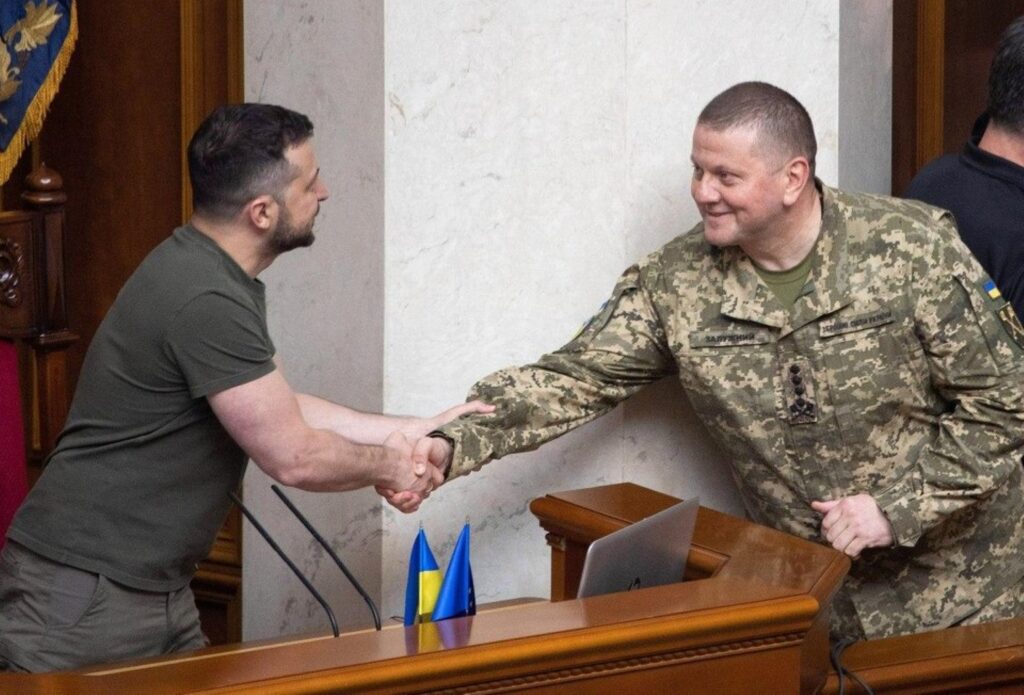
Valerii Zaluzhny in this story is not merely a dismissed general. By February 2024 he had become a symbol: of the successes of the first phase of the war (the defence of Kyiv, the Kharkiv counteroffensive), of a professional army, of a different type of public trust: not personalized by the president, but earned on the battlefield.
That specificity was visible at the very moment of the dismissal. A KIIS poll conducted on 5–10 February 2024, literally in the days of the decree, showed that 94 percent of respondents trusted Zaluzhny, and 64 percent trusted Zelensky (down from 77 percent in December). The president dismissed a subordinate whose trust rating exceeded his own by thirty percentage points. In a healthy system of power, something like that should not happen.
The official reason was the need to renew strategy and approach at the front, a “reboot” of the Armed Forces of Ukraine. The culmination of the conflict is considered to be Zaluzhny’s November article in The Economist, in which he openly admitted that the war had reached a positional stalemate: the Office of the President took this as a challenge thrown personally at Zelensky. Western media (Reuters, The Guardian, The Economist) wrote about the decision as a risky one precisely because it struck at the morale of the army and society. Some of Zelensky’s opponents and some analysts linked the dismissal not to operational expediency but to fear of popularity: Zaluzhny himself never declared political ambitions, but for many observers he remained a potential consolidating figure all the same. In his address on the dismissal, Zelensky explicitly denied any political motivation.
It is not worth asserting with certainty that fear of competition was the cause of the February decision: the motives of the state’s leadership at a given moment cannot be verified from the outside. But it is worth posing a question more important than any particular answer: what happens to a political system when a military commander becomes one of the most popular people in the country, and the only reaction mechanism provided by that system is a personnel decision by one person?
What is significant is what did NOT happen after 8 February 2024. Many Ukrainians received the dismissal decree almost as a betrayal. During the war years Zaluzhny had become a colloquial symbol of resistance; many newborns were named after him. And yet there was no protest. When a year and a half later, in July 2025, Ukrainians take to the streets for the first time since the start of the full-scale war, the reason will not be the dismissal of a man, but an assault on an institution, NABU and SAP. That is not a coincidence, but a measurable difference in thresholds.
2024 was the year in which society was not yet ready to protest the way it would in 2025–2026. The war created an enormous reserve of patience: fear, the front, the threat of defeat, trauma. All of this together produces an extremely high threshold of political mobilization. But the absence of street protest does not mean an absence of grievance or distrust: it only means that this distrust had not yet found a form of expression.
Zaluzhny left behind a political and emotional trace that did not fade. At the end of 2024 his personal trust rating remained at 70.9 percent, higher than any of Zelensky’s figures in the same period. In 2026, already ambassador in London, he still led almost every trust ranking among Ukrainian public figures, even though he had been physically outside Ukrainian politics for two and a half years. And a Socis poll from early August 2026 produced perhaps the most telling number in this entire text: in a hypothetical second round of a presidential election, Zaluzhny would defeat Zelensky by 66.2 percent to 33.8 percent.
By dismissing Zaluzhny, Zelensky with his own hands created a dangerous political opponent for himself, a mistake he would repeat two and a half years later with Fedorov, who was far more loyal to him. The system found no way to convert trust in Zaluzhny into any institutional form, neither into a party, nor into a post with real powers, nor into public competition in elections that cannot be held. Zaluzhny himself, by every indication, did not seek such competition and deliberately avoided it, not wanting to rock the boat in the middle of a war. The problem was not solved. It was postponed, just as in 2022, and that is precisely why the next knot would be tied not around a person, but around an institution.
NABU and SAP: the moment when distrust moves from people to institutions
The fragment about Zaluzhny was about a man. July 2025 is already about an institution, and that is a fundamentally different category of conflict.
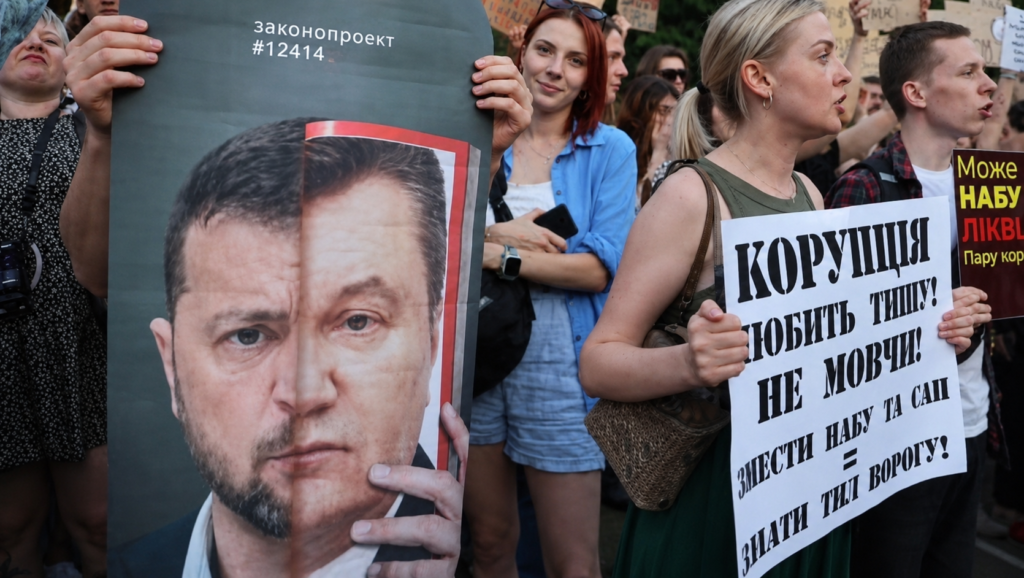
Formally, everything began unobtrusively. In January 2025 five Servant of the People deputies registered draft law No. 12414, on investigations into missing persons in the near-front zone, a subject with no connection whatsoever to the anti-corruption bodies. In April it was adopted at first reading. On 21 July, the day before the decisive vote, the SBU, the State Bureau of Investigation and the Prosecutor General’s Office, without court warrants, carried out around 70 searches of at least 15–19 NABU employees, calling this an operation to “neutralize Russian influence.” NABU director Semen Kryvonos cut short an official trip to the United Kingdom on an emergency basis. As formal grounds they cited some employees’ involvement in traffic accidents and alleged ties to Russia; two detectives were detained.
The next day, 22 July, at a sitting of the committee on law-enforcement activity, entirely different amendments were unexpectedly added to the draft law on missing persons, on subordinating NABU and SAP to the prosecutor general, that is, on effectively abolishing their independence. The Rada voted the changes through the same day, and that very evening Zelensky signed the law.
The reaction came that same evening, and that is the most important difference from February 2024. People took to the streets of Kyiv, Lviv, Dnipro, Odesa and other cities with homemade cardboard placards: hence the name “cardboard protests” or “cardboard Maidan.” These were the first anti-government demonstrations since the start of the full-scale invasion. The threshold that could not be crossed at the moment of the dismissal of the country’s most popular general proved to have been crossed by an assault on a nameless acronym. That distinction was what mattered: whether society takes to the street is decided not by the strength of the grievance, but by whether the threat touches an institution or a person.
It must be said honestly: without external pressure (the EU’s threat to halt financing) the cardboard protests would most likely not have won. The street has real force above all when elections and political accountability stand behind it: those who have angered society simply will not be elected again in the next cycle. In this case it is unknown when those elections will take place at all. An end to the war is not in sight; it may last another year, two, five, or longer. This is the same logic as in 2013–2014: had it not been for Putin’s external pressure on Yanukovych (the demand not to sign the association agreement with the EU), there might have been no Euromaidan and no Revolution of Dignity at all, because there would have been no reason for protest itself, and Ukraine would have repeated the path of authoritarian consolidation on the model of Belarus or Kazakhstan. Then, as now, the decisive role was played by pressure from outside, not by street energy alone; without it this would most likely not have worked in 2013–2014, nor in 2025.
Pressure came from outside as well. The ambassadors of the G7 states expressed concern; a European Commission spokesperson stated outright that financial support for Ukraine is conditioned on progress in democratic governance, and that NABU and SAP are of key importance for the path to EU membership. Resistance lasted nine days: on 31 July the Rada passed a new law that restored the independence of both institutions.
The explanation about a “Russian trace” did not withstand the test of time. A year later, none of the cases of treason or assistance to Russia opened that July had ended in a conviction; the only court ruling was an acquittal.
And here is a detail that would become understandable only in November. Sources at NABU told Ukrainian journalists that the SBU and the Prosecutor General’s Office had acted preemptively that July: the bureau was just then preparing charges against Tymur Mindich, co-owner of the Kvartal 95 studio. The July attempt to dismantle NABU was not a fight against abstract corruption or invented Russian influence, but an attempt to stop one specific investigation, one around which a scandal would erupt a few months later anyway, only louder than anyone in the Office of the President could have imagined.
Mindichgate: an explosion at the centre of the presidential vertical of power
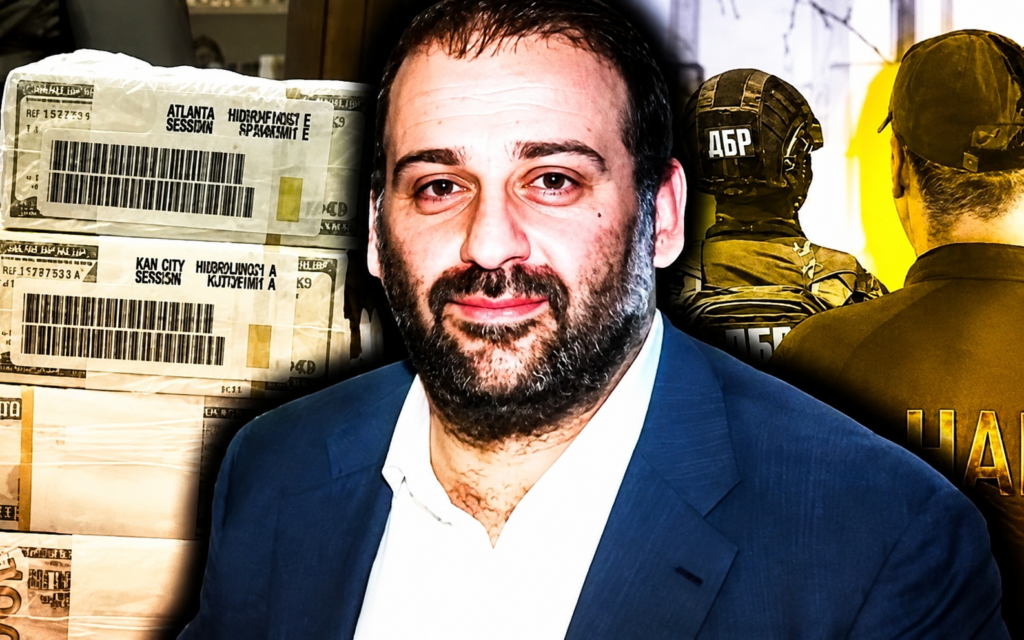
On 10 November 2025 NABU and SAP announced the results of Operation Midas, an investigation conducted in secret for at least fifteen months, since the summer of 2024. More than 70 searches, around a thousand hours of audio recordings, an exposed scheme of kickbacks amounting to 10–15 percent of the value of contracts of the state company Energoatom, the country’s largest electricity producer.
The central figure is Tymur Mindich, co-owner of the Kvartal 95 studio and, as he is described, a former personal friend of Zelensky. In the case materials he appears under the alias “Karlsson.” A few hours before the searches, Mindich left Ukraine, and has not returned to the country since.
The circle of suspects went far beyond business: charges were brought against Herman Halushchenko, then the serving justice minister and previously energy minister, and Oleksii Chernyshov, a former deputy prime minister (in the case materials, “Che Guevara”). After two days, Yulia Svyrydenko’s government removed Halushchenko from his post, and Energoatom’s supervisory board was dissolved. That same evening Zelensky spoke in defence of NABU and SAP, talking about the “inevitability of punishment” and “cleanliness” at Energoatom, but, according to Ukrainian media, in his address he avoided naming Mindich.
Here the circle that began in July closes. The same institution that four months earlier they had tried to subordinate to the prosecutor general dealt the president’s circle the most painful blow since the start of the full-scale war. If NABU sources were right about the motives of the July attack, November became proof that even maximum pressure on an institution does not always break it. It held, and used that victory.
But November did not bring an ending either. Personal sanctions were imposed on Mindich and Tsukerman; at the beginning of 2026 their cases were referred to Interpol; in March the prosecutor’s office sent a request for Mindich’s extradition from Israel. The investigation continued. In the summer of 2026 the figures in the case received new charges, including money laundering, but the man whose name gave the scandal its colloquial title, “Mindichgate,” in mid-2026 still remained beyond the reach of Ukrainian justice.
The investigation did not remain confined to Energoatom. In the spring of 2026 Ukrainska Pravda revealed a new series of recordings, the “Mindich tapes”, which, according to the newspaper, documented how people linked to Mindich and to Andrii Yermak, by then the former head of the Office of the President, in fact controlled the state-owned Sense Bank and the chemical giant Karpatnaftochim. Neither Fire Point nor Sense Bank admitted the allegations, and the bank’s internal audit found no violations, yet by the summer of 2026 the scale of the story had gone far beyond a single energy tender.
And that, ultimately, is the most accurate portrait of the very word “correction” in the title of this text. The system is capable of detecting a problem and even of reacting with personnel moves: the dismissal of a minister, the dissolution of a supervisory board, sanctions. But seeing a case through to the end, to a verdict against a person from the president’s closest personal circle: that is already another, far more demanding level of conversion, which the system, at the time this text was written, had not yet demonstrated.
Yermak: from “grey eminence” to a symbol of centralization
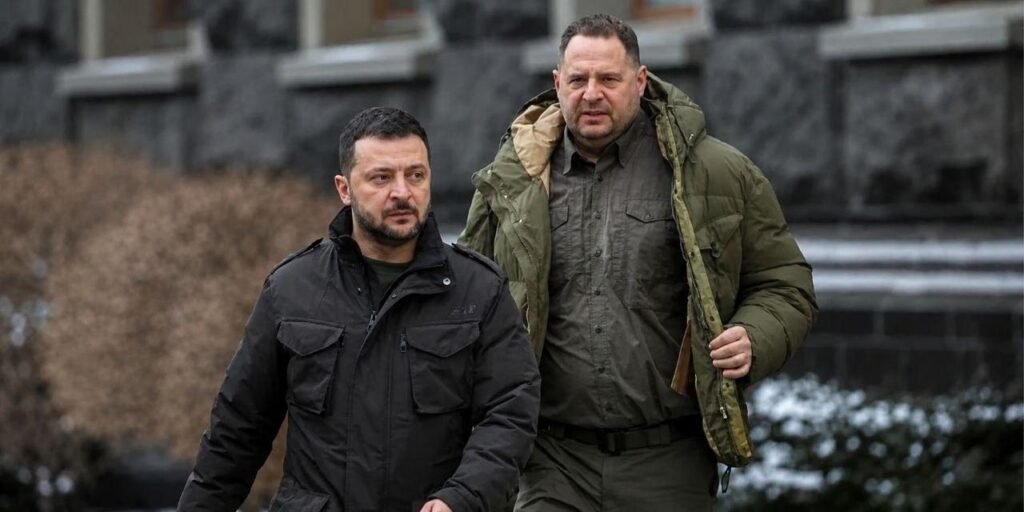
Andrii Yermak headed the Office of the President from February 2020, nearly six years. In that time he became the most influential unwritten post in Ukrainian power: the man who controlled access to the president, shaped the agenda, and conducted negotiations with Western partners. That is precisely why on 22 November 2025 Zelensky appointed him head of the Ukrainian delegation to talks with the United States on a peace plan, which looked like the peak of trust.
Six days later it was all over. On the morning of 28 November, NABU and SAP detectives entered Yermak’s apartment in the government quarter, investigative actions that, according to information from RBC-Ukraine sources, were linked to Operation Midas. That same evening Zelensky announced in an address that Yermak had submitted his resignation and that he had signed the decree. The official explanation, a reluctance to face “rumours and speculation” against the backdrop of talks with the United States, did not once mention the searches.
Yermak himself told the American publication New York Post that he was going to the front, felt slandered, and that his “dignity had not been defended”, even though he had been in Kyiv since 24 February 2022. NABU never announced charges: in February 2026 bureau director Semen Kryvonos even refused to confirm where the former head of the Office of the President was, calling it a “secret of the pre-trial investigation.” Still in February, Zelensky in an interview explicitly denied any link between the resignation and the NABU investigation, insisting that he had “his own reasons”, a statement hard to reconcile with the chronology of a single day.
The most burning information surfaced after the resignation. According to MP Yaroslav Zhelezniak, on the “Mindich tapes” Yermak appears under the alias “Ali Baba.” SAP head Oleksandr Klymenko publicly suggested that it was this figure who issued orders to pursue NABU detectives, and may have stood behind the very attempt to abolish the bureau’s independence in July 2025, which was prevented only by street protests.
If that is true, the thread opened in the chapter on NABU and SAP closes once and for all: the man suspected of commissioning an attack on an anti-corruption institution himself became one of the main victims of that same institution once it held. Analysts at ZN.ua described the November events this way: the case first struck the president’s business circle, and then the card with the figure of the head of the Office of the President “brought down the whole house of cards.” According to their observations, the system sensed where this was heading even before the official statement: that week prosecutors suddenly disappeared from courtrooms, and hearings were postponed until spring.
It is hard to imagine a cleaner example of centralization without conversion. For nearly six years power was drawn into a single informal post outside any constitutional procedure. And when that post fell, it fell not as a result of a democratic mechanism of accountability or of public political competition, but as a result of an investigation that this same post, according to the available suspicions, had tried to stop four months earlier.
The absent subject: where in this story is parliament?
Let us look more closely at the four episodes above: Zaluzhny, NABU and SAP, Mindichgate, Yermak. In each of them there is a president taking personnel decisions. There are the security services carrying out searches. There is the street coming out with cardboard placards. There is, finally, Brussels, threatening to halt financing. But in none of these four threads does the Verkhovna Rada appear as an independent subject.
That is not a coincidence, but a direct consequence of 2019, described at the beginning of the text: a standalone majority gathered around a single face, deputies without political capital of their own. A party that is not an institution does not produce deputies capable of acting against the will of the faction leadership, even when that leadership is wrong. The law subordinating NABU to the prosecutor general was passed by the Rada on 22 July 2025 in the space of a few hours, without public debate, and that is more telling than the mere fact of passage: in a parliament capable of agency, such speed would be physically impossible, regardless of the content of the decision.
And yet the Ukrainian parliamentary tradition knows opposite examples, precisely at moments when inertia seemed the safest option.
On 24 August 1991 the Verkhovna Rada of the Ukrainian SSR (and this is important: the same Rada in which a majority of deputies sat as members of the Communist Party) within a few days of the failure of the Moscow putsch voted through the Act of Declaration of Independence of Ukraine: 346 votes “for,” with 300 required. Leonid Kravchuk presided, and the decision was not taken because some presidential office ordered it: the institution of the president of independent Ukraine did not yet exist. Parliament acted as a subject because a direct threat, the possible restoration of a hard union centre after the putsch, made further inaction more dangerous than action.
22 February 2014 is an even clearer example. The Verkhovna Rada, by 328 votes, adopted a resolution on the “self-removal” of Viktor Yanukovych from the office of president. Among those voting “for” were deputies from the faction of the Party of Regions itself, which was melting before one’s eyes: some openly left it, others simply refused to defend the president on whose majority he had until recently formally relied. The legal cleanliness of that decision is still debated today: it was adopted not under Article 111 of the Constitution, but through the formula of “self-removal” and “circumstances of extreme necessity.” Politically, however, it was the moment when parliament proved that even a majority built on personal loyalty can break apart and vote against the source of that loyalty when reality, a president fleeing the country, becomes undeniable for everyone at once.
In both cases the common denominator is one: parliament’s agency was activated not in ordinary circumstances, but at the moment when the collapse of the alternative became obvious to everyone at once. Here, too, is the main caveat to this parallel: 1991 and 2014 were sharp, one-off ruptures after which there was no going back. The crisis of 2019–2026, by contrast, is slow, cumulative, without a single point of no return, and therefore without a natural trigger that would force even an obedient faction to speak in its own voice.
And that is precisely why parliamentary agency is not merely one possible answer, but perhaps the only institutional answer to the diagnosis posed throughout this text: a mechanism for converting trust that does not depend on the decision of one person. The question is not whether the Verkhovna Rada is capable of such a role at all. 1991 and 2014 prove that it is. The question is whether it can learn to activate that agency preventively, before a catastrophe, and not only after the fact, when the catastrophe has already given its name.
This, ultimately, goes beyond parliament itself: it is a regularity of Ukraine’s entire political culture. The Ukrainian people themselves have more than once become the engine of change through ordinary elections. But something else is far more characteristic: when the state veers off course, it is not so much repaired gradually as corrected by a jolt. One can call this “kick democracy”: when society gives the authorities who have taken a wrong course a literal kick, and only then, under street pressure rather than institutional procedure, do they return to the right course. 1991, 2004, 2014, the cardboard protests of 2025: these are all episodes of the same model: not a smooth correction, but a jolt after the accumulated crossing of the threshold of patience.
Budanov and Fedorov: an attempt to replace one type of capital with another
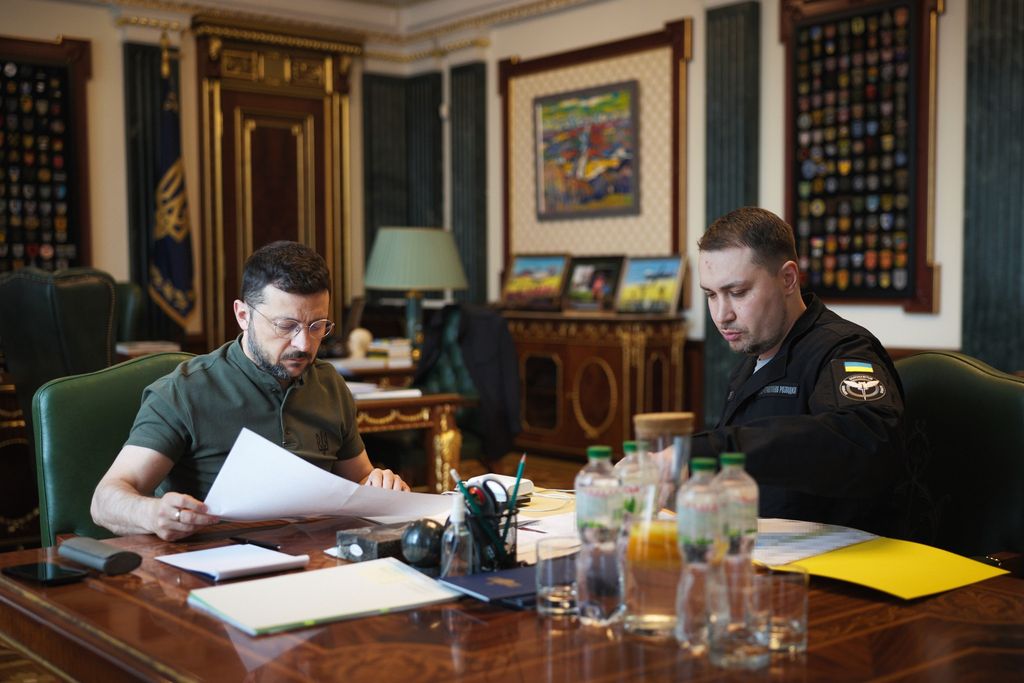
More than a month after Yermak’s resignation, Zelensky publicly considered candidates for his post: Fedorov, Shmyhal, Budanov, diplomat Serhii Kyslytsia, deputy director of the Office of the President Pavlo Palisa. On 2 January 2026 the choice fell on Budanov, then head of the GUR; Kyslytsia received the post of first deputy to the new head of the Office of the President. That same evening three decrees were signed at once: on Budanov’s appointment, on his release from the GUR, and on the dismissal of Oleh Ivashchenko from the post of head of the Foreign Intelligence Service. Ivashchenko became the new head of the GUR.
This decision should be read not as an ordinary rotation, but as an attempt to import into the Office of the President a different type of legitimacy. Yermak had purely apparatus power: control of access, not public trust as such. Budanov, by contrast, at the moment of nomination had one of the highest personal trust ratings in the country; sociologist Oleksii Antypovych of the Rating group openly called him, alongside Zaluzhny, a potential rival to Zelensky in a presidential election. Budanov himself, in a December interview with LB.ua, denied this, stating that he was not planning a political career. Telling and symbolic: the new head of the Office of the President did not even take Yermak’s office, but chose another, several times smaller office on the same floor: the one in which Serhii Shefir, the president’s oldest friend, dismissed back in March 2024, had once worked. Staff jokingly called this a choice of “better karma.”
That same day Zelensky also confirmed the second part of the reshuffle: Mykhailo Fedorov, long-time minister of digital transformation and architect of the drone programme of the Armed Forces of Ukraine, was put forward as a candidate for defence minister. The president’s argument was almost literally the same as in Budanov’s case, only in a different register: the need for “maximum technological capability” of the army. On 14 January the Rada confirmed the nomination by 277 votes.
The logic of both decisions is identical: after Yermak and Mindichgate, trust in the institutions around the president had fallen so far that an ordinary personnel swap would no longer work, people were needed whose reputations existed independently of Bankova and would strengthen, rather than weaken, the presidential vertical. Budanov carried the capital of a victorious intelligence chief. Fedorov carried the capital of technological success, understandable in a single word both to Ukrainians and to Western partners: drones.
But the decision remained a personnel one all the same: that is the same instrument as all the previous ones. Zelensky did not create a new channel through which public trust in Budanov or Fedorov could be institutionalized independently of the president’s will; he simply moved trusted people into chairs that he himself distributes. If the thesis of this text is correct, that the system can find trusted people but cannot convert trust in them into something more durable than a nomination, the further fate of this decision was to become either an exception or another confirmation. It became the latter, and much faster than anyone could have expected.
The Fedorov paradox: appointed to strengthen trust, dismissed after six months
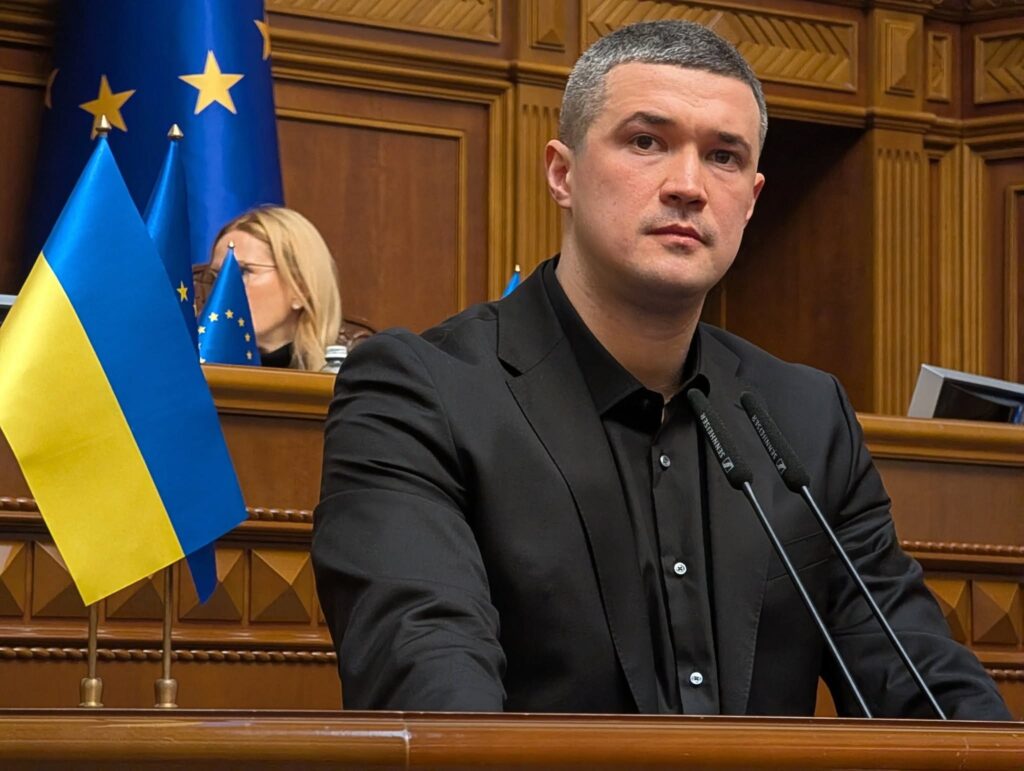
On 14 July 2026 the Verkhovna Rada supported the resignation of Yulia Svyrydenko’s government. Under the constitutional procedure this meant the automatic loss of office for the entire cabinet, including Fedorov. On the evening of the next day, 15 July, Fedorov publicly confirmed that he was leaving the post of defence minister. On 16 July Zelensky appointed as acting minister Yevhen Khmara, an officer from the SBU’s Alfa special unit, already in Serhii Koretskyi’s new government.
Publicly, the cause of the conflict was given as Fedorov’s differences with Commander-in-Chief Oleksandr Syrskyi. According to The Economist’s version, the core was more specific: an audit initiated by Fedorov found cost overruns in the Ministry of Defence and the Armed Forces amounting to around 300 billion hryvnias, and the minister demanded Syrskyi’s dismissal. At a briefing on 16 July Fedorov himself put it almost aphoristically: he needed the post not for the post itself, but in order to see the matter through to victory, and in an arrangement in which Syrskyi remained at the head of the army, he did not see how to do that. Together with Fedorov, his advisers Serhii Sternenko and Serhii Beskrestnov (“Flesh”) stepped down. Two weeks later, in an interview with Ukrainska Pravda, Fedorov himself substantially refined this picture: there had been no personal conflict with Syrskyi, both had taken office with their own vision of conducting the war, and the divergence was institutional in character, concerning the implementation of that vision, not personal hostility. It is worth adding that a conflict between the civilian leadership of the defence ministry and the military commander-in-chief is not in itself a sign of crisis: it is a routine, almost inevitable tension proper to established democracies with civilian control over the army.
That same evening, 16 July, protests began in Kyiv at the Office of the President and in other cities: the same “cardboards” as a year earlier during the attack on NABU and SAP, this time already in defence of a specific person, not an institution. The protests lasted, with varying intensity, for more than two weeks. There were two demands: restore Fedorov to his post and dismiss Syrskyi. Behind those demands one could sense not only an elite conflict over “who is closer to the president”: among the protesters, including demobilized soldiers, the slogan “we fight with drones, not with people” could be heard, a direct juxtaposition of Fedorov’s emphasis on drones with the practice of the territorial recruitment centres under Syrskyi. That gave the protest a social base, not only an elite one.
On 21 July Zelensky fulfilled the second demand. He appointed as commander-in-chief Mykhailo Drapatyi, considered an ally of Fedorov, and the next day he also replaced Chief of the General Staff Andrii Hnatov with Ihor Skybiuk. He never fulfilled the first demand: Fedorov refused the alternative posts he was offered, including deputy prime minister for military innovation, insisting that he would agree only to the defence ministry.
Sociology recorded the scale of the political price almost immediately. A Rating group poll of 20–21 July showed that 72 percent of Ukrainians opposed Fedorov’s dismissal; only 5 percent supported it. Within a week, trust in him rose from 35 percent to 65 percent. In the trust ranking he was second only to Zaluzhny (70 percent) and ahead of Budanov (62 percent) and Zelensky himself (59 percent). At the same time, 55 percent supported Syrskyi’s dismissal; only 15 percent opposed it. Political scientist Volodymyr Fesenko noted a mirror effect: according to the same Rating poll, readiness to vote for Zelensky in a hypothetical election fell from 32 percent in June to 22.3 percent, precisely at the peak of the conflict.
That is precisely the paradox announced at the beginning of the text. Fedorov was appointed in January 2026 in order to import trust into a structure that had lost it. Six months later, the attempt to remove Fedorov himself became the fastest and most direct proof of this text’s main thesis across all seven years: even when the president publicly and almost immediately fulfils one of the street’s two demands, dismissing Syrskyi, that does not restore the lost trust, because the key demand remains uninstitutionalized by any mechanism other than a presidential “yes” or “no.” Zelensky could dismiss Syrskyi in a single day. He could not, either in a week or in a month, give Fedorov back what the protesters really demanded: not the post as such, but a guarantee that the ministry’s work does not depend on the mood of one person at the top. It is from that inability, and not from Fedorov’s personal ambitions, that the statement with which this text begins grew.
Money, not generals
The conflict with Syrskyi is not the only explanation offered by the Ukrainian press. Even before the July crisis, when after Yermak’s resignation Zelensky considered Fedorov as a candidate to head the Office of the President, Ukrainska Pravda (in the words of journalist Mykhailo Tkach) reported that both the newly dismissed Yermak himself and the head of the mono-majority, Davyd Arakhamia, had opposed that nomination. Both, according to this information, feared that Fedorov, having gained influence and a high rating, would in time want to run for president. This is the same line of suspicion that accompanied Zaluzhny and Budanov, except that this time, if the sources are to be believed, it determined a personnel decision even before Fedorov took over the defence ministry at all.
Here it is worth returning to the chapter on the absent subject, and immediately specifying whose agency is meant: not parliament as an institution, but individual deputies. The Verkhovna Rada as an institution showed no agency even once in seven years. But one of its leaders did show it. As head of the mono-majority, Arakhamia has quite real, measurable influence on personnel decisions: if the sources are not mistaken, he used that influence twice to keep Fedorov out of the Office of the President and not to keep him at the defence ministry. This does not refute the thesis of parliament’s lack of agency. On the contrary, it sharpens it: agency in the Rada exists, but it operates at the scale of a single faction leader, serving a narrow private interest, not at the scale of an institution that would restrain the president in the name of a systemic interest. These are different “muscles”, and the second of them the Verkhovna Rada as an institution, by every indication, has not yet trained even once.
The July crisis, according to this version, also had a more prosaic cause. RBC-Ukraine independently notes months of a public campaign against Fedorov by the head of the Rada’s tax committee, Danylo Hetmantsev, considered close to Arakhamia, including lawsuits for the protection of honour and dignity. Daria Kaleniuk, director of the Anti-Corruption Action Centre, and Yurii Hudymenko, head of the public anti-corruption council at the Ministry of Defence, both of them sectoral voices, not accidental commentators, directly linked the pressure on the minister to the transfer of part of defence procurement to open tenders: a reform that, in their view, was destroying the “opaque business model” of players connected with army supply and making Fedorov inconvenient for those who had grown used to influencing the allocation of contracts. None of these claims is backed by a court verdict or a document, and Arakhamia himself publicly denies his involvement. But this version has been revealed by enough independent, sectoral sources that it is not a mere conspiracy theory. It is rather another unconfirmed, yet highly probable line of explanation alongside the official one.
This version also has its own, almost symmetrical logic: the fate of the post was predetermined, regardless of how Fedorov performed in it. Had he failed, dismissal for incompetence. Since he performed as well as he did, dismissal, because he had accumulated too much of his own trust capital, not borrowed from the president. This is not a unique trap designed especially for him: in February 2024 Zaluzhny fell into it in the same way.
From this, too, emerges the unprofessionalism of the decision itself. To dismiss someone at the peak of popularity, instead of waiting for a natural fade in the rating or an unsuccessful step by the minister, is a sign of a lack of political experience. Had Zelensky waited for a more convenient moment, Fedorov would most likely have left quietly and remained on the team as an example of a “burned-out star” without political ambitions, just as he had remained on it for all seven years. What matters here is not the post itself, but the combination: Fedorov headed the digital track already during the 2019 election campaign, meaning he was in the president’s closest circle even before the victory to which he in large measure contributed, and at the same time, unlike other figures from that same first team (Yermak, Shefir, whose power rested on informal closeness to the president rather than on an official post), he held a formal ministerial portfolio in every successive government, until Koretskyi’s government, where the president got rid of him. Instead of preserving that rare combination (personal loyalty since 2019 and a formal office), the president with his own hands turned his most loyal ally into his most dangerous potential rival: the same man whose August statement on wartime elections opens this text.
And an uncomfortable question remains, to which none of the versions gives a satisfactory answer: why did Fedorov begin to speak about corruption, the old system and the need for elections only after his dismissal and failed attempts to return to the post, and not years earlier, despite uninterrupted work in the apparatus of power since 2019? The simplest explanation, and at the same time the most cynical, is this: as long as he remained inside the system and had a chance of returning, silence paid off; having lost both the post and the prospect of return, silence ceased to pay. That does not undermine the substance of his charges against the system, but it is a serious reason to doubt the purity of the motives of the moment at which he decided to voice them.
If this version is even partly true, it does not refute the text’s main thesis: it sharpens it. This is no longer only a system that cannot convert trust into something more durable than a presidential decision. It is a system in which specific players with a specific financial interest are concerned that a mechanism of such conversion should never arise.
Why now: the conversion crisis
Each episode in this text, taken separately, can be explained locally: Zaluzhny was dismissed because of military strategy; they tried to subordinate NABU as part of a fight against “Russian influence”; Mindich was exposed thanks to solid detective work; Yermak left because of “rumours and speculation”; Budanov and Fedorov were appointed because of a need for competence, and the latter was dismissed because of a conflict with the commander-in-chief, or, according to a no less convincing version, because of procurement interests that his reform disrupted. There is a grain of truth in each of these explanations, but read in sequence these seven episodes add up not to seven different stories, but to one, about a system that regularly detects a problem of trust and for seven years has not once managed to solve it other than by a one-man presidential decision.
Here is the answer to the question “why now.” Not because August 2026 brought something qualitatively worse than November 2025 or even July 2025. In terms of purely factual weight, Mindichgate is most likely still the largest single scandal in this entire series. The point is something else: the threshold of social patience, as shown in the chapter on Zaluzhny, is not constant: it falls with each successive confirmation of the same thesis. In February 2024 the country did not take to the streets even in defence of a general with a 94 percent rating. In July 2025 it came out in defence of a nameless acronym. In July 2026, already again in defence of a specific person, but this time immediately and on a mass scale.
Ukraine is not living through a personnel crisis. It is living through a conversion crisis: the system’s inability to transform public trust into something more durable than a one-man presidential decision. The system does not lack talented, honest, trusted people. Zaluzhny, Budanov or Fedorov are confirmation of that. It can, when institutions are not obstructed, detect corruption at the highest level. Mindichgate proved that. But every time the moment arrives when trust must be transformed into something more durable than a presidential decree, into a party, into a post with independent powers, into an election result, a conversion mechanism simply does not exist. There is only one channel: the will of one person, who is himself the greatest beneficiary of the absence of an alternative.
Parliament, as shown above, historically was able to be such an alternative channel, twice, in 1991 and 2014, at moments of sharp, inescapable crisis. Across the seven years described in this text the Verkhovna Rada did not once make use of that capacity, even when, in the space of a few hours, it voted through a law directly contrary to the state’s long-term interests. That is not an accident of the 2019 mono-majority alone: it is a habit that persists despite the passage of time that, in peacetime conditions, would have contained more than one electoral cycle.
Fedorov’s appeal for wartime elections, with which this text begins, is not a simple solution: the Constitution forbids elections during martial law, and changing that norm in the middle of a war is a matter no less explosive than everything that happened earlier. But the very appearance of this demand, from a man who only six months earlier was asking merely for the return of his chair, shows how far the erosion of belief has gone that the system is capable of repairing itself with the tools it already has.
The correction crisis does not consist in Ukraine lacking the capacity to detect its own mistakes. Over seven years it has proved that it can do this surprisingly well: by journalistic investigation, by detective work, by street protest, even by presidential decree. The crisis consists in the fact that after every detection the system can do only one thing: wait until the same person whose one-man decision is the original cause of the problem decides what to do next. And, as the story around Fedorov himself shows, that inability is not always innocent: sometimes behind it stand quite specific people who have an interest in its remaining an inability for as long as possible.
In place of an epilogue: the first ten days
On 23 August Zelensky publicly answered Fedorov’s statement for the first time. Elections right now, in his words, are “a tsunami for the state that will split Ukraine”; he is prepared to consider them if partners provide concrete guarantees of safe voting for soldiers, frontline territories and millions of Ukrainians abroad, but no Western partner has so far offered such guarantees, and Putin does not agree to any variants of a ceasefire. Separately he said that Fedorov is being “pushed in the wrong direction” and that he himself had repeatedly tried to keep him on the team.
That same week Fedorov gave an interview to BBC News Ukraine and substantially softened his words: according to his version he had not called for elections, but had “initiated a constructive discussion”; he denied that this was an attack on the president or an attempt to destabilize the authorities; he confirmed that he had not been in contact with Zelensky either after the video address or for several weeks before it. He did not answer a direct question about presidential ambitions. According to journalists he is “considering various options.” Asked whether Zelensky turns a blind eye to corruption in his own circle, he answered evasively: those questions should be directed to the president himself.
Reactions spread across the entire spectrum. Former deputy defence minister Vitalii Deineha called it a “false start of Fedorov’s presidential campaign.” Historian and former MP Volodymyr Viatrovych warned that elections during wartime could become a convenient tool for Russia to take what it had failed to take by war. Detector Media criticized both at once: the president, who “sowed the wind and will reap the whirlwind,” and the ex-minister-“visionary,” whose words about strategies and the future are as yet backed by no concrete action.
On 28 August an international thread was added: Fedorov became an adviser to Italian defence minister Guido Crosetto on defence innovation, drones, autonomous systems, air defence. A telling detail: according to Crosetto himself in an interview with La Repubblica, he called Fedorov with this proposal literally the day after the July dismissal.
The choice itself looks strange. In Ukraine Fedorov refused even the post of deputy prime minister, and here he agreed to an advisory role in another state’s defence ministry. There is nothing immoral in this, but the message for the Ukrainian voter is imperfect: this is already not the first unsuccessful step by Fedorov’s team in public communication, and after it the minister himself will increasingly be spoken of not as an innovator enjoying public trust, but as an ordinary hypocrite politician who seeks not change but power.
Neither side made progress toward an institutional solution.
The detail that makes this moment different from all the previous ones: Zelensky now has no one left onto whom to shift the blame. In Yermak’s case it worked. Toxicity and incompetence could be dumped on the “grey eminence” who had supposedly usurped manual control of the state, while the source of all his power was the president himself, who had delegated that control to him. Now, after Yermak, Fedorov and Syrskyi (people whom he himself chose, himself appointed and himself dismissed), the blurring of his own responsibility no longer works for him.