
In Hungary, a heated debate will continue at least until June 30 over the changes proposed by Péter Magyar, which we heard during his hour-long speech on June 22 at the Országház. He described the reform proposals as Operation “Purifying Fire.” I recommend reading Dominik Héjj’s article for Interia, which you can find at the link below.
Hungary: Péter Magyar Makes an Announcement and Quotes His Ex-Wife – News on INTERIA.PL
I will, however, focus on summarizing the most important points:
- Magyar compared Fidesz’s rule to the activities of the Cosa Nostra—the infamous Italian crime syndicate known for murder, embezzlement, and corruption.
- According to the current prime minister, Viktor Orbán has taken control of Hungary through his “mafia tentacles,” using the media, institutions, criminals, and the elite.
- Interestingly, the Fidesz leader has been accused of corrupt collaboration with left-wing parties and overly aggressive protectionism.
- The Hungarian prime minister launched an uncompromising attack on President Tamás Sulyok, calling him a puppet who is asking another entity—namely, the Constitutional Court—to strengthen his mandate based on a law that does not exist. Magyar also mocked his analogy comparing Orbán to a captain who will always take the helm and steer the ship in the right direction. He maliciously suggested that if Sulyok were to write letters, they would have been well-received by Stalin, and just as sarcastically thanked him for sparking national opposition to Fidesz. He announced that Sulyok’s mandate would be revoked the day after the proposed 17th constitutional amendment takes effect.
- Until the constitutional process is completed—but for no more than five years—the National Assembly will elect a new President of the Republic to replace Tamás Sulyok.
- Magyar announced the creation of an Office for the Recovery and Protection of National Assets, to be appointed by parliament. It will be composed of the best prosecutors, police officers, tax experts, and IT specialists, and will have broad investigative powers. It is to operate independently of the government, and its leadership will be granted immunity.
- A 12-year term limit for members of parliament will be introduced, and the number of cardinal laws will be reduced.
- Peter Magyar also announced further public consultations, which are to culminate in setting a date for a referendum on amending the constitution.
- Very significant changes will take place in the judiciary: an age limit of 70 will be introduced for judges of the Constitutional Court (this affects four judges associated with Fidesz—Juhász, Lomnicia, Polt, and Haszonicsné Ádámová); a specific group of judges will now be able to file a motion to remove the President of the Curia and the Chair of the National Judicial Council, as well as nominate three candidates for these positions, one of whom will be elected by Parliament. The President will then appoint the winners to these offices.
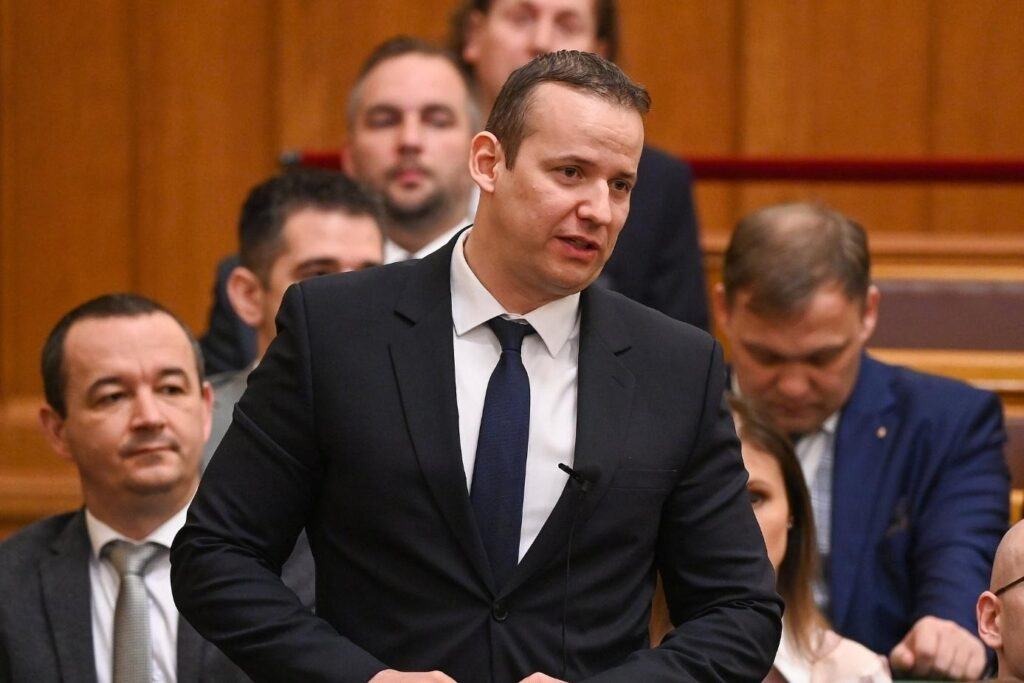
- Magyar also addressed László Toroczkai, whom he had effectively presented with a fait accompli—he stated that they were on the same side, so Toroczkai could not vote against these amendments, as doing so would aid the mafia.
The leader of Mi Hazánku did not take this behavior lying down and responded to Magyar with a very strong tweet on X. He questioned Magyar’s credibility, citing his ties to Fidesz and accusing him of spreading baseless lies about him.
Magyar Péter tegnap és ma is folyamatosan mutogatott, odaszólogatott nekem az ülésteremben. Mindezt a képernyőkön keresztül általában nem lehet látni, hallani. Szokása szerint gúnyolódott, és először ma ő vetette oda nekem, hogy "bohóc".
— Toroczkai László (@ToroczkaiLaszlo) June 23, 2026
Majd hosszasan személyeskedett, többek… pic.twitter.com/0Bxp9bPWtl
Speaking from the parliamentary rostrum, Toroczkai emphasized that he does not consider Magyar a partner, pointing to Magyar’s silence regarding the case of teacher Ilaria Salis in the European Parliament, a lack of trust in the selection of the future president, and disagreements over how to draft a new constitution (Toroczkai is a supporter of the Constitutional Assembly).
For those who are more curious to learn about his stance, I recommend this podcast from Eventus Podcast Studio; the link is below:
A szegedi lakóteleptől a parlamenti padsorokig- Toroczkai László története
WHAT DOES FIDESZ SAY ABOUT THIS?
Representatives of the political party that has ruled Hungary for the past 16 years are expressing their dissatisfaction with Tisza’s policies, citing numerous arguments.
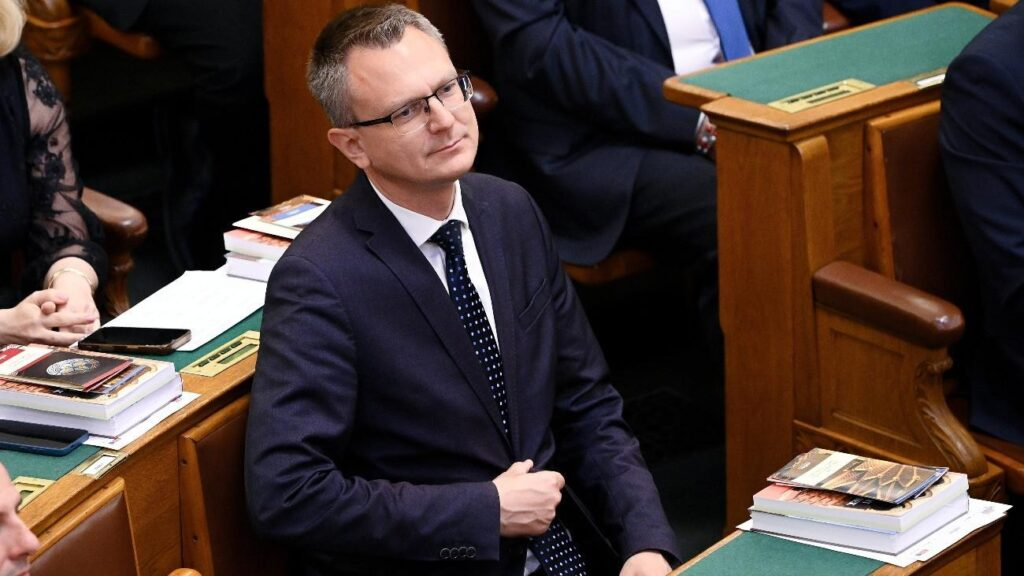
KDNP leader Bence Rétvári, speaking from the parliamentary rostrum, expressed his outrage at references to the mafia, defending his party as a group of patriotic people. Additionally, he accused Magyar of issuing “political judgments” whose content and language are unworthy of Parliament and the legacy of József Antall.
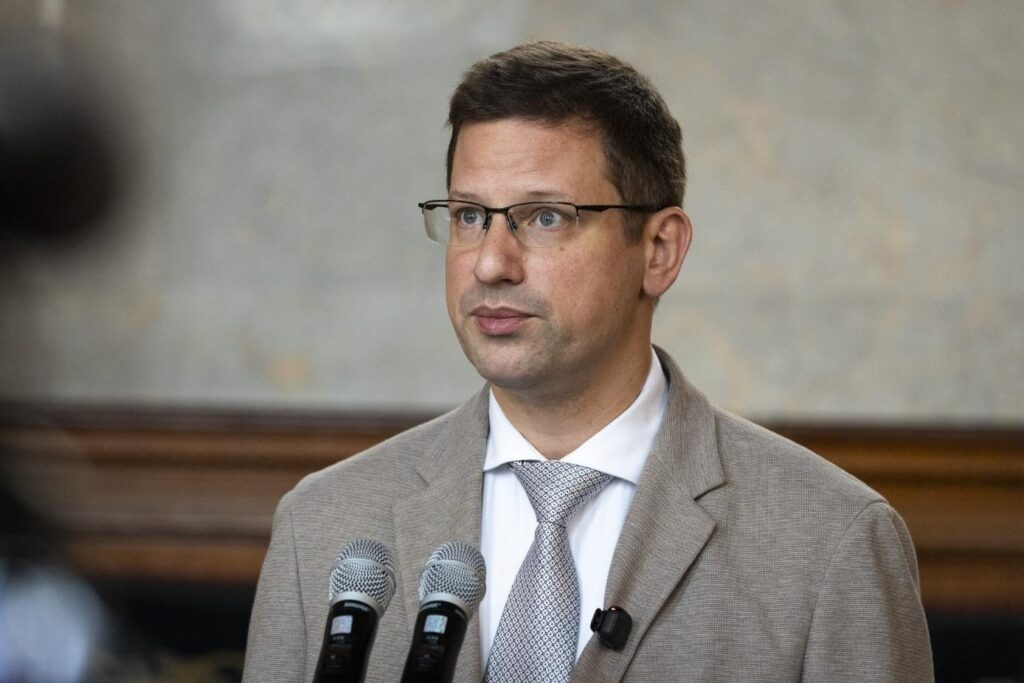
Gergely Gulyás, the second-in-command of the Fidesz party after Orbán, called Magyar’s speech the worst in the party’s history, defending his party’s 16 years in power as the best period of the past century. He accused Magyar himself of groundlessly disrupting political dialogue and of having ties to Viktor Orbán. In an interview with the 444 news site, he pointed out the risk of having to repay funds for four “additional” years in office if this amendment were to take effect. He also expressed outrage at being compared to the assassins of Giovanni Falcone and Paolo Borsellino.
“Equating former ruling parties with the mafia eliminates the possibility of constructive political dialogue. Comparing the government in Hungary—which has been elected four times in a row in free elections and which you supported for fourteen years—to a murderous mass organization defies common sense. It is a shame, but it is also a shame that your group does not hold back on this issue. You are not fighting the Mafia; you are building a dictatorship. You want to shorten the terms of elected public officials.”
Tisza is accused of engaging in “digital populism.” The opposition points to the excessive role of social media as a driving force behind the prime minister’s actions. According to Kristóf Odrobina, a journalist for Magyar Nemzet:
“If the prime minister lives on Facebook and governs the country according to the logic of likes, shares, and comment sections, then legislation will inevitably adapt to this digital minimalism. When scrolling through a news feed becomes the main forum for state leadership, legislation will inevitably become cheaper, simplified, and turn into a wooden wedge that can be swallowed in a single gulp.”
This is an accurate observation from the opposition’s perspective, for whom the process of removing the president is not only constitutionally difficult but also represents the sole remnant and a clear symbol of the continuity of Fidesz’s tradition of power. They fear that reducing political action to one-man popularity stunts will undermine the reputation of Hungarian political life.
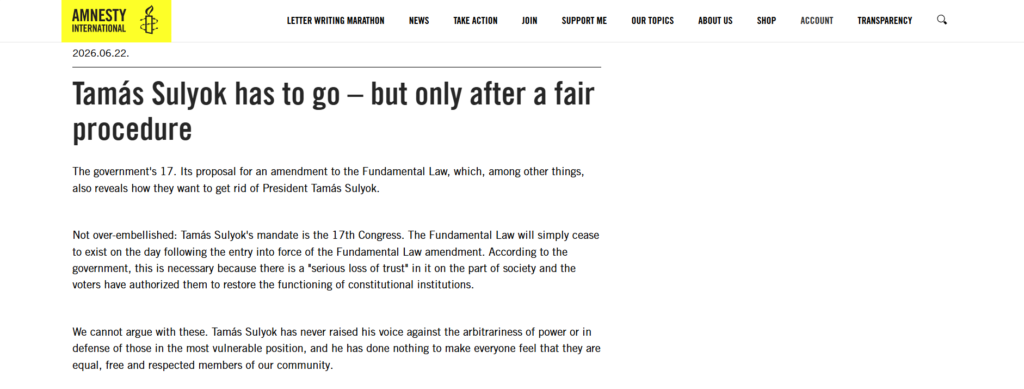
In an effort to discredit Magyar, Fidesz also cited the position of Amnesty International Magyarország, the Hungarian section of Amnesty International. The organization published a statement saying that Tamás Sulyok should step down, but only following a fair procedure, not through a one-sentence constitutional amendment.
Bibliography:
magyarnemzet.hu
nyugatifeny.hu
444.hu
telex.hu
A szegedi lakóteleptől a parlamenti padsorokig- Toroczkai László története
Napirend előtti miniszterelnöki felszólalás
A szegedi lakóteleptől a parlamenti padsorokig- Toroczkai László története