
Introduction
In June 2016, residents of the United Kingdom went to the polls to vote in a referendum on leaving the European Union. Although the vote was advisory in nature, Prime Minister David Cameron’s government announced that it would carry out the will of the voters. And so, with a turnout of 72.2%, 51.9% of voters supported the United Kingdom’s exit from the European Union. Since then, the only head of the United Kingdom’s government who has had to step down from office after losing an election has been Rishi Sunak.
On Monday, June 22, Keir Starmer—the sixth British prime minister since the 2016 referendum—announced his resignation. But how did it come to this: despite a landslide victory over the Tories in the July 2024 general election, the Labour Party leader is leaving 10 Downing Street in disgrace after two years in office—and who is his most likely successor?
Zwycięstwo Partii Pracy i Keira Starmera
The Labor Party’s victory in the 2024 parliamentary elections was not solely due to the success of its election campaign, but primarily to the incompetence of the Tories, whose final years in power were marred by scandals and poor decisions. During the COVID-19 pandemic, when the United Kingdom was under lockdown and ordinary Britons were unable to see their families or say goodbye to dying loved ones in hospitals, Prime Minister Boris Johnson was hosting parties with members of his cabinet at 10 Downing Street. The “Partygate” scandal exposed the government’s hypocrisy and showed that the elites operate under different rules than the rest of society. She was succeeded by Liz Truss, who, despite serving for only 44 days, led the country into a massive economic and political crisis. In September 2022, she announced the so-called “mini-budget”—the largest plan for tax cuts since Margaret Thatcher’s time, one that favored the wealthiest. Financing this plan would have entailed drastically increasing the national debt by tens of billions of pounds, a move against which the Office for Budget Responsibility (OBR) had warned. The announced plan sparked panic in the financial markets; the pound plummeted to a historic low against the dollar, yields on British government bonds rose sharply, and the Bank of England had to intervene to save pension funds from bankruptcy. In response, banks withdrew many mortgage offers, and interest rates rose sharply, which hit the middle class hard. Amid the ensuing chaos, Liz Truss stepped down as prime minister and was replaced by Rishi Sunak. He promised to stabilize the financial markets, reduce hospital wait times, and curb illegal immigration from Western Europe. However, he stopped short of delivering on these promises; in 2023, the United Kingdom teetered on the brink of recession, the paralysis in the National Health Service (NHS) worsened due to doctors’ strikes, and the influx of immigrants only intensified. In this situation, Prime Minister Sunak entered 2024, the year in which elections were scheduled to take place in the United Kingdom. However, due to changes in electoral law, it was unclear exactly when they would be held. Facing a decline in the polls in May 2024, he announced early elections for July 4.
At a time when the Conservative Party was losing the public’s trust, Keir Starmer, as the new leader of the Labour Party, set about rebuilding the party following its defeat in the 2019 general election. Starmer marginalized the party’s most far-left wing, replacing the most radical candidates in constituencies with centrists and people loyal to him. During the campaign, he promised stability and transparent fiscal policy, vowing that his government would not raise the three main taxes: income tax, VAT, and Social Security contributions. Furthermore, he presented himself as a calm and predictable figure who—in contrast to the chaos caused by Liz Truss—would restore order and the rule of law. By distancing himself from the radical left, Starmer regained support for Labour in northern England, which Boris Johnson had won over in 2019 with promises of massive investments. Furthermore, the votes of center-right and right-wing voters were split between the Tories and Nigel Farage’s new populist party, Reform UK. The emergence of a right-wing alternative to the Conservative Party had a huge impact on the election results, as the United Kingdom uses a first-past-the-post electoral system with single-member districts (SMDs).
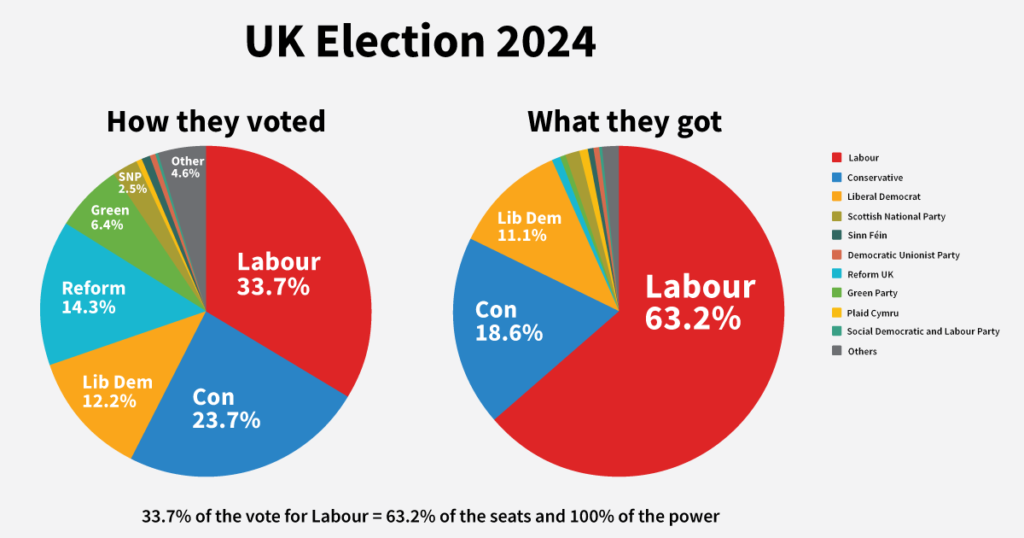
The 2024 parliamentary elections resulted in a victory for the Labour Party. Although it received only 33.7% of the vote, the electoral system allowed it to win as many as 63.2% of the seats, securing a massive majority in the Palace of Westminster. However, these elections were also the least representative in British history. Keir Starmer took office as Prime Minister of the United Kingdom on July 5, 2024.
Why has Starmer lost public support?
The Labour Party and Keir Starmer won the 2024 election on a platform of stability and effective reforms, in contrast to the chaos and constant scandals of the Conservative Party. However, the new prime minister very quickly began to face his first challenges.
As early as July 2024, Chancellor of the Exchequer (the equivalent of finance minister) Rachel Reeves announced cuts to winter fuel allowances, which primarily affected retirees. In December 2025, Starmer’s government introduced the “Family Farms Tax”—a tax on inheritances of farms. For many farmers who had voted for Labour in the general election, this was a betrayal of trust that led to protests. In his approach to policy-making, Keir Starmer became known for constantly changing and backtracking on his promises. The government first announced sweeping reforms—such as changes to business rates for pubs, social welfare reforms, and a tougher crackdown on gangs—only to backtrack on them after the first protests from the backbenches, which gave the prime minister the image of a man without a backbone or firm convictions.
Another problem arose with the nomination of Peter Mandelson as the British ambassador to the United States. From the very beginning, this decision was seen as a return to the party-political deals of the 1990s. However, this appointment did not become a full-blown scandal until 2025, when, in September of that year, at the request of a U.S. House of Representatives committee, new, previously undisclosed information regarding Jeffrey Epstein’s pedophile ring was revealed. The information revealed that Mandelson had maintained regular and close ties with Epstein for years. Faced with the scandal, Starmer dismissed him from his post; however, this was not the end of the political fallout for the prime minister, as in February 2026, it came to light that Mandelson had provided confidential financial information to Epstein during the 2008 financial crisis, for which he was arrested by British police.
Starmer had been in a weak position on the international stage since early 2025, when Donald Trump returned to the White House. Relations with the Trump administration were tense from the very beginning, mainly due to Elon Musk’s influence on the U.S. president. From the start of Starmer’s term, Musk had been critical of him, accusing him of restricting free speech, using excessive police force against right-wing protests, and treating left-wing and ethnic minority protesters too leniently. Furthermore, Starmer was indecisive regarding his stance on U.S. military operations. In contrast to Spanish Prime Minister Pedro Sánchez, who openly criticized U.S. and Israeli actions against Iran and banned U.S. forces from using Spanish bases, Keir Starmer showed indecision. Internationally, he was perceived as an inconsistent leader, and domestically, the party’s far-left wing began actively criticizing his passivity regarding the situation in the Middle East.
However, the most destabilizing factor that has led to such widespread unpopularity of both the Labour Party and Keir Starmer is the ethnic and racial tensions that have erupted in the United Kingdom in recent years in the form of violent protests and scandals. Although the Labour leader has been very effective in curbing the influx of new illegal immigrants since taking office, ethnic conflicts have only increased in intensity and frequency in recent years. Robberies, murders, and rapes—often racially motivated—have occurred, with people of Asian descent responsible for the majority of these crimes. Local councils dominated by Labour Party members ordered the removal of the St. George’s flag, labeling it a symbol of homophobia and racism. Police officers visited people who had posted critical comments and messages about the situation in the United Kingdom. These and many other events served as the spark that ignited the protests that have been erupting across the United Kingdom since 2024. The murder of Henry Nowak and the police’s handling of his killer, as well as rumors of rape gangs, fueled xenophobic and anti-immigrant sentiments among white English people, from whom right-wing parties— Reform UK and the new far-right Restore Britain, mobilizing the masses for the local elections in May 2026.
The Labor Party’s Debacle in the 2026 Local Elections in England
Amid social tensions, unfulfilled reforms, and a loss of voter confidence, Keir Starmer’s government launched its campaign for the local elections in the United Kingdom, scheduled for May 7, 2026. In addition to the local government elections in England, elections to the Scottish Parliament and the National Assembly for Wales were held at the same time.
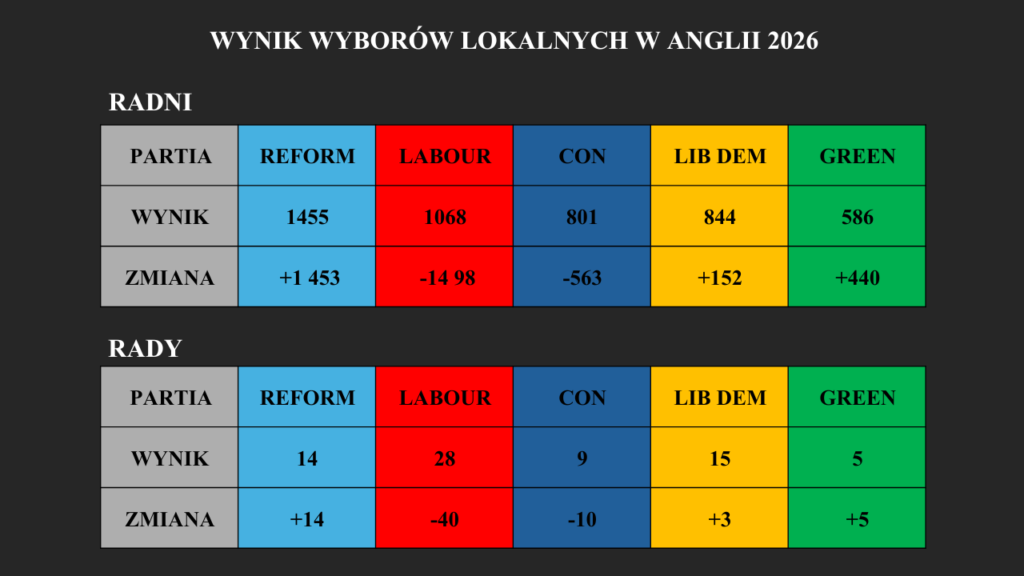
The local elections in England ended in a crushing defeat for the establishment parties; the Labour Party and the Conservative Party suffered massive losses, with Reform UK, the Liberal Democrats, and the Greens being the main beneficiaries. In the face of such a massive defeat, rumors of Starmer’s resignation began circulating just one day after the results were announced. Panic broke out within Labour as Reform UK began to dominate regions that had been Labour strongholds for many years. Cabinet members began pressuring the prime minister to resign, and several even stepped down from their posts to exert pressure. Initially, however, Starmer strongly resisted this pressure.
Unexpectedly, on May 14, Josh Simons, the incumbent Labour MP for Makerfield, resigned his seat. He openly admitted that he was doing so deliberately to enable Andy Burnham to return to national politics and run in the special election. This would allow Burnham to enter Parliament and begin his bid for the party leadership. Only a member of the House of Commons can issue such a challenge. At the same time, riots broke out following the release of body-camera footage from police officers regarding the murder of Henry Nowak and clashes between protesters and police in Belfast after an attack by a knife-wielding assailant of Sudanese origin. In addition, an audit into rape gangs was published, revealing that officials and the police had covered up these rapes for years out of fear of accusations of racism. Pressure on Starmer was mounting from all sides.
On June 18, a special election was held, which Burnham won easily. By then, it was almost certain that if Keir Starmer did not step down, Andy Burnham would challenge him for the party leadership—and thus for the position of prime minister. Ultimately, after consulting with his advisors and close associates, on Monday, June 22, Keir Starmer announced that he was resigning as Prime Minister of the United Kingdom and leader of the Labour Party. He also announced plans for an internal election to select a new party leader; however, as of the date of this essay (June 29), Andy Burnham remains the only candidate.
Nowa nadzieja – Andy Burnham

In the current situation, the following questions therefore arise: Who is the Labor Party’s new hope—Andy Burnham—and why is he, rather than any member of the cabinet, the favorite to become prime minister?
The answer lies in his unique political position, which he has built over the past decade away from Westminster. As the long-serving mayor of Greater Manchester, Burnham has earned the nickname “King of the North.” He has made a name for himself as a pragmatic politician capable of staunchly defending the interests of local communities—a trait he demonstrated, among other things, during high-profile clashes with Boris Johnson’s government during the pandemic. While ministers in Keir Starmer’s cabinet lent their names to unpopular decisions, such as cutting fuel allowances for retirees or the controversial Family Farms Tax, Burnham remained untainted. He was not tainted by any of the recent image scandals, including the Peter Mandelson affair. To a weary public, he became a symbol of a return to the Labour Party’s roots—a politician from the provinces who understands the problems of ordinary people, rather than a technocrat from London. Josh Simons’ resignation and Burnham’s swift victory in the Makerfield by-election gave him a definitive, fresh democratic mandate to take power and demonstrated that he is capable of winning back voters who had previously switched to Reform UK.
Manchesterism – socjalizm przyjazny biznesowi
Fundamentem programu politycznego, z którym Andy Burnham zamierza wejść na 10 Downing Street, jest tzw. Manchesterism. To autorska doktryna, stanowiąca próbę przełamania dotychczasowego impasu ideologicznego wewnątrz Labour. Burnham odrzuca zarówno dogmatyczny, skrajnie lewicowy socjalizm ery Jeremy’ego Corbyna, jak i chłodny, menedżerski centryzm Starmera, który wyborcy uznali za pozbawiony kręgosłupa.
Manchesterism w praktyce opiera się na trzech filarach:
- Decentralizacji władzy (Devolution) – Burnham uważa, że regiony powinny same decydować o swoich wydatkach i polityce społecznej, odchodząc od koncentracji władzy w Pałacu Westminsterskim.
- Silnych usługach publicznych pod kontrolą społeczną – sukces jego reformy transportowej w Manchesterze udowodnił, że usługi publiczne mogą działać sprawnie bez nastawienia na czysty zysk korporacyjny.
- Pragmatycznym partnerstwie z prywatnym kapitałem – w przeciwieństwie do tradycyjnej lewicy, Burnham nie walczy z biznesem. Jego celem jest tworzenie stabilnych warunków dla inwestorów, pod warunkiem, że generują oni dobrze płatne miejsca pracy i wspierają lokalną infrastrukturę.
- Ta wizja „socjalizmu przyjaznego biznesowi” ma stać się tarczą w walce z rosnącą w siłę partią Reform UK. Burnham chce udowodnić mieszkańcom północnej i środkowej Anglii, że stabilność ekonomiczną i poczucie bezpieczeństwa można odbudować bez uciekania się do populistycznych i radykalnych haseł oraz podżegania do zamieszek na tle etnicznym.
Zakończenie
The period since the Brexit referendum has been one of immense economic, social, and political instability for the United Kingdom. The fact that there have been six prime ministers in 10 years—most of whom stepped down following failures and political scandals—is a sad reality of the United Kingdom’s political system. In 2024, the first-past-the-post system gave the Labour Party full power, even though it won only 33.7% of the vote; however, mired in scandals and unable to resolve internal conflicts, it received a “yellow card” from the public in the 2026 local elections. Social tensions are fueling right-wing parties, while the left-wing electorate—dissatisfied with Starmer’s lack of firm opposition to Israel’s actions in Gaza and its war against Iran and Hezbollah—is shifting toward the Green Party. Time will tell whether Burnham will be able to reverse the trend and keep Labour in power. He faces many challenges left over from previous governments, which were unable to resolve them. Will the “King of the North” be able to effectively implement his economic plan, or will he, like his predecessors, succumb to the pressure of scandals and social tensions?
Bibliography:
- Uberoi, E. (2016). Analysis of the EU Referendum results 2016 (Research Briefing No. CBP-7639). House of Commons Library. https://commonslibrary.parliament.uk/research-briefings/cbp-7639/
- BBC News. (2023). Boris Johnson report: Key findings from the Partygate inquiry. https://www.bbc.com/news/uk-politics-65913184
- Clift, B. (2022). Trussonomics and the OBR. UK in a Changing Europe. https://ukandeu.ac.uk/trussonomics-and-the-obr/
- Macrotrends. United Kingdom GDP Growth Rate. Dane na rok 2023. https://www.macrotrends.net/global-metrics/countries/gbr/united-kingdom/gdp-growth-rate
- BBC News. (2023). Jeremy Corbyn blocked from standing as Labour candidate. https://www.bbc.com/news/uk-politics-65102128
- Fair Vote Canada. (2024). First-past-the-post hands the Labour Party all the power with 33.7% of the vote. https://www.fairvote.ca/07/07/2024/uk-election-first-past-the-post/
- BBC News. (2024). Winter fuel payments scrapped for millions. https://www.bbc.com/news/articles/cx02zdd92zdo
- BBC News. (2026). Who is Peter Mandelson? https://www.bbc.com/news/articles/c3edlg5w855o
- BBC News. (2024). Elon Musk: Downing Street says ‘no justification’ for civil war tweet. https://www.bbc.com/news/articles/c5ydddy3qzgo
- Polak, M. (2025). Wojna na flagi. Patriotyzm, prowokacja, czy walka o duszę narodu? Krytyka Polityczna. https://krytykapolityczna.pl/swiat/wielka-brytania-prawica-flaga-sw-jerzego/
- The Telegraph. (2026). Sorry for treating dying stab victim as racist, say Hampshire Police. https://www.telegraph.co.uk/news/2026/05/28/sorry-treating-dying-stab-victim-racist-hampshire-police/
- Grafika wyników wyborów lokalnych w Anglii z 2026 roku własnego opracowania, autor: Karol Sornat, na podstawie: https://election.news.sky.com/elections/england-councils-2026
- CNN. (2026). UK leader Starmer fights to save premiership as scores of Labour lawmakers urge him to resign. CNN. https://edition.cnn.com/2026/05/11/uk/uk-starmer-labour-calls-to-resign-latam-intl
- Sky News. (2025). Could Andy Burnham be a serious threat to Sir Keir Starmer? https://news.sky.com/story/could-andy-burnham-be-a-serious-threat-to-sir-keir-starmer-13432021
- BBC News. (2026). Burnham to give mayors more power in 10-year plan to transform economy. https://www.bbc.com/news/articles/c14yr0mgdp6o