
Art, as well as related events, often sparks controversy. This is usually the result of addressing taboo topics, breaking the norms of a given community, or challenging the dominant canon of beauty. However, the strong emotions surrounding this year’s Venice Biennale are not caused by the artists’ works. It is the actions of the event’s organizers and the participating countries that have made it the subject of widespread discussion around the world. Although the 61st edition of the Biennale is unique in many respects, the discussions surrounding it have been dominated by political disputes and protests.
Czym jest weneckie Biennale?
The Venice Biennale (La Biennale di Venezia) is one of the oldest and most popular cultural events in the world. It takes place every two years and attracts numerous artists, art critics, and tourists from around the world. The first Biennale took place in 1895 and focused primarily on painting and sculpture, earning international recognition even then. Over the years, the event has evolved and expanded to include other art forms. Today, it is a prestigious showcase of contemporary art that runs from spring through fall.
The event consists of an international exhibition presented in the Giardini gardens and the former shipyard complex (known as the Arsenale), exhibitions in the national pavilions, and numerous accompanying events. The independent La Biennale di Venezia Foundation is responsible for organizing the event and selects the chief curator. The chief curator determines the event’s theme and decides which works will be featured in that year’s curated exhibition. Countries participating in the Biennale often have their own pavilions and bear the costs of their construction and maintenance. Other countries present their works in exhibition spaces throughout the city. The works displayed there are selected by the countries’ governments or by institutions designated for this purpose.
The Biennale is often referred to as the “Olympics of the art world.” This is due to the awards presented by an international jury during the opening ceremony. The main awards are two Golden Lions, awarded to the best participant in the main exhibition and the best national pavilion, and a Silver Lion awarded to a promising young artist. In addition, the jury may award two special mentions to artists from the international exhibition and one special mention to a participating country. The curator also has the right to award a Golden Lion for Lifetime Achievement to a selected artist.
This event is of immense significance not only for the world of art and culture but also for politics. The works presented in Venice often serve as commentary on contemporary issues and as a form of social and political dialogue. It is the exhibitions at the Biennale that shape the themes discussed in the art world and define what contemporary art is and where it is headed. For artists, participating in this event is a tremendous honor and offers them a chance to gain international fame. The exhibitions also provide an opportunity to discover new artists whose works may be noticed by critics and leading art galleries. Additionally, the Venice Biennale serves as a platform for political rivalry. The works presented in the national pavilions often reflect the ambitions of nations and the prevailing ideologies within them. Winning the Golden Lion, meanwhile, underscores their standing in the cultural sphere. Politics and geopolitics have always been present at the Biennale, where art has served as a tool of propaganda but also as an expression of resistance against oppression. Examples of this include dedicating the entire 1974 event to Chile as a protest against Augusto Pinochet’s seizure of power, and the exclusion of South Africa for 30 years in opposition to the policy of apartheid.
The 2026 Biennale – A Special Edition
The Venice Biennale (La Biennale di Venezia) is one of the oldest and most popular cultural events in the world. It takes place every two years and attracts numerous artists, art critics, and tourists from around the world. The first Biennale took place in 1895 and focused primarily on painting and sculpture, earning international recognition even then. Over the years, the event has evolved and expanded to include other art forms. Today, it is a prestigious showcase of contemporary art that runs from spring through fall.
The event consists of an international exhibition presented in the Giardini gardens and the former shipyard complex (known as the Arsenale), exhibitions in the national pavilions, and numerous accompanying events. The independent La Biennale di Venezia Foundation is responsible for organizing the event and selects the chief curator. The chief curator determines the event’s theme and decides which works will be featured in that year’s curated exhibition. Countries participating in the Biennale often have their own pavilions and bear the costs of their construction and maintenance. Other countries present their works in exhibition spaces throughout the city. The works displayed there are selected by the countries’ governments or by institutions designated for this purpose.
The Biennale is often referred to as the “Olympics of the art world.” This is due to the awards presented by an international jury during the opening ceremony. The main awards are two Golden Lions, awarded to the best participant in the main exhibition and the best national pavilion, and a Silver Lion awarded to a promising young artist. In addition, the jury may award two special mentions to artists from the international exhibition and one special mention to a participating country. The curator also has the right to award a Golden Lion for Lifetime Achievement to a selected artist.
This event is of immense significance not only for the world of art and culture but also for politics. The works presented in Venice often serve as commentary on contemporary issues and as a form of social and political dialogue. It is the exhibitions at the Biennale that shape the themes discussed in the art world and define what contemporary art is and where it is headed. For artists, participating in this event is a tremendous honor and offers them a chance to gain international fame. The exhibitions also provide an opportunity to discover new artists whose works may be noticed by critics and leading art galleries. Additionally, the Venice Biennale serves as a platform for political rivalry. The works presented in the national pavilions often reflect the ambitions of nations and the prevailing ideologies within them. Winning the Golden Lion, meanwhile, underscores their standing in the cultural sphere. Politics and geopolitics have always been present at the Biennale, where art has served as a tool of propaganda but also as an expression of resistance against oppression. Examples of this include dedicating the entire 1974 event to Chile as a protest against Augusto Pinochet’s seizure of power, and the exclusion of South Africa for 30 years in opposition to the policy of apartheid.
The 2026 Biennale – A Special Edition
The 61st edition of the Biennale, taking place this year, is unique in many ways. The organization of this event was entrusted to Koyo Kouoh, a native of Cameroon. This was a historic decision, as she became the first woman from Africa to serve as chief curator of the Venice International Art Exhibition. Kouoh previously served as director and curator of the largest museum of contemporary art on the African continent—the Zeitz MOCAA in Cape Town. She was considered one of the most influential figures in the art world, having fought for years against a Western-centric view of contemporary art while promoting artists from Africa. Unfortunately, Koyo Kouoh died unexpectedly from cancer a year before the exhibition’s opening (she passed away on May 10, 2025, while this year’s Biennale began on May 9).
However, the event’s organizers decided to carry out the curator’s vision, and this task was entrusted to a five-person team consisting of her colleagues. As a result, the 2026 Biennale is not only an art exhibition but also a commemoration and tribute to Koyo Kouoh’s extraordinary legacy. In keeping with her vision, the event’s theme is “In Minor Keys.” In music, minor keys are often associated with melancholy and intimacy. In line with Kouoh’s vision, this theme is meant to represent a departure from the chaos of the present day and grand narratives toward quiet and often overlooked issues. The exhibition aims to encourage visitors to quiet their minds and slow down in order to notice what we overlook amid the hustle and bustle of everyday life. The exhibition therefore focuses on themes that are not immediately obvious, difficult, and intimate.
This year’s Biennale runs from May 9 to November 22. The main exhibition features works by 110 artists from around the world, selected by Koyo Kouoh before her death. The event also features 100 national pavilions (up from 87 two years ago), with seven countries presenting their works in Venice for the first time: Guinea, Equatorial Guinea, Nauru, Qatar, Sierra Leone, Somalia, and Vietnam. In addition, the Biennale is enriched by 31 accompanying events taking place throughout the city.
Although this year’s Venice Biennale is intended to commemorate Koyo Kouoh and encourage reflection, it is highly controversial. This important and moving exhibition stirs strong emotions and is a source of political tension.
The Involvement of Russia and Israel
Controversy surrounding the Biennale began even before the exhibition opened. This was the result of a decision by the president of the Biennale Foundation, Pietrangelo Buttafuoco, who allowed Russia and Israel to participate in the event. This sparked opposition from both the artistic and political communities.
Russia last exhibited its works in Venice in 2020. In 2022, the artists responsible for representing the country withdrew in protest against the full-scale invasion of Ukraine, and Russia did not participate in the following edition of the Biennale, instead lending its pavilion to Bolivia. Israel also returned after a hiatus. In 2024, the exhibition in the country’s pavilion did not open following a decision by artist Ruth Patir. She stated that her works would be on view once a ceasefire was in place in the Gaza Strip.
Russia
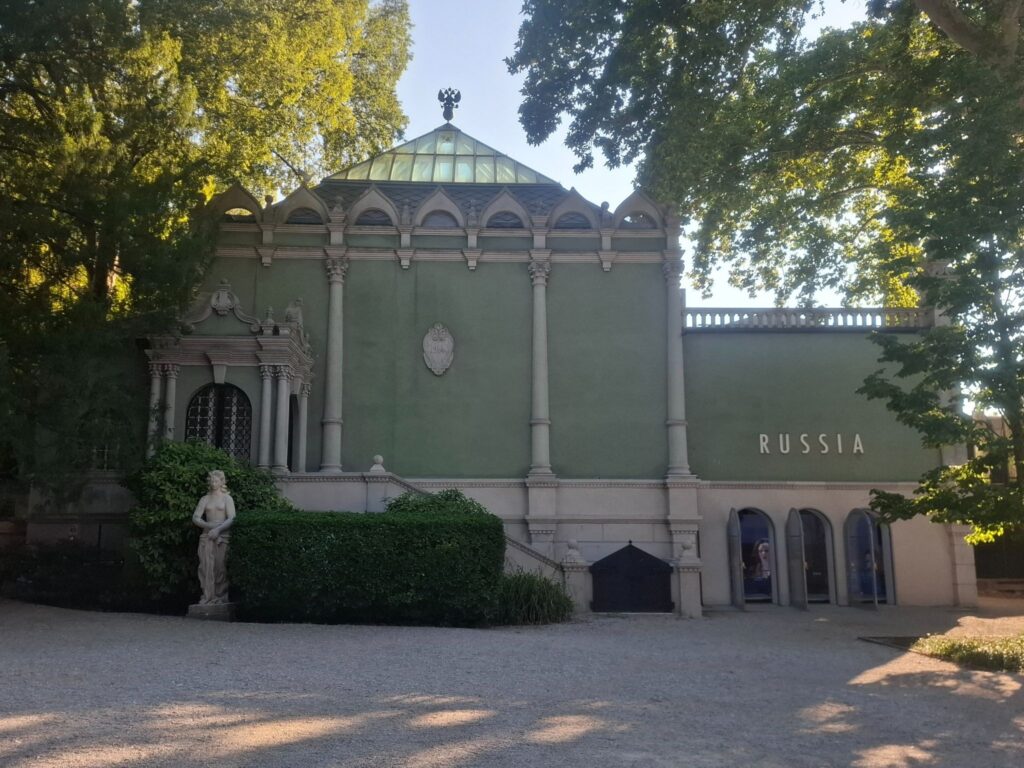
The news of Russia’s participation in the Biennale was confirmed in early March when the list of exhibitors was published. Anastasia Karneeva was appointed curator of the Russian pavilion, which sparked further outrage. She is the daughter of Nikolai Volubyev, a former KGB and FSB general who is currently the deputy director general of Rostec (a Russian company founded by Putin in 2007 that manufactures military equipment used in the war in Ukraine). He has been subject to EU and U.S. sanctions since 2014. Furthermore, the company “Smart Art,” which Karneeva founded together with Sergey Lavrov’s daughter, Ekaterina Vinokurova, is responsible for managing the pavilion.
The exhibition presented in the Russian pavilion was titled “The Tree Is Rooted in the Sky.” It took the form of a multidisciplinary performance focused primarily on music. About 40 artists participated, mainly from Russia, but also from Argentina, Brazil, Mali, and Mexico. The exhibition was intended to showcase the artistic richness of regions not typically associated with major centers of world art. Its goal was also to create a platform for cultural exchange and a space for dialogue. In addition, a floral installation was set up in the pavilion. As stated by Mikhail Shvidkoy, Russia’s former Minister of Culture and the country’s delegate for international cultural exchange, this project is intended to draw attention to the primacy of culture over politics. He also said that Russia is not returning to the Biennale because it never left. This is due to the presence of the country’s pavilion in Venice, which—regardless of whether Moscow is represented—is always located in the Giardini gardens, where the works are displayed.
Buttafuoco announced that Russia, as the owner of the pavilion, may participate in the exhibition whenever it so desires. He also assured that the Biennale remains a space for dialogue, where there is no room for exclusion or censorship. This sparked outrage in artistic and political circles. As early as March 5 (the day after the list of participating countries was announced), the Italian Ministry of Culture issued a statement indicating that this decision had been made despite the government’s opposition. The issue of Russia’s participation also caused divisions in Rome. Deputy Prime Minister, Minister of Infrastructure and Transport, and leader of the Northern League party, Matteo Salvini, strongly supported Russia’s participation in the exhibition. However, Italy’s Minister of Culture, Alessandro Giuli, took a different view; on March 12, he called on Tamara Gregoretti, who serves as the government’s representative on the Biennale’s board, to resign. The reason cited was her failure to inform the ministry about Russia’s return to the event. Gregoretti firmly stated that she does not intend to resign, as she operates within an independent foundation and is therefore not subject to the ministry’s guidelines. On March 13, the Ministry of Culture requested documentation from the Biennale organizers regarding Russia’s participation in the event. The aim was to verify whether this conflicted with the sanctions imposed on Moscow after 2022. After receiving the documents, the government found no irregularities. However, Italian media revealed that only part of the correspondence had been provided, that Russia’s return had been planned as early as the summer of 2025, and that the foundation had actively assisted the Russian side in obtaining visas and reopening the pavilion.
Immediately after the announcement of Russia’s participation in the 61st edition of the Biennale, the Ukrainian side expressed its opposition and outrage. In early March, Ukrainian Foreign Minister Andriy Sybiha and Culture Minister Tetiana Berezhna issued a statement urging the Biennale authorities to reconsider Russia’s participation in the event. They also pointed out that Moscow uses culture as a tool of influence and has been actively destroying Ukraine’s cultural heritage since 2014. According to data, since the start of the full-scale invasion in 2022, 346 artists and 132 media workers have been killed as a result of Russia’s actions. A total of 1,707 cultural heritage sites and 2,503 cultural infrastructure facilities have been damaged or destroyed, of which 558 were completely destroyed. Furthermore, Russia has looted at least 35,482 museum artifacts, and direct losses in the cultural sector have been estimated at over $4.2 billion. However, these figures are from a statement issued on March 9, and as a result of Russian attacks, the scale of destruction and theft continues to grow every day. The Arts Against Aggression International Movement also issued a petition to the Biennale’s organizers condemning Russia’s return. It was signed by over 10,000 people, including many prominent figures from the worlds of art and culture.
Swoje oburzenie wyrazili również przedstawiciele państw Unii Europejskiej. Z inicjatywy łotewskiej minister kultury Agnese Lāce do prezesa oraz zarządu Biennale wysłano list, w którym apelowano o ponowne rozpatrzenie uczestnictwa Rosji. Wskazano w nim na ogromne zniszczenia, jakie spowodowały działania Moskwy na Ukrainie oraz zwrócono uwagę na fakt, że zadaniem instytucji kultury jest nie tylko promowanie sztuki, ale również bycie wzorem moralnym. Pod protestem podpisali się przedstawiciele 22 państw europejskich (Austrii, Belgii, Bułgarii, Chorwacji, Danii, Estonii, Finlandii, Francji, Niemiec, Grecji, Hiszpanii, Irlandii, Litwy, Łotwy, Luksemburga, Holandii, Norwegii, Polski, Portugalii, Rumunii, Szwecji i Ukrainy). Kopię listu otrzymał także włoski minister kultury. Przedstawiciele Unii Europejskiej również odnieśli się do powrotu Rosji na wydarzenie. Na początku marca wiceprzewodnicząca Komisji Europejskiej Henna Virkkunen i komisarz UE ds. sprawiedliwości międzypokoleniowej, młodzieży, kultury i sportu Glenn Micallef wydali oświadczenie, w którym stanowczo potępili decyzję fundacji o ponownym otwarciu rosyjskiego pawilonu. 27 marca Komisja Europejska zwróciła się do stałego przedstawiciela Włoch w Brukseli z prośbą o informacje dotyczące powrotu Rosji na Biennale, aby sprawdzić zgodność tych działań z sankcjami nałożonymi na Moskwę. Natomiast 10 kwietnia Komisja oznajmiła swoje plany dotyczące zawieszenia dotacji Biennale w wysokości 2 mln euro. Organizatorzy wydarzenia mieli 30 dni na wytłumaczenie swojej decyzji, ale nie zdołali obronić swojego stanowiska. W wyniku tego Komisja Europejska oficjalnie zleciła w lipcu Europejskiej Agencji Wykonawczej ds. Edukacji i Kultury (EACEA) wstrzymanie i cofnięcie unijnego finansowania wystawy. Co więcej kwestię powrotu Rosji poruszono także w czasie spotkania ministrów spraw zagranicznych państw UE w Luksemburgu 21 kwietnia tego roku, a odebranie finansowania zapowiedziała wcześniej Kaja Kallas.
Israel
The artistic community’s opposition also concerned Israel’s participation in this year’s edition of the Biennale. As early as late October, the Art Not Genocide Alliance (ANGA) had demanded that Israel be excluded from the event. This was in connection with the genocide Israel is committing in the Gaza Strip and the destruction of Palestinian cultural heritage sites. On March 17, 2026, ANGA sent a letter to the president and board of the Biennale, in which it once again opposed the Jewish state’s participation in the exhibition. It was signed by 240 artists, curators, and staff members associated with the event’s organization. Some of them signed anonymously to protect themselves from any potential consequences.
The Biennale authorities have consistently defended their position, citing neutrality and a desire for dialogue. Additionally, the event’s board stated that they cannot exclude any country recognized internationally by Italy from participating in the exhibition, especially if it has its own pavilion in Venice (as is the case with Russia and Israel, among others).
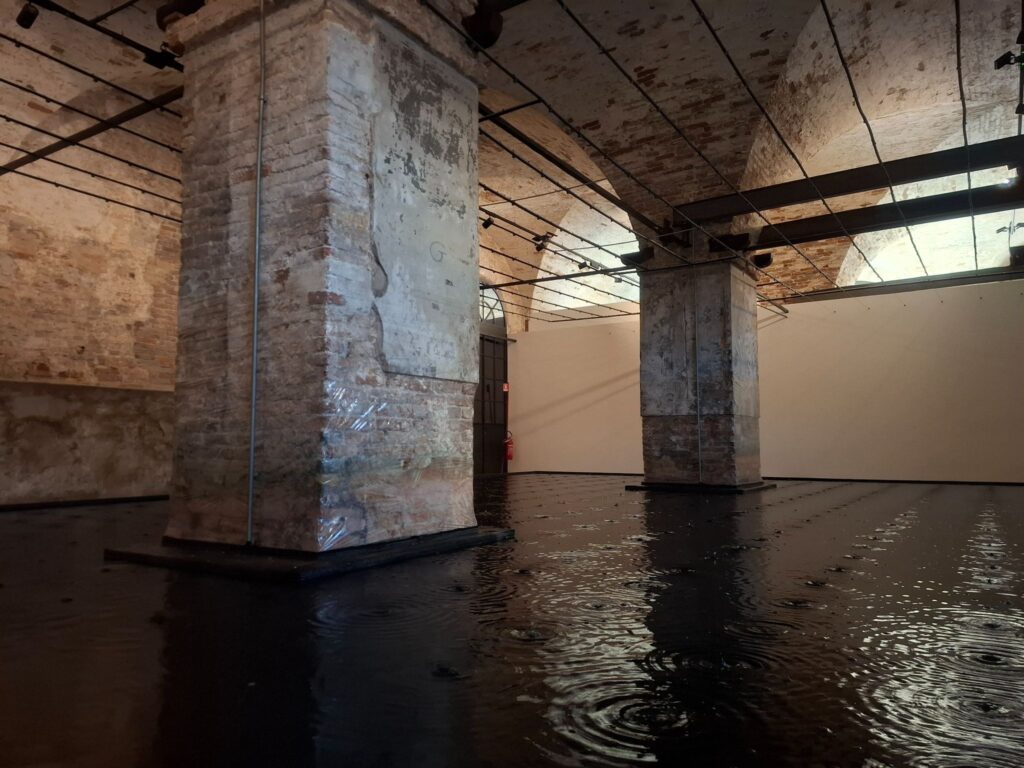
This year, the exhibition by Belu-Simion Fainar, an artist representing Israel, can be seen at the Arsenale rather than in the national pavilion. This is due to ongoing renovations, though some have pointed to the organizers’ efforts to ensure that country’s presence at the event. Fainar’s work itself, in the context of the ongoing genocide in the Gaza Strip, can be perceived as a paradox. The work “The Rose of Nothingness,” presented as part of the Israeli exhibition at the Biennale, consists of a pool filled with black water into which drops fall from an installation above. This is meant to symbolize the coming together of people from different cultures. The artist was reportedly inspired by the work of Paul Celan, a poet of Jewish descent who survived the atrocities of the Holocaust. The work refers in particular to the poem “Death Fugue” (Todesfuge), in which the author describes the barbarism of the Nazis and creates a vision of black milk. According to the description on the Biennale’s website, it is a liquid that “unites life and death, matter and spirit.” According to the artist, “The Rose of Nothingness” is intended to be apolitical, and its purpose is to encourage visitors to pause for a moment and reflect. However, the sprinkler system from which water drips was created by Netafim for agricultural use in desert areas. The same company has been accused of supplying its irrigation systems to illegal Israeli settlements in the West Bank.
The pivotal moment
Although controversy surrounded this year’s Biennale from the very beginning, the period of just under three weeks leading up to the exhibition’s official opening proved to be the most turbulent. On April 22, the international jury announced that it would not consider works representing countries whose leaders “are currently accused of crimes against humanity by the International Criminal Court.” In a statement, the five-member panel of experts tasked with awarding the prizes justified its decision by citing the responsibility to curate the exhibition in accordance with Koyo Kouoh’s vision and to defend human rights. Although no country was explicitly named, according to the jury’s decision, the delegations from Russia (V. Putin has been subject to an ICC arrest warrant since 2023) and Israel (in 2024, the ICC issued an arrest warrant for B. Netanyahu) would be barred from winning the Golden Lion.
Many Biennale participants supported the jury’s decision, though it also drew criticism. In a post published on the X portal, Israel’s Ministry of Foreign Affairs described the panel of experts’ stance as “a stain on the art world.” According to the ministry, the jury’s decision was politically motivated, and as a result, the event had transformed from a venue for free artistic expression into a forum for anti-Israel propaganda. An artist representing Israel also expressed his outrage. Belu-Simiona Fainaru, together with his lawyer, reportedly filed a notice of intent to sue with the Biennale organizers, the Italian Ministry of Culture, and the office of the Italian Prime Minister. The reasons for taking legal action were reportedly discrimination based on nationality and anti-Semitism, which were linked to Israel’s exclusion from eligibility for the Golden Lion. The Italian Minister of Culture reportedly spoke with the artist by phone, offering his support and pledging to combat all forms of discrimination. On April 25, Alessandro Giuli also announced that he would not be present during the pre-opening and the opening ceremony of the event. This was due to Russia being allowed to participate in the exhibition. The Biennale’s board, however, distanced itself from the jury’s decision, stating that the jury carries out its duties independently and with freedom of expression.
On April 29, the Italian Ministry of Culture sent inspectors to Venice to gather full information regarding Russia’s participation in the exhibition. It was also announced in late April that the Russian pavilion would not be open to the public. The exhibition could only be viewed during events organized for the media and art critics prior to the official opening. On May 9, the pavilion was closed, but special screens were installed in the building’s windows to display recordings of the performances and events that took place during the pre-opening.
On April 30, the jury resigned. Solange Farkas (chair of the jury), Zoe Butt, Elvira Dyangani Ose, Marta Kuzma, and Giovanna Zapperi made this decision in light of the previous statement. Undoubtedly, it was also the result of intense pressure from the parties involved in the dispute and the inability to resolve it in a neutral manner. In response to the experts’ resignation, the Biennale’s board announced the postponement of the awards ceremony from May 9 (the exhibition’s opening day) to November 22 (the event’s final day). It also announced that the prestigious Golden Lions would be replaced by two Visitors’ Lions. The awards will be given to the best participant in the main exhibition and the best national pavilion. Visitors will decide who receives the award. Anyone who purchases a ticket to visit the Arsenale and the Giardini—and whose visit is verified by the ticketing system—will be able to cast a vote for one candidate in each of the two categories. As emphasized in a statement on the Biennale’s website, any country participating in the event may compete for the Visitors’ Lion. This was justified as an initiative aligned with the Biennale’s values, which include dialogue, openness, equality, and the fight against exclusion.
Iran withdrew from the exhibition just a few days before its opening. On May 4, this information was published on the Biennale’s website, though no reason was given for the decision. However, it did not come as a surprise to everyone. Iran had not even selected its artist, and tensions in the Middle East remained high. Transporting the artwork to Venice would also have been problematic given the current situation in the country.
From May 6–8, a pre-opening of the exhibition took place for the media and select figures from the art world. This was a time of numerous protests, though they had begun even before the event opened to invited guests. At noon on May 5, the Solidarity Drone Chorus took place in front of the Giardini gardens. About 60 artists and Biennale participants hummed the song “Drone” by Ahmed Muin, a music teacher from Gaza. Many of them wore T-shirts bearing the names of Palestinian artists killed during the conflict. This initiative was intended to express solidarity with Palestine and to protest Israel’s participation in the event. The Solidarity Drone Chorus also took place every day during the pre-opening at various locations associated with the Biennale. On May 6, the group Art Not Genocide Alliance organized a demonstration in front of this year’s Israeli pavilion at the Arsenale. About 200 people took part in the protest against Israel’s participation in the exhibition, chanting slogans criticizing “artwashing” and the actions of the Biennale’s board. During the demonstration, the exhibition was closed, and security personnel guarded the entrances. On the same day, activists from the Russian group Pussy Riot and the Ukrainian feminist movement FEMEN organized a protest in the Giardini gardens against Russia’s participation in the event. As a result, the Russian pavilion was closed and cordoned off by police. A group of about 50 people wearing their signature pink balaclavas set off pink, blue, and yellow flares, listened to punk music, and chanted slogans condemning Russia’s actions. Although some of the activists attempted to enter the pavilion, they were stopped by uniformed officers. Both protests ended without any confrontation with the police. On the first day of the pre-opening, a march organized by representatives of the Baltic states also took place. It proceeded from the Lithuanian pavilion through the Arsenal—where the Latvian pavilion is located—to the Estonian pavilion, and was intended to demonstrate solidarity with Ukraine. On the same day, following the ceremonial inauguration of the Polish pavilion, a meeting was held there between the culture ministers of Poland, Lithuania, Latvia, Estonia, Moldova, and Ukraine. Together, they issued a statement condemning Russia’s participation in the exhibition and expressing support for Kyiv.
On May 7, the group Pussy Riot staged a protest in the center of Venice, including outside the Palazzo Ca’ Giustinian, which houses the Biennale’s administrative headquarters. The aim of the protest was to arrange a meeting between activist Nadezhda Tolokonnikova and the foundation’s president, Pietrangelo Buttafuoco. Although she was invited inside for a conversation with the organizers, Buttafuoco was not there.
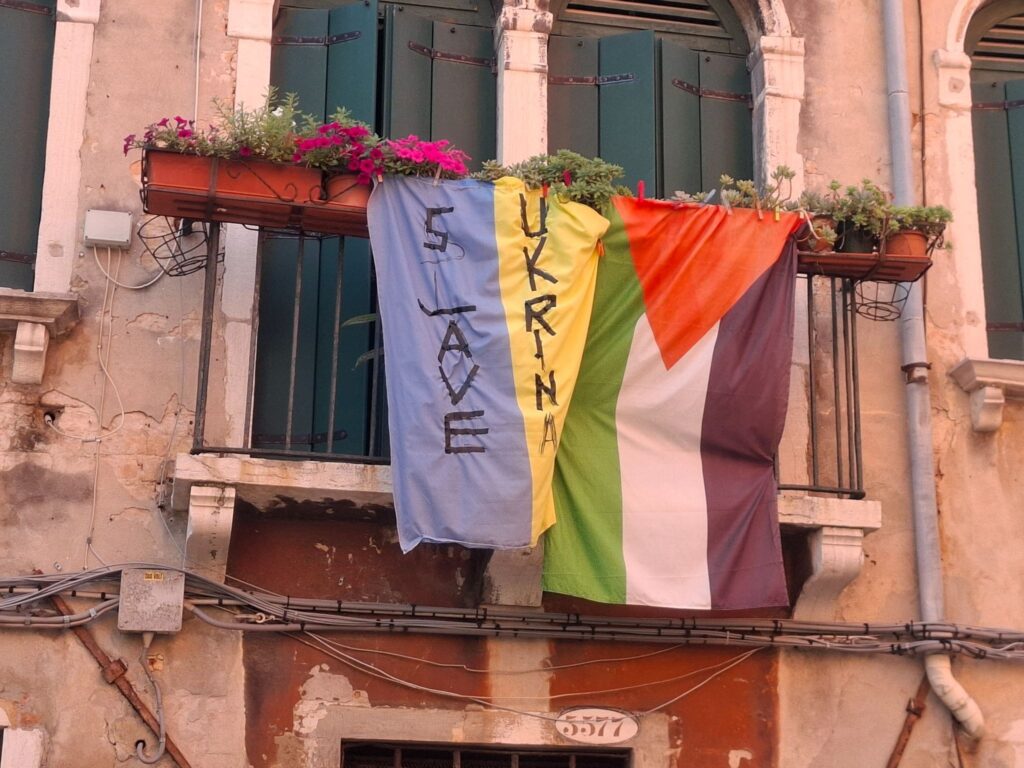
On May 8, a 24-hour strike and a series of protests organized by the Art Not Genocide Alliance and Italian labor unions took place. Their aim was to express opposition to Israel’s participation in the Biennale and solidarity with Palestine. Attention was also drawn to the defense of the rights of workers in the culture and arts sectors. On that day, approximately 20 national pavilions were closed for the entire day or for a specific period of time. Many of them displayed Palestinian flags and posters announcing the strike, and artists participating in the main exhibition incorporated references to Palestine into their works. At 4:30 p.m., a pro-Palestinian march also took place, in which, according to ANSA, approximately 2,000 people participated (according to police, approximately 1,000). The march proceeded from Via Garibaldi—one of Venice’s main streets—toward the Arsenal. Numerous speeches were delivered during the march, and participants carried banners with pro-Palestinian slogans. Clashes with police also occurred, but no one was injured. It was one of the largest demonstrations in the Biennale’s more than 130-year history. On the same day, Italian Deputy Prime Minister Matteo Salvini visited the event. As he stated, his visit was intended to put an end to the controversies surrounding the event and to pay tribute to art and Venice. He also visited the Russian pavilion, where he was warmly welcomed by curator Anastasia Karneeva.
On May 9, the Biennale opened to the public. As previously announced, there was no official opening ceremony, and for the first time in the event’s history, the Italian Minister of Culture did not attend the opening of the Italian pavilion and exhibition. However, he was not the only one. Many officials and ministers of culture from countries presenting their works did not come to Venice to show their solidarity with Ukraine and Palestine. On that day, further acts of protest against the foundation’s decision also took place. Although the Russian pavilion was closed, the sound of an air raid siren rang out in front of it. On opening day, 52 artists from the main exhibition and 16 national pavilions withdrew from the competition for the Visitors’ Lions, as announced in a letter addressed to the Biennale Foundation. In the days that followed, the number of people who wished to show their solidarity with the jury in this way grew. Although many participants withdrew from the event, visitors were able to vote for their works as soon as voting opened in mid-May. In response, a total of 67 artists from the curated exhibition and representatives of 39 national pavilions sent a second letter to the La Biennale di Venezia Foundation on May 20. In it, they objected to actions that were seen as disregarding the jury’s decision and demanded that the names of the signatories be removed from all materials related to the Visitors’ Lions. The signatories also demanded that voting on their works be blocked and that all votes already cast for them be invalidated. However, the Biennale Foundation did not respond to either letter. As a result, on June 3, the May 20 letter was made public, and the artists announced that they would consider further actions, including legal steps.
Australia
On February 7, 2025, Creative Australia (the government agency responsible for funding and promoting the arts and managing the Australian pavilion in the Giardini) announced that the country would be represented in Venice by Lebanese-Australian artist Khaled Sabsabi and curator Michael Dagostino. Five days later, The Australian published an article in which the authors expressed their concerns about this decision and drew attention to the artist’s previous works. These primarily include the film YOU (2007), featuring Hezbollah leader Hassan Nasrallah, and Thank You Very Much (2006), which contains footage from the September 11, 2001, attacks. The article suggested that these works might promote terrorism and portray it in a positive light, and it also highlighted Sabsabi’s anti-Israel stance. The issue of the artist’s participation was also raised during a session of the Australian Parliament on February 14. At that time, Senator Claire Chandler asked Penny Wong, the Minister for Foreign Affairs, why, in the face of rising anti-Semitism, Australian authorities were allowing an artist who portrays a terrorist to represent the country at the Biennale. The government representative stated that she was not familiar with the details of Sabsabi’s previous works. That same day, the Minister for the Arts called the CEO of Creative Australia to inquire about the issues raised in the Senate. The institution’s board was to convene a meeting that evening, at which a unanimous decision was made to withdraw the nominations of the artist and the curator.
This sparked widespread controversy and opposition from the art community. Several members of Creative Australia resigned from their positions, and the country’s potential representatives at the Biennale announced that they would not participate in the event if selected. The decision was also condemned by Archie Moore and Ellie Buttrose, who received the Golden Lion for Best National Pavilion in 2024. Criticism was also voiced regarding the censorship of artists and the decisive influence of politicians over cultural events. In response to the withdrawal of Sabsabi’s nomination, Koyo Kouoh invited him to participate in a curated exhibition. Politicians, including Senator Sarah Hanson-Young, also expressed their outrage, with Hanson-Young stating that Creative Australia’s decision had brought “international shame” upon the country. The organization’s CEO, Adrian Collette, defended the board’s decision during a hearing before the Senate Budget Estimates Committee, citing the artist’s previous works, which he believed could provoke divisions and exacerbate anti-Semitic attitudes.
In response to widespread criticism from the artistic community, an independent review of Creative Australia’s decision was commissioned from the consulting firm Blackhall & Pearl. The resulting report pointed to a lack of transparency and an excessive influence of media and political pressure on the withdrawal of Khaled Sabsabi and Michael Dagostino’s nominations. In July 2025, the institution officially reinstated them as Australia’s representatives at the Biennale. Creative Australia also apologized to the artist and curator and announced changes to the selection procedures for future representatives. This decision was met with enthusiasm, as well as the approval of the Minister of the Arts. Ultimately, Sabsabi’s works can be viewed this year both in the Australian Pavilion in the Giardini and in the curated exhibition at the Arsenale.
United States
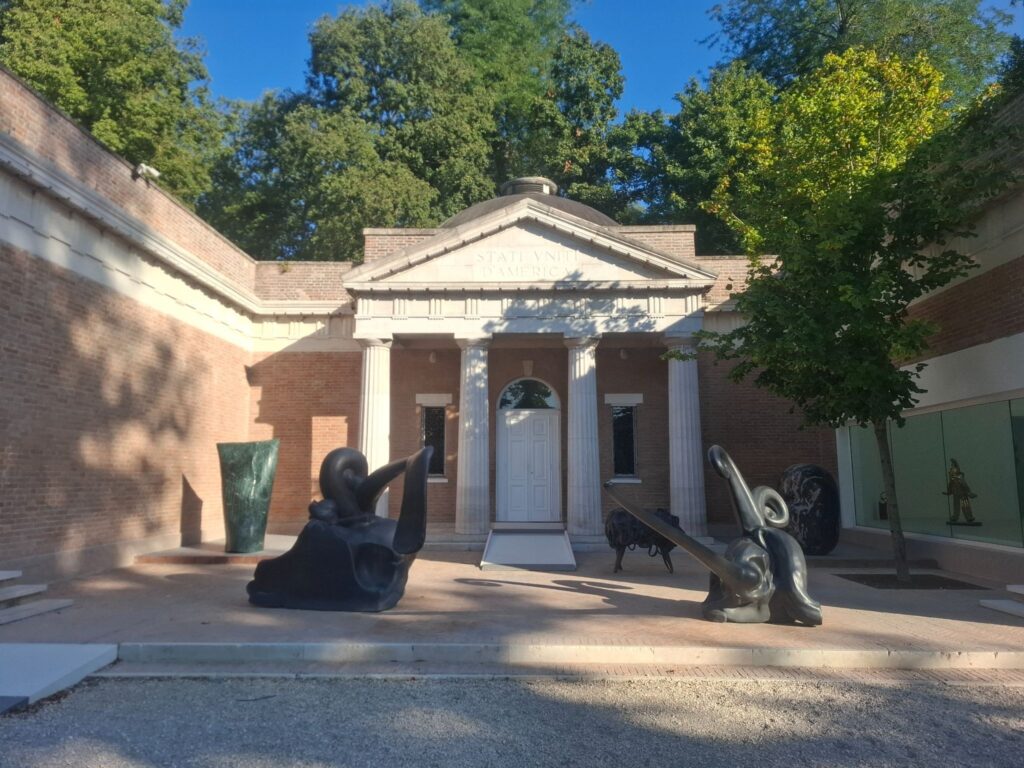
The United States also faced controversy during the selection process for its pavilion. In previous years, the artist representing the U.S. in Venice was selected by the National Endowment for the Arts (NEA), an independent government agency responsible for supporting and funding the arts. However, this year the State Department took over this task, which entailed a drastic reduction in NEA funding. According to the guidelines of the Donald Trump administration, the works were to present traditional American values, but at the same time, “the implementation of any program promoting diversity, equality, and inclusivity” was prohibited. Responsibility for the U.S. pavilion in the Giardini was entrusted to the American Arts Conservancy, a nonprofit organization led by Jenni Parido. Interestingly, she has no background in the art world and previously ran a high-end pet food store in Florida. There have been claims that she received this position thanks to Erin Scavino, the head of the U.S. “Art in Embassy” program and the wife of a close associate of President Trump.
The selection of an artist to represent the United States at the Biennale proved to be a problem for the American side. Several candidates declined to participate in the event due to financial risks and concerns about future associations with the Donald Trump administration. Ultimately, the artist was selected later than usual, and the chosen artist turned out to be Alma Allen. The selection of the American sculptor came as a surprise, as he was not a well-known figure in the art world. His exhibition, titled “Call Me the Breeze,” features approximately 25 sculptures made of stone, bronze, and wood, which focus on the relationship between humans and nature as well as geological processes. However, the works in the pavilion drew criticism from art experts, who pointed out a lack of creativity and even compared the sculptures to decorations in hotel lobbies.
In light of the overwhelmingly negative comments about Allen’s works, the “Helter Skelter” exhibition at the Prada Foundation was dubbed the unofficial U.S. pavilion. The exhibition features over 50 works by Arthur Jafa and Richard Prince and explores themes related to racial tensions, contradictions, and myths in American culture. In contrast to the official U.S. representation, the exhibition has received positive reviews.
Most importantly, the United States’ participation in this year’s Biennale is also controversial. Many people have pointed out that the U.S. attacked Iran alongside Israel and is therefore jointly responsible for the conflict in the Middle East. On April 3, more than 70 artists and curators associated with the event signed a letter demanding that Russia, Israel, and the United States be excluded from the exhibition. They emphasized the need to protect human rights and called on the Biennale’s board to uphold curator Koyo Kouoh’s vision. Respected British artist Anish Kapoor also stated that the U.S. should be excluded from the event for its “repugnant politics of hatred” and “constant incitement to war.”
South Africa
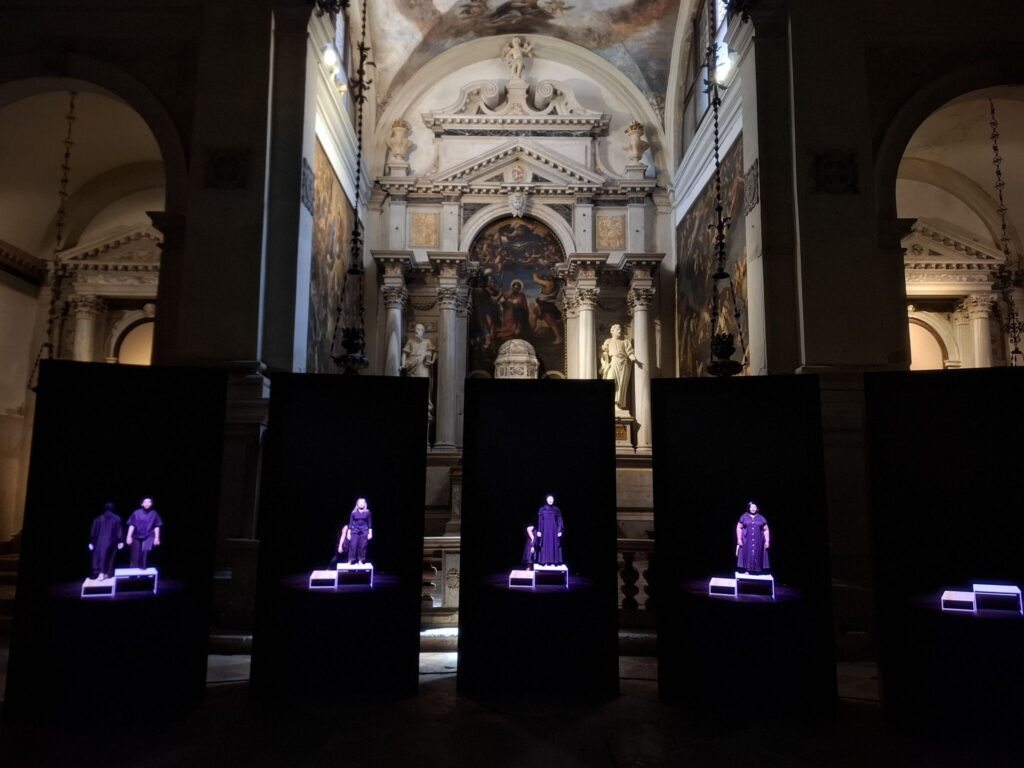
In December 2025, Art Periodic, an independent organization responsible for selecting South Africa’s representative to the Biennale, announced that Gabrielle Goliath would be the representative with her work *Elegia* (*Elegy*). The work was intended to be an extension of a long-standing series of works dedicated to the memory of victims of violence, social inequality, and human rights violations. It consisted of screens on which seven opera singers took the stage one after another. The artists collectively sustain a single high note for an hour; when one singer runs out of breath, she steps down from the platform, and the next one takes her place. The work was intended to serve as a mourning ritual and to commemorate a South African student murdered in 2015, the Nama women of Namibia killed by German colonizers in the early 20th century, as well as the Palestinian poet Hiba Abu Nada, who was killed in the Gaza Strip as a result of an Israeli attack in October 2023.
That same month, South Africa’s Minister of Sport, Arts, and Culture, Gayton McKenzie, described the work as “highly controversial and linked to an ongoing international conflict that is causing significant tensions.” He also reportedly demanded that the artist remove references to the Israeli-Palestinian conflict from the work. Goliath refused, prompting McKenzie to cancel the contract for the installation of the work in the South African pavilion on January 2. This occurred one week before the deadline for selecting the work that was to represent the country in Venice.
This move sparked outrage in the art community, which accused the minister of political interference and censorship. On January 8, members of Art Periodic responsible for selecting Goliath’s work published an open letter in which they defended their decision and opposed any measures restricting artistic freedom. In response to numerous attacks, McKenzie issued a statement on January 10 in which he emphasized that the work presented at the Biennale should promote South Africa and rejected accusations of censorship. He also announced that he had terminated his collaboration with Art Periodic because he believed there was a risk that works presented in the national pavilion could be exploited by a foreign state to further its own political agenda.
It is worth noting that in 2023, the South African government filed a lawsuit against Israel with the International Court of Justice, accusing it of genocide and violations of international law. McKenzie, unlike the country’s authorities, holds pro-Israel views. He defended Israel by stating that genocide is not taking place in the Gaza Strip and opposed the exclusion of that country from cultural and sporting events. He also announced that he would renew and strengthen relations between South Africa and Israel if he wins the 2029 election.
Goliath appealed the minister’s decision to the country’s president, Cyril Ramaphosa, and to South Africa’s Department of International Relations and Cooperation. She also filed a lawsuit with the Supreme Court, accusing McKenzie of acting unlawfully and violating freedom of expression. However, the lawsuit was dismissed a few hours before the deadline for submitting applications to participate in the Biennale. As a result, her work could not be resubmitted to represent the country in Venice.
Following numerous protests and controversies, South Africa announced in February that it would not participate in the 61st edition of the Biennale. A month later, it was announced that *Goliath* would be exhibited in Venice, thanks to the efforts of the Bertha Foundation and the London-based cultural institution Ibraaz. Elegy was on display from early May through late July at the Church of Sant’Antonin in the Castello district. Interestingly, the work was not a Biennale-related event but an independent exhibition.
Qatar
Qatar is making its debut at the Biennale this year, but it has already been accorded a tremendous honor. It has been granted permission to build its pavilion in the Giardini gardens. It has thus become the first country from the Persian Gulf region to have its own exhibition space in Venice and the first country in 30 years to receive permission to build one. The last country to open a permanent pavilion in the Giardini was South Korea in 1995.
The Comune di Venezia officially approved the plan to build the Qatari pavilion during a city council session, at which it was also announced that the city had accepted a $50 million donation from Qatar. This development sparked numerous comments suggesting that Qatar had “bought its way in” to the Biennale. Some critics argued that this decision is part of a broader strategy by the country, which has been investing in culture and sporting events for years to improve its image on the international stage and strengthen its soft power.
According to the Israeli news site Ynetnews, Qatar was the country Minister Gayton McKenzie was referring to in his January 10 statement. Although he did not name any country, the website claimed that Qatar was responsible for promoting an anti-Israel narrative at the Biennale. According to information published by the news site, Qatar had also reportedly committed to purchasing works displayed in the South African pavilion because they promoted a critical message toward Israel. It should be emphasized, however, that these reports have not been confirmed by the authorities of either South Africa or Qatar, and the article itself was based primarily on anonymous diplomatic sources from South Africa.
Somalia
Although Somalia is participating in the Biennale for the first time, its debut has already sparked controversy. In April, the Somali Arts Foundation (SAF), along with three other arts institutions and several artists, issued a statement criticizing the exhibition for failing to include artists living in Somalia. All three individuals representing the country at the Biennale belong to the Somali diaspora and create their work outside the country’s borders. Furthermore, the statement accused the organizers of conducting the pavilion’s preparation process without meaningful consultation with the local art community, and claimed that the exhibition does not speak on behalf of Somali artists.
Shortly thereafter, the Somali queer art collective Warbixinta Cidda published a statement on social media criticizing the selection of Fabio Scrivanti as co-curator of the pavilion. The statement highlighted the country’s history as a former Italian colony, and the appointment of an Italian to such an important position was seen as an echo of colonialism. The collective also demanded that Scrivanti be removed from his role as co-curator.
Subsequently, an open letter to the organizers of the Somali pavilion was published in the media. It alleged that those responsible for organizing the exhibition had used threats, intimidation, and pressure against artists who criticized their actions. The statement also expressed solidarity with Gabrielle Goliath and criticized the Biennale’s board for its anti-Palestinian actions. It also set forth five demands, including the removal of the Italian co-curator, a public response to the criticism, and an end to threats against individuals and groups critical of the organizers’ actions. A boycott of the pavilion was announced should these demands not be met.
Summary
The 61st Biennale will undeniably go down in history as one of the most turbulent editions in the event’s history. It was dominated by political disputes, protests, and numerous controversies, thereby pushing the works presented in Venice into the background. Although the main exhibition was realized in accordance with the vision of the late curator, the event itself—intended to encourage pause and reflection—was overshadowed by high-profile political scandals. Thus, this year’s Biennale, meant to honor her work in support of art and culture, became an arena for conflict between opposing sides.
A major problem facing this year’s Biennale is “artwashing.” Russia and Israel undoubtedly want to assert their presence on the international stage, but also to whitewash their image through art. For Moscow, the opportunity to return to the exhibition was undoubtedly an excellent chance to assert its position following numerous exclusions from cultural and sporting events since 2022. Russia’s presence at such a prestigious event could prompt other countries and organizations to make concessions toward it. For Ukraine, this would undermine its efforts to isolate the aggressor and weaken Kyiv’s position in the war. For Israel, participation in the Biennale may be an attempt to divert attention from the situation in the Gaza Strip or to cultivate the image of a democratic state active in the cultural sphere. For Qatar, participation in this event may also be an attempt to rebuild its reputation, which has been tarnished by human rights violations.
The mere presence of Russia and Israel at the exhibition may be a sign of legitimization of their actions, but this would be further underscored if either of them were to win the grand prize. The new method of having visitors vote for national pavilions carries the risk of result manipulation. Russia is known for carrying out cyberattacks, which could also affect the Biennale’s servers. Israel, on the other hand, has already conducted multimillion-dollar mobilization and advertising campaigns encouraging people to vote for its representatives in the Eurovision Song Contest in recent years. A similar situation could arise in the case of the Venice exhibition, although so far no such activities have been detected on the part of Tel Aviv. If Russia or Israel wins the Visitors’ Lion, it could be perceived as a symbol of support for that country and, by extension, as undermining the support given to Ukraine and Palestine. This could be exacerbated by the withdrawal of popular and respected artists from the competition for the main prize. Delegations from, among others, the Nordic countries, Poland, and Austria—whose pavilions have been well-received by critics and frequently featured in the media—have opted out of competing for the Lion of the Audience. This gesture undoubtedly demonstrates solidarity with the jury’s decision and opposes the participation of aggressor states in the event, but it may also inadvertently lead to their victory. Less competition could work in their favor, especially if countries with recognizable exhibitions and strong visitor support choose not to participate.
This year’s Biennale also demonstrated the immense power of art and the artistic community. When the organizers decided to allow Russia and Israel to participate in the exhibition, the artistic community responded with firm and widespread opposition. Numerous boycotts, protests, and withdrawals demonstrated that there is no place for propaganda and artwashing in the art world. Foundations and institutions have repeatedly shown their resistance to censorship by organizing their own events. Examples of this include the exhibition of the work Elegy in Venice after it was rejected by the South African minister, as well as the exhibition “Gaza – No Words – See the Exhibit,” which presents the realities of life in Gaza and the brutality of Israel’s actions. This demonstrates that contemporary artists and institutions are capable of effectively uniting in defense of their values.
This year’s edition of the Biennale demonstrated that the worlds of art and politics are closely intertwined. Given the controversies surrounding the exhibition, it is also difficult to argue that cultural institutions should remain neutral. It is precisely these institutions that convey and present specific values; therefore, it is unreasonable to expect them not to take a specific stance in the face of conflicts and divisions. Although the events in Venice sparked a great deal of emotion and controversy, it is worth believing that they will serve as a valuable lesson for the organizers. Thanks to this, future editions of the Biennale will be able to become, above all, a celebration of art and a space for dialogue, rather than a source of division.
Bibliography:
https://www.labiennale.org/en/art/2026
https://www.afar.com/magazine/everything-you-need-to-know-about-the-2019-venice-biennale
https://www.artnews.com/feature/what-is-venice-biennale-1234703040
https://universes.art/en/venice-biennale/2026
https://culture.pl/pl/artykul/biennale-w-wenecji-moralne-niepokoje-w-tonacji-moll
https://www.dw.com/en/venice-biennale-in-crisis-the-controversies-explained/a-76807499
https://oko.press/corka-lawrowa-i-corka-generala-fsb-pawilon-rosyjski-biennale-wenecji
https://www.ilgiornale.it/news/politica/cos-violenza-diventa-normale-2636814.html
https://www.gov.pl/web/kultura/protestujemy-przeciwko-udzialowi-rosji-w-biennale-w-wenecji
https://www.consilium.europa.eu/pl/meetings/fac/2026/04/21
https://edition.cnn.com/2026/05/01/style/venice-biennale-russia-israel-controversy
https://hyperallergic.com/over-6-000-sign-letter-opposing-russias-venice-biennale-pavilion
https://www.labiennale.org/en/art/2026/israel
https://hyperallergic.com/israels-plan-to-artwash-genocide-at-the-venice-biennale
https://wccalliance.org/making-apartheid-bloom
https://www.artnews.com/art-news/news/russian-pavilion-2026-venice-biennale-return-1234775410
https://wiadomosci.wp.pl/izrael-wykluczony-z-biennale-ostra-reakcja-msz-7279883541051392a
https://artreview.com/venice-golden-lion-jury-wont-consider-russia-and-israel
https://artreview.com/israeli-pavilion-artist-issued-legal-warnings-before-biennale-jury-resignation
https://www.theartnewspaper.com/2026/05/05/iran-will-not-participate-2026-venice-biennale
https://www.labiennale.org/en/news/islamic-republic-iran-will-not-participate
https://www.theartnewspaper.com/2026/05/06/major-protests-take-place-at-venice-biennale-previews
https://www.theartnewspaper.com/2026/05/06/major-protests-take-place-at-venice-biennale-previews
https://apnews.com/article/italy-biennale-protest-russia-9ea82ea4d6e73949deb66e3fbea17348
https://ocula.com/magazine/art-news/israeli-pavilion-protest-venice-strike
https://ocula.com/magazine/art-news/russia-protests-venice-biennale-2026-pussy-riot
https://pl.vot-tak.tv/93127141/biennale-rosja-protest
https://metropolism.com/nl/feature/frustrating-the-infrastructure-the-venice-biennale-2026-strike
https://www.pap.pl/aktualnosci/protesty-przeciw-udzialowi-izraela-w-biennale-sztuki-w-wenecji-wideo
https://metropolism.com/nl/feature/frustrating-the-infrastructure-the-venice-biennale-2026-strike
https://www.abc.net.au/news/2025-02-19/creative-australia-venice-biennale-khaled-sabsabi/104952110
https://www.abc.net.au/news/2025-07-02/khaled-sabsabi-venice-biennale-reinstated/105487220
https://hyperallergic.com/south-africa-axes-venice-biennale-proposal-centering-gaza-victims
https://ocula.com/magazine/art-news/south-african-pavilion-artist-defies-venice
https://www.dsac.gov.za/Statement%20on%20Venice%20Biennale%20Decision
https://www.theartjournal.com/articles/qatar-bought-its-way-to-the-venice-biennale-does-it-matter
https://www.ynetnews.com/article/hkj311amhze
All photos are from the author’s private archive.