
What happened?
It all began with the narrative put forward by the coalition government of ANO, the Motorists’ Party, and the SPD, which made it clear that it had the final say regarding the Czech Republic’s representation at the NATO summit in Ankara. The goal of the Czech delegation is to explain to Donald Trump the reasons behind the disruptions in defense funding (the Czech Republic has agreed to increase spending to 3.5% of GDP by 2035). At that time, the pledged 24 billion crowns (approximately 1 billion euros) for defense were still missing for the current calendar year. According to Babiš, he and his government have a better grasp of the defense budget and strategy for the coming years, while the president most often acts as a critic abroad—according to the prime minister, he could afford to do so because the government did not have to explain itself or defend its decisions. Pavel viewed these reports as an attempt at blackmail and could not understand this attitude. He believed there was no reason to break the 27-year-old tradition of both the president and the prime minister representing the Czech Republic at NATO summits. If this were to happen, it would set a precedent similar to the Anglo-Saxon model, which could be used to defend similar decisions in the future. As a result, on April 8, a letter was drafted calling on the prime minister to provide a detailed explanation of the Czech government’s position, expressing the president’s desire to attend the summit, and emphasizing his constitutional rights as set forth in Article 63 of the Constitution of the Czech Republic. Thus began a two-month tug-of-war over the primacy of information dissemination, international and domestic authority in appointing delegations, and the threat of a lawsuit over presidential authority. Analyzing Maria Zámečníková’s interview for Irozhlas.cz on April 13, 2026, we can arrive at the accurate conclusion that both sides have valid points, and the difficulty lies in finding a middle ground. Neither side will be willing to back down in the face of constitutional chaos, where roles have not been clearly defined. It is true that, like the President of Poland, his Czech counterpart lacks the authority to conduct an independent foreign policy. This does not, however, preclude him from having his own opinion; nevertheless, when making statements on behalf of the entire nation, he must be in consensus with the government. Zámečníková points to an attempt to resolve this conflict in 2015, which involved amending the Czech Constitution: “Article 67—which states that the government is the highest executive authority—would add that domestic and foreign policy decisions are made within the framework of the executive branch.” However, the amendment was not adopted. This therefore allows a relatively powerful president to remain entrenched in traditionalism.
June 22 and a New Phase of the Conflict
Ultimately, following the threat of a lawsuit challenging his authority on May 21 and the rescheduling of government meetings, Petr Pavel will indeed lead the Czech delegation to the UN summit in September on June 8, but on June 22 he was not included on the list of Czech representatives traveling to Ankara. Babiš ultimately did not change his position, but only slightly modified its meaning. He said that the president had been the leader of the previous administration on foreign affairs, and now the government wants to be more active and independent in taking responsibility for its own policies. He also stated: “It is not true that this would mean his absence or that we would forbid him from doing anything,” referring to the decision of June 8. Petr Macinka, the foreign minister designated to travel with Babiš, echoed his argument regarding autonomy. It is worth noting that, in reality, it is the leader of the Motoristé sobě party who has been the driving force behind such a harsh stance against Pavel from the very beginning of the conflict. This is most likely an act of revenge for the refusal to appoint Filip Turek as Minister of the Environment. The opposition’s reaction was easy to predict: for the ODS, the commander-in-chief of the armed forces must go; the leader of the Pirates, Zdeněk Hřib, considers the prime minister’s decision an act of submission to Macinka’s vindictive behavior. Furthermore, none of the opposition representatives accepted the trampling of the tradition of bilateral representation. President Pavel’s response was not long in coming:
Poslechněte si mé vyjádření k podání návrhu na zahájení kompetenčního sporu u Ústavního soudu. pic.twitter.com/lLdeB1nuRI
— Petr Pavel (@prezidentpavel) June 23, 2026
Rozhodnutí pana prezidenta podat kompetenční žalobu respektuji, ale nemyslím si, že je to dobře. Není správné, pokud na sebe ústavní činitelé podávají žaloby k Ústavnímu soudu, proto jsem také kompetenční žalobu nepodal, když pan prezident odmítal jmenovat pana Turka ministrem,…
— Andrej Babiš (@AndrejBabis) June 23, 2026
SPD leader Tomio Okamura also voiced support for the government’s stance on the “360°” program:
Naše vláda rozhodla, že prezident Pavel nepojede na summit NATO, jelikož podle Ústavy je za zahraniční politiku odpovědná vláda a prezident je lídrem opozice s opozičními názory. pic.twitter.com/TdAP1KgtHf
— Tomio Okamura (@tomio_cz) June 23, 2026
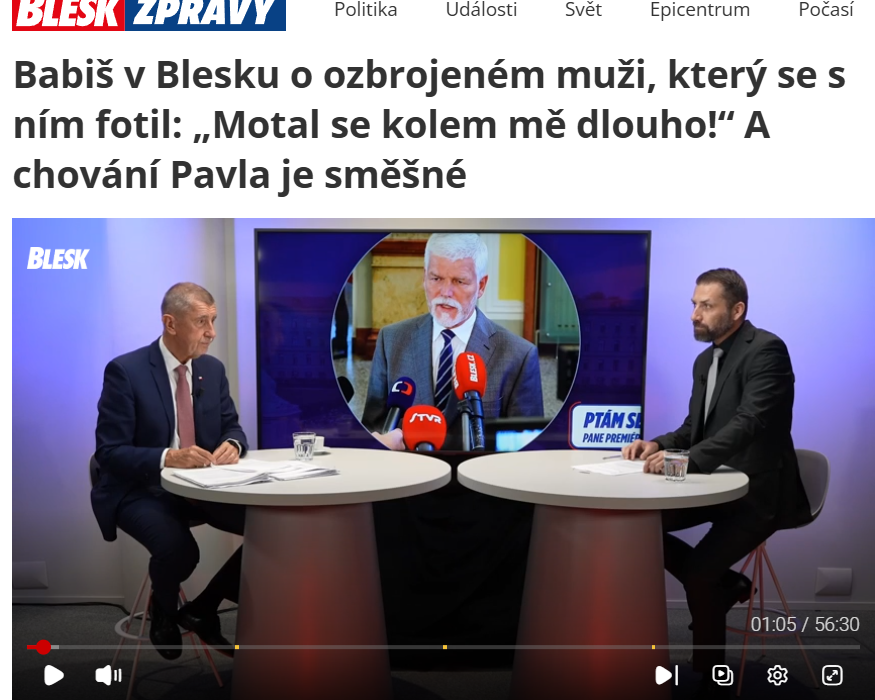
Let’s not forget Petr Macinka, who is openly at war with Pavel. According to Filip Turek, the government’s decision regarding the president is a political vendetta. It is highly likely that, following a decision unfavorable to his ally, Macinka considers it a matter of honor not to include the president’s name on the delegation list. Babiš, however, wisely noted that such a bitter feud would harm the government in the next election and began to soften his message, saying that he has no “bad blood with the president.” He then explained his position in great detail to the website blesk.cz:
To understand the essence of the issue, I highly recommend watching the commentary by Staslav Balík, a retired judge of the Czech Constitutional Court, on ČT24 from June 23, 2026.
On June 24, the court ruled in favor of the president’s 27-page complaint. Based on an interim measure used for only the fifth time in history, it granted Peter Pavel’s request and ordered the government to include him in the delegation to the NATO summit in Ankara.
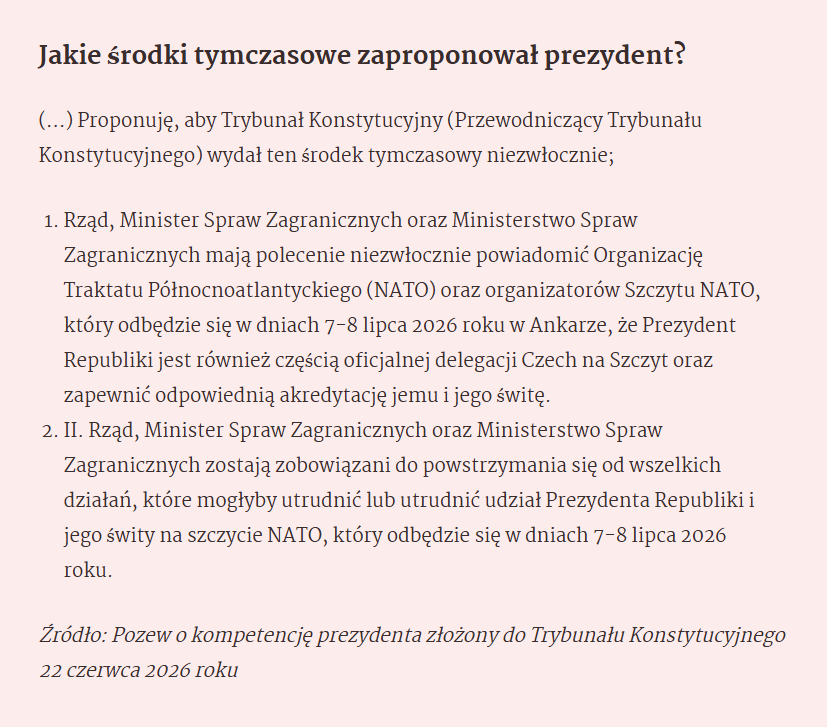
Reactions were very mixed:
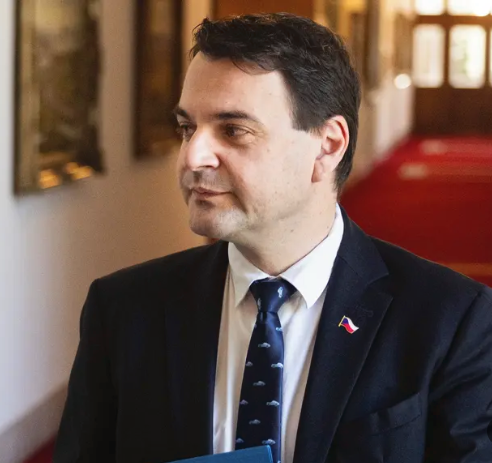
Filip Turek considers this decision proof of a lack of objectivity and an attempt to shift the political system toward a presidential one. Petr Macinka compared the president to an invader trying to conquer territories alongside his lobbying group, and also accused him of attempting a constitutional coup—which is how he views the president’s entire lawsuit. He added that “Comrade” Pavel would not be certain whether he would lead the delegation, as Babiš would make that decision this coming Monday. The prime minister himself was more subdued in his response—he expressed gratitude for the swift reaction but voiced dissatisfaction with the lack of any opportunity to modify the decision. The SPD’s role was to constantly accuse the Constitutional Court of a lack of objectivity, a charge that Chief Justice Josef Baxa sought to refute.
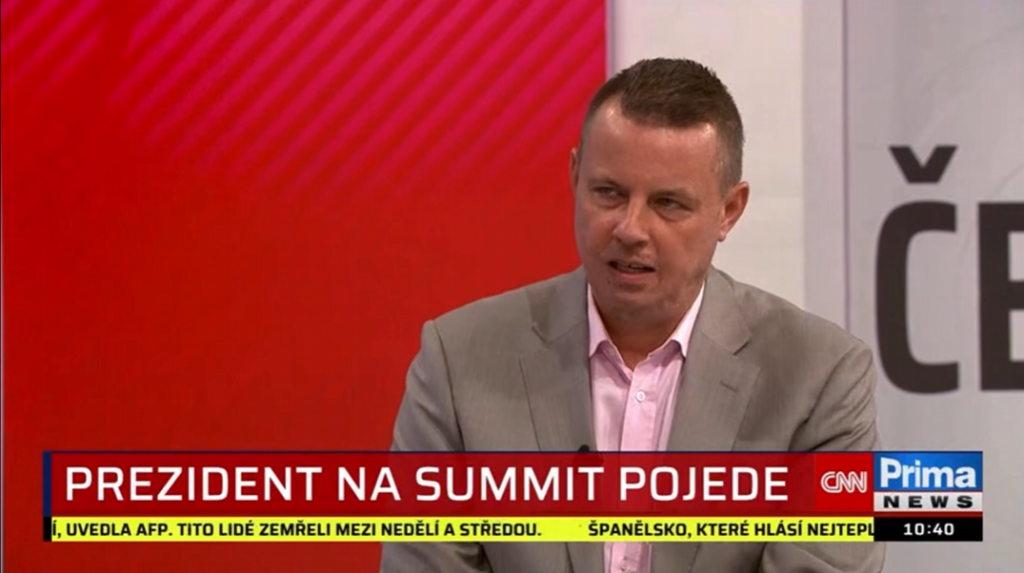
“Uważam to za najpoważniejsze nadużycie Trybunału Konstytucyjnego w historii naszego kraju. Sędziowie, którzy zagłosowali za, zasłużyliby na czerwoną kartkę za brutalne naruszenie naszego porządku konstytucyjnego”, powiedział Jindřich Rajchl z SPD. Udzielił on zresztą 25 czerwca wywiadu dla CNN Prima, w którym dokładnie tłumaczy postawę swojego otoczenia politycznego w tym konflikcie.
Opposition parties—ODS, STAN, and TOP 09—are, as one might expect, very pleased with the Constitutional Tribunal’s decision and are fiercely defending the institution on social media.
In conclusion, the dispute over the Czech Republic’s representation at the July NATO summit in Ankara did not end with the Constitutional Court’s decision, which resolved only the lesser of the two problems: the government cannot block Petr Pavel’s participation in the delegation. Who, in practice, is steering Czech foreign policy at moments of the utmost importance? We do not know, and we will have to wait and see just how minor a role Petr Macinka assigns to Petr Pavel in Ankara (as if the mere denial of permission to attend the dinner were not humiliating enough). The conflict is entering a new phase: on the one hand, Andrej Babiš’s cabinet has announced that it will accredit the president for the NATO summit, thereby complying with the court’s interim ruling. On the other hand, this did not signify a political agreement between Hrad—the president’s inner circle—and the government. This conflict has not only a personal dimension but also a constitutional one, as the informal principle of the Czech political system—that politicians are capable of reaching an agreement on their own—has failed to hold. Debates over the limits of the president’s power and mutual accusations do not bode well. All we can do is wait until June 29, because on that date (barring any dramatic developments), this dispute may escalate further.