“The blue tsunami” has swept across the United States. What next?
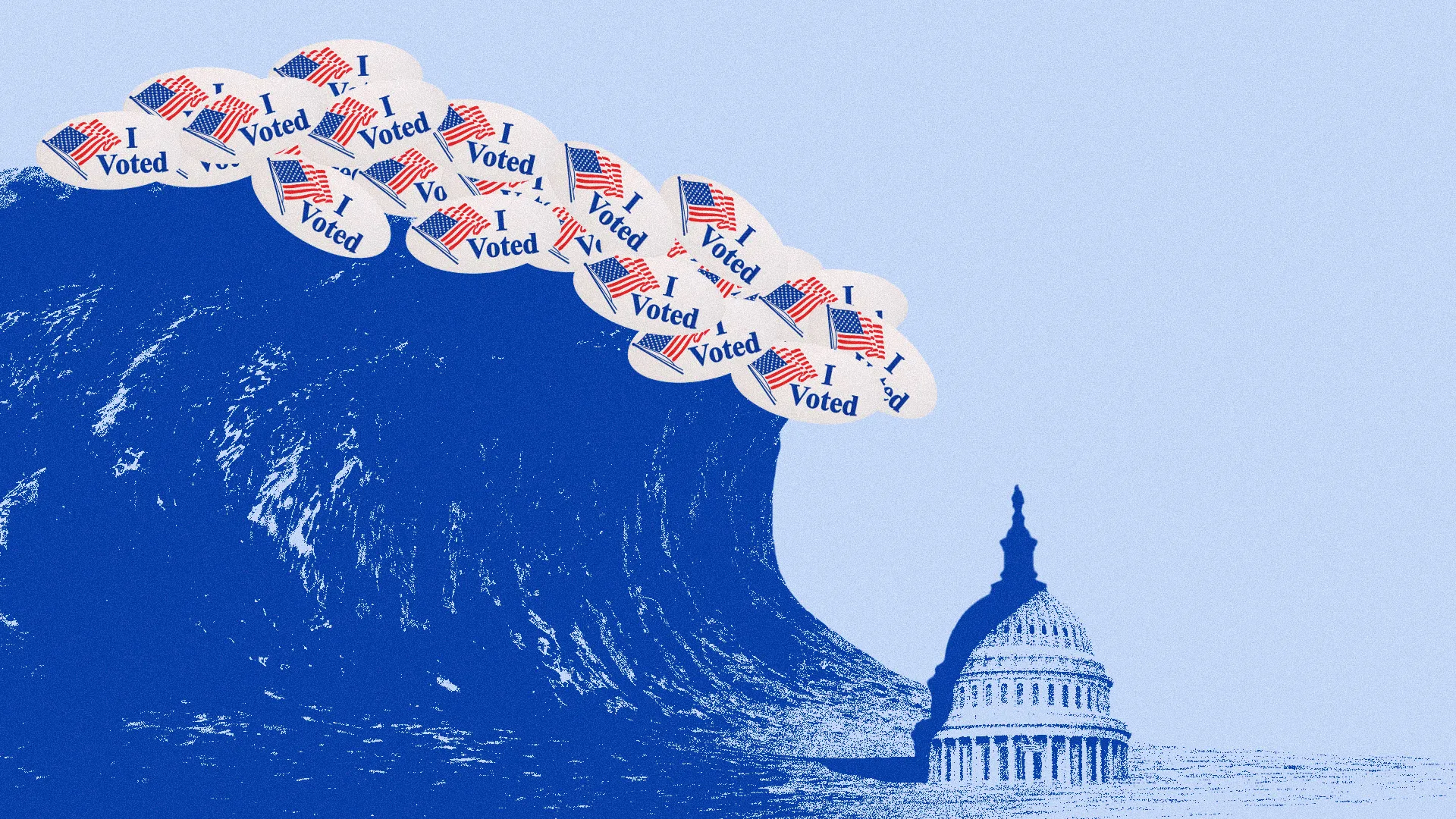
The results of this year’s American midterm elections would probably not have been dreamed of even by the most ardent supporters of the Democratic Party. At the time of writing, the opposition is on track to seize more than 250 seats in the House of Representatives and 54–56 seats in the Senate — in both cases securing a clear majority. For the first time since 2010, Democrats will hold more governorships than Republicans, between 28 and 30.
Given the record unpopularity of Donald Trump and his administration, a Democratic victory in Tuesday’s vote was an expected outcome. However, its scale completely exceeded the expectations of polling firms and experts dealing with electoral forecasts. The counting of the remaining votes is still ongoing, but conclusions can slowly be drawn and potential scenarios for the future can be outlined.
A few words about the results
Election night brought many surprises. An early warning signal for the Republicans was the unexpectedly weak performance of their candidates in Florida and the very rapid declaration of winners in the Senate races in Virginia, Georgia, and North Carolina. The beginning of their total catastrophe came at the moment when the media announced the defeat of Senator Darline Graham in South Carolina — Annie Andrews will be the first Democrat representing that state in 22 years.
Texas, considered the “Republican California,” is symbolically the greatest GOP defeat in this year’s elections. Democrats not only flipped the Senate seat — the controversial Ken Paxton lost to James Talarico by as much as twelve percentage points — but also took over the majority of local offices, led by the governor’s seat. Seeking a fourth term, Greg Abbott suffered a sensational defeat against Gina Hinojosa. This is the first time since 1994 that a Democrat has won any statewide race in the “Lone Star State.”
Democratic Party candidates performed above expectations in all states considered competitive before Election Day. Sherrod Brown and Amy Acton took Ohio, Josh Turek and Rob Sand won in Iowa, and Susan Collins, who has held her seat for nearly 30 years, lost to Troy Jackson. Kansas will send Adam Hamilton to the Senate, the first Democrat in almost a hundred years, and Abdul El-Sayed won in Michigan and will become the first Muslim senator in the history of the United States, despite his primary opponent turning against him. Democrats also flipped governor seats in Georgia and Nevada and are currently the favorites to win in Kansas and Alaska. In the latter, vote counting is still ongoing in the Senate race as well, where according to forecasts Democrat Mary Peltola has a better chance of winning. Some of the biggest sensations are the results in the Senate races in the “red” Deep South — Republicans narrowly held on in Louisiana, and the result in Mississippi currently indicates the most tightly contested race in the fight for the upper chamber. Democrat Scott Colom is leading there by only a few dozen votes and has a real chance of defeating the incumbent senator Cindy Hyde-Smith. The battles for the governor’s seats in Tennessee, Alabama, and South Carolina were also surprisingly close.
The House of Representatives had already long been out of reach for the Republicans, but few could have predicted the scale of the defeat. The gerrymandering war they launched last year did not help. The new maps did not deliver the intended results in Texas, Alabama, and very possibly also in Tennessee. In Florida and Ohio, Democrats may increase their holdings despite unfavorable districts, and the Republican gerrymandering in North Carolina has completely collapsed — at the time of writing, the Associated Press has not called a victory for any GOP candidate there, and incomplete results indicate massive losses.
Data from exit polls seem to confirm exceptionally low support for the president’s administration, the Republican Party, but also — interestingly — for the victorious Democratic Party. It can therefore be concluded that voters handed the opposition the win primarily because of the unpopularity of Donald Trump and his government, not out of sympathy for the Democrats and their policies. The most important issues for American society were economic matters (rising cost of living or high fuel prices), the war in Iran, corruption, and the state of domestic democracy.
“Lame duck”? Paralysis? Compromise? What might the last two years of Donald Trump’s administration look like?
To the surprise of many, President Donald Trump seems to accept the election results, even announcing the possibility of “cooperating with the Democrats for the good of the United States.” At the same time, he has already reminded several times of his veto power, and has also begun looking for those to blame for the Republicans’ defeat (he claims that since he was not on the ballot, the blame does not lie with him). So far he has mainly hit Fox News — the leading conservative outlet, where, in Trump’s view, Democrats received too much airtime. The defeated Texas governor Greg Abbott also took a hit, labeled by the president as a RINO (Republican in name only). Although Donald Trump’s reaction has so far been exceptionally calm — at least for him — scenarios involving contesting the election results remain possible, especially in Alaska. In the event of a win by Mary Peltola, which we may not learn about for several weeks, the Department of Justice may try to annul the result through the case of the “fake” Dan Sullivan.
Taking both chambers of Congress gives the Democrats very extensive powers. Beyond the obvious control over drafting new laws, there is also the possibility of creating investigative committees targeting members of the president’s administration and his associates, as well as initiating impeachment proceedings. Due to the balance of power in the Senate, even if the House of Representatives takes such actions, Trump would not lose his position. Above all, the president cannot introduce any major initiatives or appoint members of his cabinet or judges without the will of the Senate, although he still possesses broad powers as head of state.
I consider the most probable scenario to be one similar to what happened after Trump’s last midterms in 2018, meaning essentially a lack of any cooperation or concessions. A Democratic Senate, which we did not have then, will make it even more difficult for Trump to operate. The only likely compromise may be reached on fundamental issues, such as the state budget or the recurring saga of a government shutdown. I would rather rule out the possibility of broader cooperation between the president and the new Congress. Although some of the new senators or representative-elects declare such postulates, there is no real political will for it either among the majority of Democrats or in the White House. Trump will certainly not allow himself to be dominated and will consistently veto most Democratic bills, which may cost him politically in many cases. We can be almost certain that Trump’s governance will rely to an even greater extent on issuing presidential decrees — a limited tool, but at the same time increasingly used on a scale that raises legal doubts.
In American politics we can be sure of one thing — the hottest topic after the 2026 midterm elections will be… the next elections. In two years, both parties will have completely open primaries, for the first time since 2016. We all know how revolutionary for politics around the world the American presidential race turned out to be then. Who knows what will happen after the Donald Trump era and in the face of the growing left wing of the Democratic Party in 2028.
Sources:
2026 Midterm Election Results: Senate, House and Governor Races | AP News
Trump congratulates Democrats after dominant midterms, says he looks forward to working with them
See CBS News exit poll results for the 2026 midterm elections – CBS News
National Exit Polls: Election 2026 Results
What happens if Trump, GOP lose 2026 midterms?
https://www.axios.com/2026/11/04/midterm-takeaways-blue-wave-trump-democrats
About the author
 Adrian MatuszykVice President · Co-Editor-in-Chief
Editorial care
 Piotr KuczałaCo-Editor-in-Chief · Culture
How to cite
Adrian Matuszyk (2026). “The blue tsunami” has swept across the United States. What next?. TC/2026/27. Terra Cracovianum, Kraków.