October 1956: Warsaw-Moscow and Beijing. The failure of the Soviet armed intervention in Poland.
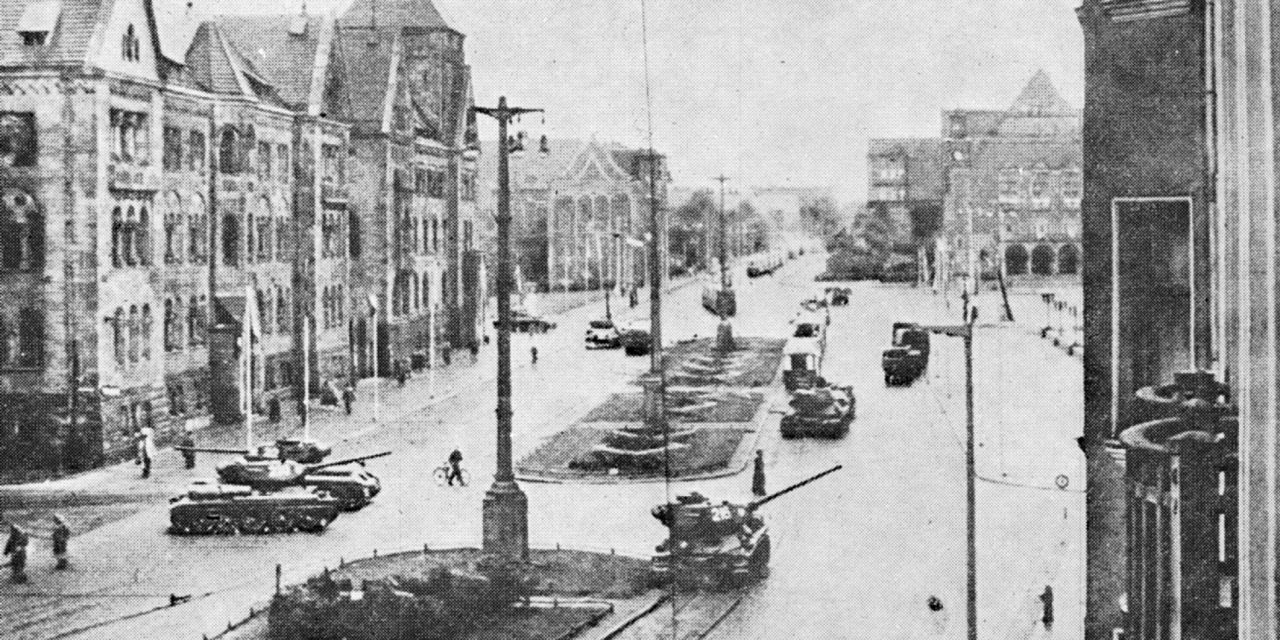
The political process that led to the crisis in October 1956 accelerated sharply after the death of the First Secretary of the Central Committee of the Polish United Workers’ Party (PZPR), Bolesław Bierut, in March 1956. Under the rule of his successor, Edward Ochab, thousands of political prisoners were released from prisons and rehabilitation proceedings were carried out. The turning point, however, was the Poznań June of 1956, when workers’ protests were bloodily suppressed by the army and the militia. The events in Poznań sparked disputes within the PZPR leadership, which split into two opposing factions: the “Natolinians” and the “Puławians.” The culmination of these tensions was to be the convening of the 8th Plenum of the Central Committee of the PZPR on 19–21 October 1956, during which it was planned to elect Władysław Gomułka—associated with the so-called “nationalist deviation”—to the post of First Secretary and to limit the influence of the “Natolinian” faction supported by Moscow.
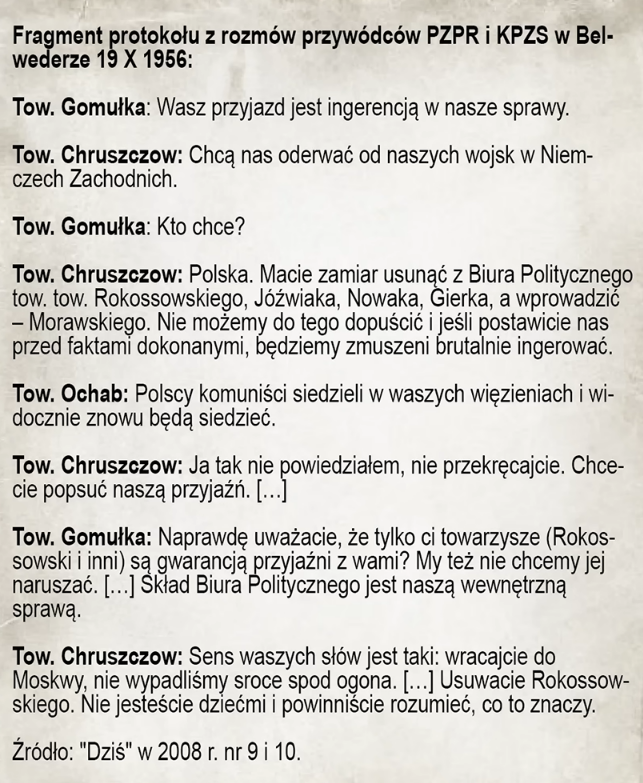
These plans caused great concern in Moscow, which believed that the filling of key posts in the PZPR could not take place without the Kremlin’s consent. On 19 October, a few hours before the start of the Plenum proceedings, a Soviet delegation headed by Nikita Khrushchev and senior military commanders landed at Warsaw airport. Khrushchev is said to have emotionally shouted to Ochab, who was greeting him on the airfield: “This trick won’t work!” The Plenum sessions were interrupted, and stormy multi-hour talks with the Soviet delegation began in the Belweder. Khrushchev categorically demanded that representatives of the “Natolinians” be included in the new Political Bureau, threatening armed intervention otherwise. The list indicated by Khrushchev: Konstanty Rokossowski, Edward Gierek, Aleksander Zawadzki, Franciszek Jóźwiak, Zenon Nowak. It is worth adding that Khrushchev was particularly keen on Rokossowski’s presence in the new Bureau.
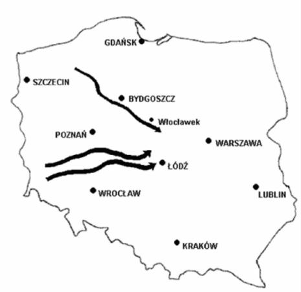
During the talks, units of the Northern Group of Forces of the Soviet Army stationed in Poland left their barracks in Lower Silesia and Pomerania, setting off in armored columns toward Warsaw. At the same time, a concentration of Soviet forces was noted in the GDR and on the border with the USSR; Soviet landing ships anchored in the roadstead of the Gdańsk port, and Polish units from Modlin, Kazuń, and Legionowo were subordinated to Defense Minister Rokossowski in order to support the Soviet advance. The armored columns ultimately halted approximately 100–150 km from Warsaw.
A key role in stopping the military scenario was played by the response of communist China under the leadership of Mao Zedong. After Stalin’s death in 1953, rivalry between Beijing and Moscow was growing within the communist camp, and Mao treated Khrushchev as an equal partner rather than a superior leader. Upon learning of the Soviet intervention in Poland, the Chinese authorities conveyed a firm objection to Moscow, threatening to take their own actions if the aggression continued. On 22 October 1956 Mao told the USSR ambassador in Beijing that the choice of Gomułka should be accepted. During the later talks in Moscow on 23–30 October the Chinese delegation was the only one that consistently opposed an armed solution.
The sessions of the 8th Plenum were resumed after the Soviet delegation’s departure on 20 October. Gomułka delivered a programmatic speech in which he condemned the errors of the Stalinist period and Bierut’s rule. In the subsequent secret elections Konstanty Rokossowski did not obtain sufficient support and did not enter the Political Bureau, which instead included, among others, Edward Gierek and Aleksander Zawadzki. The rejection of Rokossowski initially caused Khrushchev and the Presidium of the CC of the CPSU to hesitate again, and they considered resuming the intervention in order to remove Gomułka. Ultimately, however, on 24 October the Soviet troops received the order to return to barracks. The compromise that was reached resulted from several factors: China’s firm opposition, Gomułka’s assurances that Poland would remain a loyal member of the communist bloc and the Warsaw Pact, as well as the growing crisis and revolution in Hungary. The compromise also stemmed from the broader political situation throughout the Eastern Bloc. Of significant importance were the parallel events unfolding in Hungary, where on 23 October an uprising began against communist rule and Soviet domination. Unlike the Polish changes, which ended in a compromise with Moscow, the Hungarians’ drive for deeper political change led to an armed intervention by the Soviet Army and the bloody pacification of the uprising. The events in Hungary thus demonstrated the limits of the Kremlin’s tolerance for attempts at change occurring in the satellite states.
October 1956 was therefore an important turning point in Poland’s postwar history. Gomułka’s return to power and Moscow’s renunciation of direct intervention made it possible to carry out limited political changes and to reduce some of the Soviet influence. On 26 October Cardinal Stefan Wyszyński was released from internment. In addition, as a result of an amnesty, tens of thousands of prisoners regained their freedom. Proceedings were also initiated against some activists of the Stalinist repressive apparatus. This did not, however, mean the recovery of full sovereignty or a departure from the communist system. Gomułka maintained the existing systemic foundations and the alliance with the USSR, while at the same time gaining greater freedom in shaping domestic policy. In the conditions of the Cold War the degree of independence of the Eastern Bloc states depended both on social pressure and the internal situation, and on the international balance of forces and the Kremlin’s readiness to use force. The Polish October was thus both a success of limited political emancipation and proof of the durability of Soviet domination in Central and Eastern Europe.
Bibliography:
Translated by Grok AI.
- Wróbel J., Zagrożenie interwencją sowiecką w Polsce w październiku 1956 r., Przystanek Historia, 16 października 2026, https://przystanekhistoria.pl/pa2/teksty/129303,Zagrozenie-interwencja-sowiecka-w-Polsce-w-pazdzierniku-1956-r.html
- Prof. Dudek: Interwencja sowiecka w październiku 1956 r. właściwie się rozpoczęła, Gazeta Prawna, 20 października 2016, https://www.gazetaprawna.pl/wiadomosci/artykuly/986004,prof-dudek-interwencja-sowiecka-w-pazdzierniku-1956-r-wlasciwie-sie-rozpoczela.html
- Dudek A., Polski Październik ’56 | Dudek o Historii, 21 października 2023, https://youtu.be/ItVhmZo0XbQ?si=deKYd9rCDvwOPMsS
- Réka Kiss: Węgierska rewolucja i walka o wolność w 1956 roku, Instytut Pamięci Narodowej, 23 października 2026, https://ipn.gov.pl/pl/historia-z-ipn/172480,Rka-Kiss-Wegierska-rewolucja-i-walka-o-wolnosc-w-1956-roku.html
- Władysław Gomułka I sekretarzem KC PZPR, Muzeum Historii Polski, https://muzhp.pl/kalendarium/wladyslaw-gomulka-i-sekretarzem-kc-pzpr
- Życiorys, Instytut Prymasa Wyszyńskiego, https://instytutwyszynskiego.pl/zyciorys/
- Kuczyński W., Mój październik 1956, Październik ’56, 31 października 2017, https://pazdziernik56.pl/moj-pazdziernik-1956/
About the author
TDTomasz DyndaAnalyst of commodity markets and the Middle EastEditorial care
 Piotr KuczałaCo-Editor-in-Chief · Culture
How to cite
Tomasz Dynda (2026). October 1956: Warsaw-Moscow and Beijing. The failure of the Soviet armed intervention in Poland.. TC/2026/26. Terra Cracovianum, Kraków.