
Introduction
On 8–10 September, Kielce hosted the thirty-fourth edition of the International Defence Industry Exhibition, known as MSPO. These are annual defence trade fairs at which equipment manufactured by companies from Poland and around the world is presented. Many high-profile premieres were shown there, such as the new generation of the Gladius system, a new light machine gun created in cooperation between Fabryka Broni “Łucznik”-Radom, the Military University of Technology (WAT) and the Military Institute of Armament Technology (WITU), or the return of STAR-brand trucks.
However, by far the most talked-about event of this year’s fair was the presentation by Huta Stalowa Wola (HSW) of a demonstrator of the new heavy infantry fighting vehicle “Niedźwiedź” (Bear), which in the near future is to enter service with the Polish Armed Forces.
One may nevertheless ask: “Why do we need a new IFV at all?” After all, we are currently beginning to introduce the Borsuk IFV into service, also produced by HSW. Would it not be better simply to stay with one type of vehicle?
Borsuk good, but not ideal
To answer that question, one must first outline the aforementioned Borsuk — the first infantry fighting vehicle fully designed and produced in Poland. It is also the first vehicle of this type to enter service with the Polish Armed Forces after 1989, not counting temporarily operated post-Soviet BMP-2s.
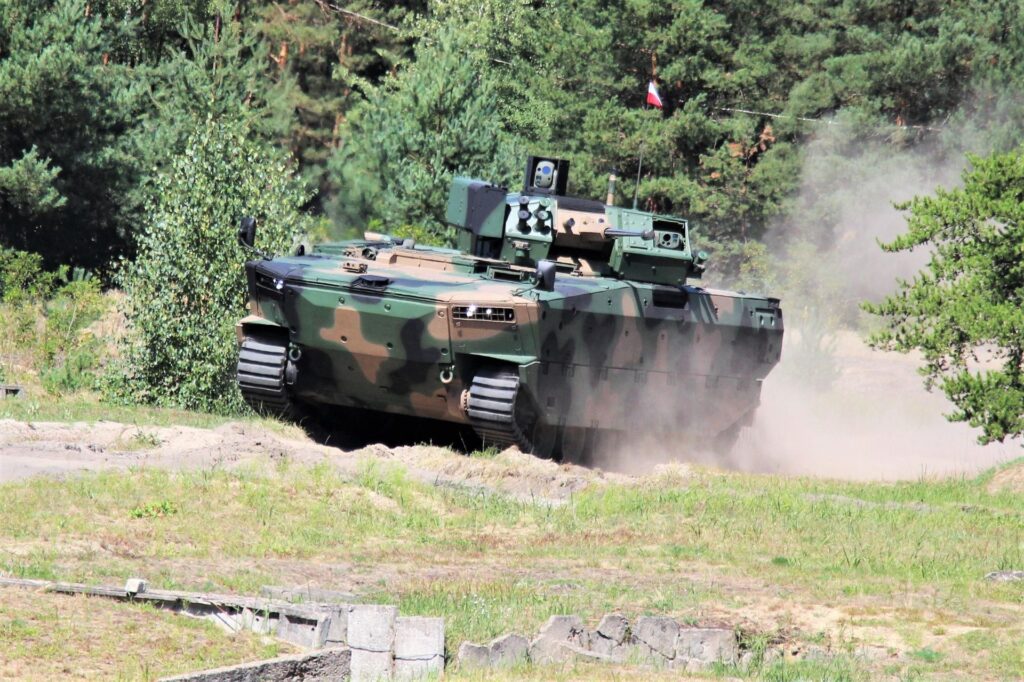
The vehicle designed by HSW has swimming capability, which sets it apart from other Western IFVs. It accommodates a three-person crew (driver, gunner and commander) and can transport a six-person dismount section. It weighs 28 tonnes and rides on a hydropneumatic suspension. It is powered by an MTU 8V 199 TE20 engine producing 720 horsepower, coupled with a fully automatic Allison Transmission 3040 MX mechanical gearbox. Its armament is the unmanned ZSSW-30 turret developed jointly by HSW and WB Electronics, armed with a 30 mm Mk 44/S Bushmaster II automatic cannon, a coaxial UKM2000C machine gun, and a twin launcher for Spike LR anti-tank missiles.
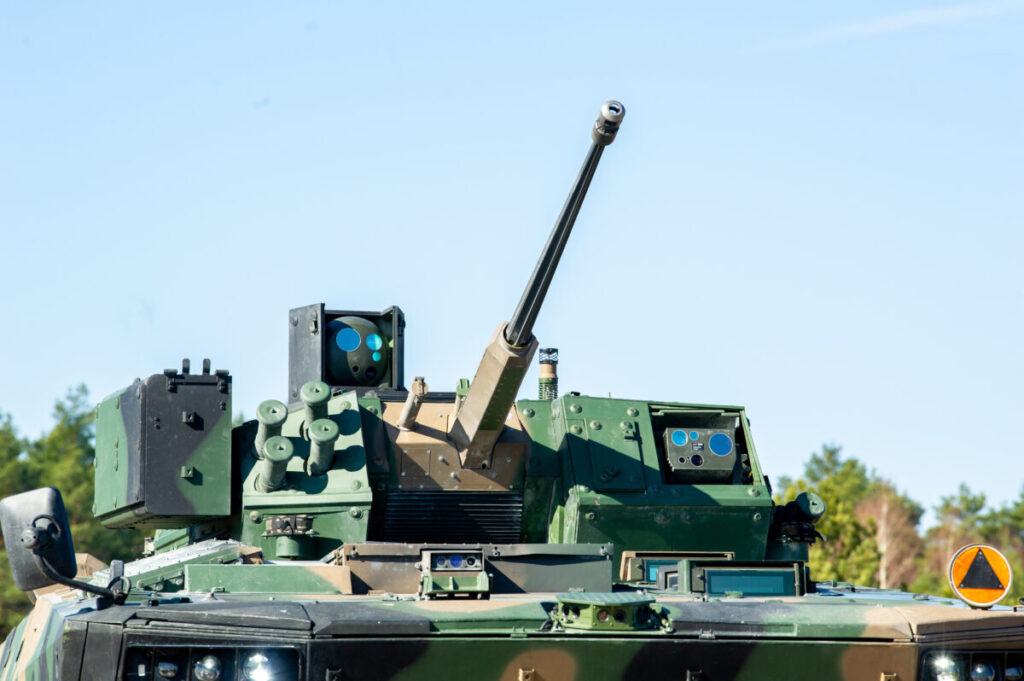
Its frontal ballistic protection meets Level 4 of STANAG 4569, which protects the vehicle against 14.5 × 114 mm rounds from a distance of 200 metres. The sides and rear meet Level 3 of the same standard, providing resistance to 7.62 × 51 mm rifle rounds. Mine protection meets Level 3 of the STANAG standard, protecting the crew against an 8 kg TNT mine charge.
This means it has good, even very good, ballistic protection for a swimming design, but rather average protection for a contemporary IFV. This results from the swim requirement imposed by the military as early as 2014. The war in Ukraine has shown, however, that today strong armour is far more important than the ability to cross water obstacles.
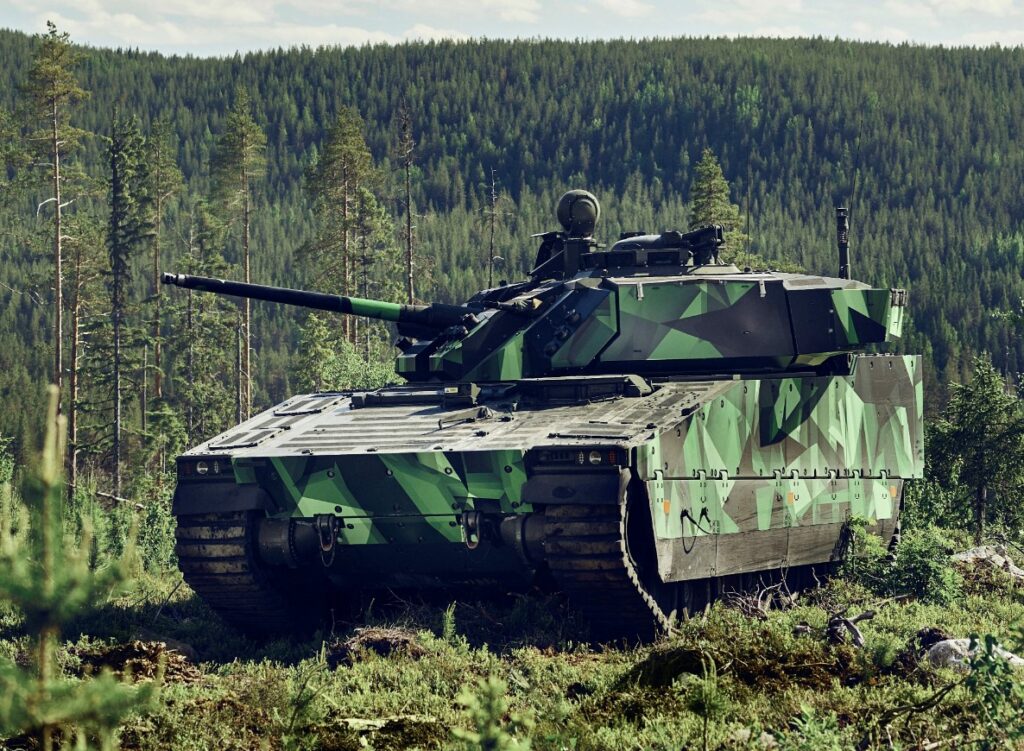
Ballistic protection looks particularly weak compared with the protection level of contemporary, heavier Western IFVs, such as the Swedish CV90 MkIV purchased by the Czech Republic and Slovakia, or the German KF41 Lynx selected by Hungary. Both of those vehicles have frontal, side and rear armour one level higher under STANAG 4569 than the Borsuk. They also have a hard-kill active protection system (APS) capable of intercepting incoming anti-tank missiles, which is now becoming standard on Western tanks and infantry fighting vehicles. Our domestic vehicle does not have such a system and cannot have one, at least in its current configuration, because its turret is not adapted to solutions of this type.
It is true that there is a possibility of adding armour to the Borsuk at the cost of swim capability, and of redesigning the ZSSW-30 turret so that an APS can be mounted on it. However, because of suspension and powertrain limitations, the vehicle’s weight reserve is only 4–7 tonnes, which greatly reduces the scope for potentially strengthening the Borsuk’s protection.
On top of this come other problems, such as the six-person dismount section, which is two soldiers smaller than in Western designs, and the relatively high price of the vehicle, oscillating around 50–60 million zlotys apiece. For comparison: the aforementioned CV90 costs about 45–50 million zlotys apiece, while the KF41 costs 39–60 million zlotys.
The beginnings of the new IFV
This led the military to start considering the introduction of a new IFV characterised by significantly greater ballistic protection. However, because of the advanced stage of work on the Borsuk and the fact that work on a new heavy IFV would take further years, its introduction into service was not abandoned. Instead, at the Defence24 Days conference in 2022 a concept was presented of adopting two types of IFV simultaneously. According to that concept, Borsuks would support tanks from the Wilk programme (which ultimately became the Korean K2 Black Panther) and would go, among other units, to the 16th Pomeranian Mechanised Division. The new IFV would support Abrams tanks in the 18th Mechanised Division, commonly known as the “Iron Division.”
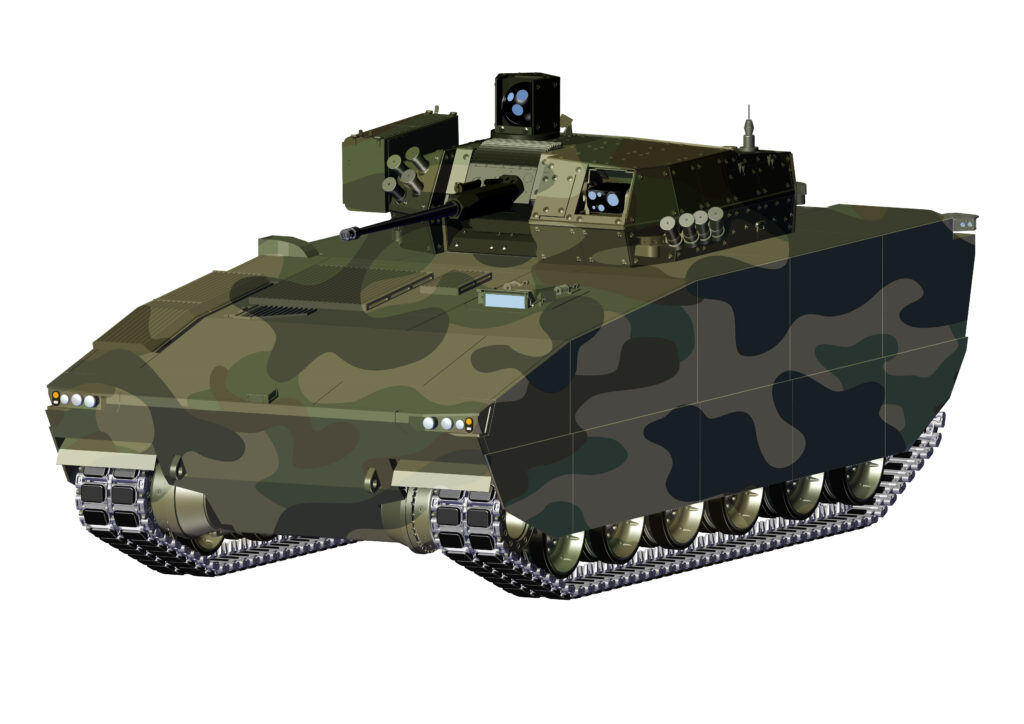
In August 2023 a framework agreement was signed with a consortium of Polska Grupa Zbrojeniowa and Huta Stalowa Wola for the development and delivery of 700 new heavy infantry fighting vehicles. They were to be designed by HSW on the basis of the chassis known from the Krab self-propelled howitzer, which would facilitate work on creating, introducing and operating the new vehicle.
However, barely a year later, on 19 December 2024, the Armament Agency revealed that the PGZ–HSW consortium had asked the Ministry of National Defence for consent to fulfil the heavy IFV delivery through so-called purchase with adaptation. This assumed the use of a foreign design and its adaptation to Polish requirements, including installation of the ZSSW-30 turret. Among the vehicles considered were the Turkish Otokar Tulpar, the previously mentioned KF41 Lynx, and the South Korean AS21 Redback, which underwent tests in the 18th Mechanised Division in 2022.
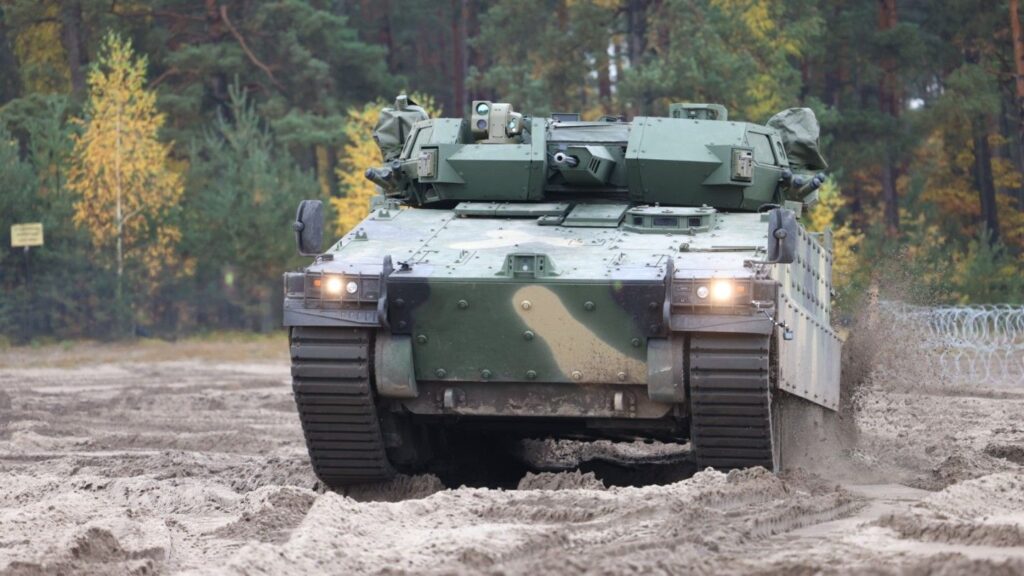
Ultimately the plans to acquire a foreign design were rejected, and the PGZ–HSW consortium continued work on the new IFV project. At MSPO 2025 its first 1:4 scale mock-up was presented, and this year a full-scale demonstrator was shown.
The first demonstrator
The new vehicle received the name Niedźwiedź, which was announced by the prime minister the day after the Kielce fair ended. This was not, however, its original name. Initially it was to bear the codename Ratel, but because that name is already used by a South African armoured personnel carrier, a change was decided upon.
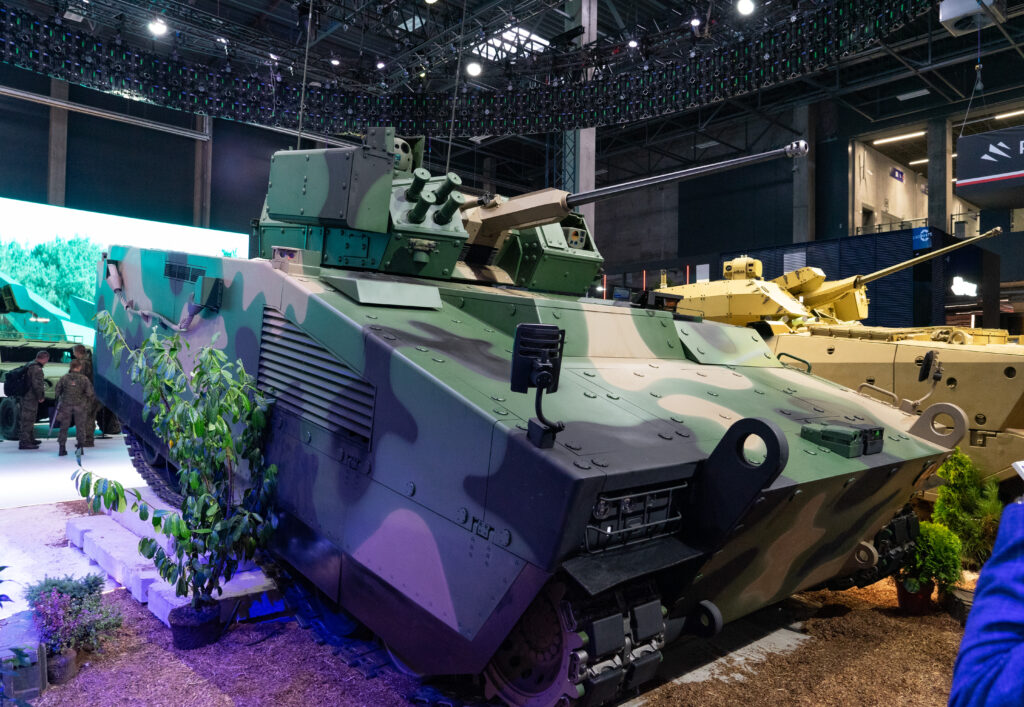
Because the vehicle is at present only a demonstrator intended to show what the new IFV will look like, its exact technical data are not known, especially regarding armour. The target, however, is protection of Level 5 or even Level 6 of STANAG 4569 at the front of the hull and at least Level 4 on the sides and rear. Mine protection is to be at Level 4a/4b, which will protect the vehicle against the explosion of mines of up to 10 kg of TNT. It is to weigh about 40 tonnes and use the powerpack from the Krab howitzer, that is an MTU MT 881 Ka-500 engine producing 1,000 horsepower coupled with an Allison X1100-5A3 transmission. The armament shown on the demonstrator is still the ZSSW-30 turret, but it is not ruled out that in the future it may be replaced by a redesigned version capable of integrating hard-kill APS systems.
In conclusion
The Bear is being created as a heavy complement to the Borsuk — a vehicle designed according to guidelines from before the outbreak of the full-scale war in Ukraine, in which it is not possible to implement solutions based on experience from that conflict. Thanks to basing the new design on components known from the Krab howitzers, the process of introducing it into the army has a chance of proceeding smoothly. According to the current schedule, by 2027 HSW is to hand over two prototypes to the military for qualification testing, and by 2029 the vehicle should reach readiness for series production. This means the pace of work is relatively high, which cannot be said of some other European armoured programmes. Let us remember, however, that so far only a demonstrator has been presented, and a final assessment of the vehicle is still to come.
Bibliography:
Translated by Grok.
MSPO 2017: Premiere of the Borsuk (5 September 2017) Defence24.
https://defence24.pl/mspo-2017-premiera-borsuka Borsuks forded a water obstacle. “The firepower is completely different” (17 November 2022) Defence24.
https://defence24.pl/polityka-obronna/borsuki-sforsowaly-przeszkode-wodna-sila-razenia-jest-zupelnie-inna Borsuks with the K2, Abrams with a heavy IFV — that is the rebuilding of the Land Forces. Gen. Jabłoński: “Every tank battalion is worth its weight in gold” [INTERVIEW] (2 September 2022) Defence24.
https://defence24.pl/sily-zbrojne/borsuk-z-k2-abrams-z-ciezkim-bwp-czyli-odbudowa-wojsk-ladowych-gen-jablonski-kazdy-batalion-czolgow-jest-na-wage-zlota-wywiad Contracts for a heavy infantry fighting vehicle and a new wheeled armoured personnel carrier (14 August 2023) Polska Zbrojna.
https://polska-zbrojna.pl/home/ArticleShow/43049 A heavy IFV for the Polish Army [ANALYSIS] (15 August 2023) Defence24.
https://defence24.pl/technologie/ciezki-bwp-dla-wojska-polskiego-analiza A heavy IFV for the Polish Army. Will we choose a foreign solution after all? (27 September 2024) Forsal.
https://forsal.pl/kraj/bezpieczenstwo/artykuly/9596419,ciezki-bwp-dla-wojska-polskiego-wybierzemy-jednak-zagraniczne-rozwiaz.html Redback tested in Poland. Hanwha Defense: we propose two turret configurations (26 October 2022) Defence24.
https://defence24.pl/przemysl/redback-testowany-w-polsce-hanwha-defense-proponujemy-dwie-konfiguracje-wiezy MSPO 2025: Huta Stalowa Wola with premieres (2 September 2025) Defence24.
https://defence24.pl/przemysl/mspo-2025-huta-stalowa-wola-z-premierami Tusk reveals the name of the heavy IFV (6 September 2024) Defence24.
https://defence24.pl/przemysl/tusk-ujawnia-nazwe-ciezkiego-bwp Not Ratel, but a new Heavy IFV [ANALYSIS] (6 September 2023) Defence24.
https://defence24.pl/przemysl/nie-ratel-ale-nowy-ciezki-bwp-analiza