It has become a common phenomenon for a US president to make a fortune after leaving office—one that many of his voters could only dream of. Donald Trump, however, is an exception here: at the time he took office in 2017, he was the wealthiest US president since George Washington. By the time he left the White House in January 2021, he was $1.2 billion “poorer” than four years earlier (January 2017 – net worth estimated at $3.7 billion vs. $2.5 billion at the beginning of 2021).
However, Donald Trump’s second term looks somewhat different. When taking the oath of office in January 2025, the 45th and 47th president possessed a net worth of virtually the same value as in 2021. Yet, since returning to the role of head of state, Trump’s net worth has grown significantly and is currently estimated at $6.3 billion.
How did Trump do it?
Officially, of course, Trump does not manage his businesses—that responsibility belongs to his sons. His wealth was multiplied through the expansion of golf clubs, hotel chains—mostly in the form of licensing agreements to use the Trump name—and an increase in the membership of the Mar-a-Lago Club. Trump also has his own line of NFTs (non-fungible tokens), which were released during the bull run for these types of products between 2022 and 2023. Following his presidential inauguration on January 17, 2025, Trump released his own cryptocurrency: Trump Coin. Some estimates indicate that the 47th president pocketed $1.4 billion from transactions related to it.
However, without a doubt, the largest source of the US president’s new wealth is Trump Media & Technology Group, a publicly traded company and the owner of Truth Social—his Twitter/X.com-style social media platform. Trump is the company’s largest shareholder, holding over 40% of the shares, which translates to a value of ~$949 million. It is worth remembering that the company is publicly listed, which means the value of the shares changes every day (at its peak, his stake in Trump Media & Technology Group was worth ~$6.25 billion).
Alright, this text is not about the Trump family’s ability to make money by leveraging contacts, position, and other resourceful methods—there are already many texts about that.
On July 16, 2026, Trump Media & Technology Group announced a new product—specifically, a new service: Truth API. This TMTG offering is precisely what this text is about, as the service tests the limits of using the presidency for self-enrichment, severely trials the definition of “insider trading,” and gives a select group of people—for the right price—the ability to obtain information that has a real impact on reality.
What is Truth API?
An API (Application Programming Interface) is a kind of waiter, but for computers. When we are at a restaurant, we place an order with the waiter, the waiter goes to the kitchen, the kitchen prepares the dish, and then the waiter brings it to the table. An API does the same thing, but for computer programs: one program requests something, the API sends the request to a second program that has it, and then brings the response back to the requesting program.
What will Truth API transmit?
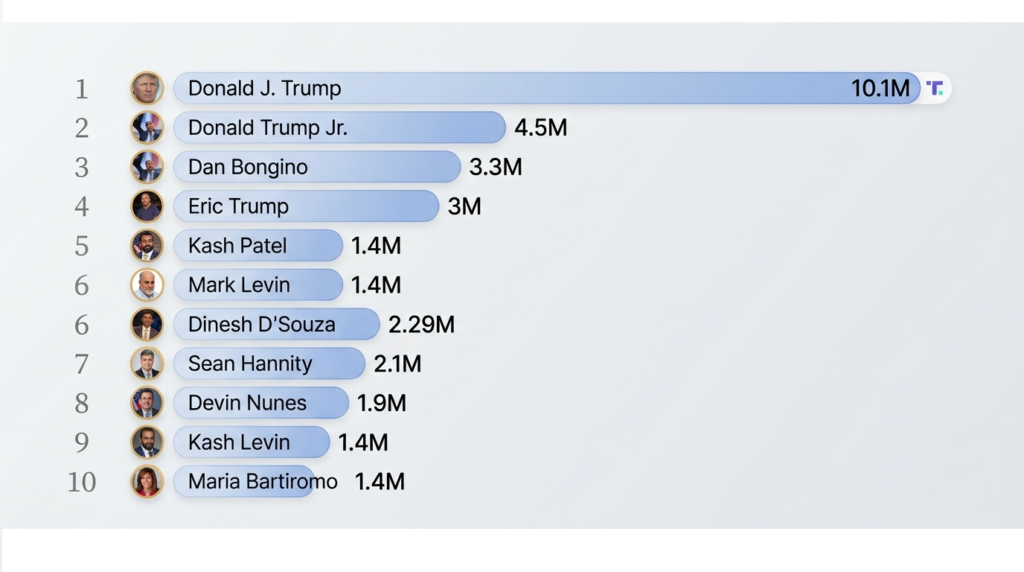
Trivial things like early access to posts published by the top 10 most-followed accounts on the platform, as well as historical data dating back to posts from 2022.
How much does this pleasure cost? Trump Media & Technology Group announced pricing in the range of $60,000 to $100,000 per month.
For whom?
The service offers millisecond access to posts from currently the most influential people in the United States. Truth Social is President Trump’s preferred platform for announcing new tariffs, military actions, and other information that has a real impact on our reality and the financial markets.
And this is precisely where the target client for this service emerges: financial institutions trading on the markets using high-frequency trading (HFT). Milliseconds are crucial for this type of stock trading—to the extent that these institutions fight for the closest possible physical access to exchange servers to minimize latency between the servers and their own infrastructure. Currently, these firms use web scraping to acquire the president’s latest posts as quickly as possible, analyze them, and ultimately decide whether to buy or sell specific assets. Truth API aims to enable these exact institutions to abandon this practice by offering access to the information source faster than was previously possible.
The Problem
The launch of this service raises serious questions about whether a platform co-owned by the head of state can sell accelerated access to market-moving information.
Generally, trading on financial markets based on inside information (insider trading) is illegal. Here, however, we are dealing with a situation where, once a post is published by the president, the information becomes public yet a select group of people gets access to it a split second before the rest of society and can monetize it earlier.
Where does the boundary between inside and public information lie in this case?
§ 240.10b5-1 Trading “on the basis of” material nonpublic information in insider trading cases.
(b) Awareness of material nonpublic information. Subject to the affirmative defenses in paragraph (c) of this section, a purchase or sale of a security of an issuer is on the basis of material nonpublic information for purposes of Section 10(b) and Rule 10b-5 if the person making the purchase or sale was aware of the material nonpublic information when the person made the purchase or sale. The law of insider trading is otherwise defined by judicial opinions interpreting Rule 10b-5, and Rule 10b5-1 does not modify the scope of insider trading law in any other respect.”
Shouldn’t information vital to the nation be available to all citizens at the exact same time? Why should specific institutions that can afford such a service receive price-sensitive information earlier?
If a member of the Trump administration knew that the president was about to write something publicly that would, for example, cause oil prices to rise, and decided to call a friend running a hedge fund to share this information—after which the friend placed a bet that oil would rise—that would be insider trading. On the other hand, is using information gained by purchasing the Truth API service considered insider trading? Donald Trump publishes a post that will drive oil prices up; algorithms at institutions with this subscription receive it a fraction of a second before the general public, analyze it, and decide to buy oil futures on the price rise—is this insider trading or not?
What’s next?
The service launched on August 1, and according to the CEO of Trump Media & Technology Group, it already has over 10 institutional clients.
The Intercept and The Freedom of the Press Foundation have already filed a lawsuit citing the First and Fifth Amendments to the US Constitution.
First Amendment:
“Congress shall make no law respecting an establishment of religion, or prohibiting the free exercise thereof; or abridging the freedom of speech, or of the press; or the right of the people peaceably to assemble, and to petition the Government for a redress of grievances.”
The lawsuit points out that everyone has the right to equal access to public statements by the president. Meanwhile, the Truth API service violates this principle because it effectively divides society into tiers, those who can afford an expense of ~$100,000, and those who cannot.
Fifth Amendment:
“No person shall be held to answer for a capital, or otherwise infamous crime, unless on a presentment or indictment of a Grand Jury, except in cases arising in the land or naval forces, or in the Militia, when in actual service in time of War or public danger; nor shall any person be subject for the same offence to be twice put in jeopardy of life or limb; nor shall be compelled in any criminal case to be a witness against himself, nor be deprived of life, liberty, or property, without due process of law; nor shall private property be taken for public use, without just compensation.”
Referring to the Fifth Amendment, the plaintiffs argue that charging high fees for access to public information is unjustified. They contend that the head of state has no right to “privatize” information in order to profit from it.
Say what you will, this is a very creative way for Donald Trump and his businesses to earn extra money—even the president’s fiercest political opponents wouldn’t have been able to come up with this a month ago.
The outcome of this lawsuit could be crucial in defining what constitutes inside information and whether a president can monetize it. Do all US citizens have the right to access information at the exact same moment? Or perhaps there is a specific group able to spend ~$100,000 a month that, by virtue of that, deserves the right to receive information a split second before the rest of society.
Bibliography:
Text original in Polish, Translated using Gemini Ai